{"title":"Blackbody Radiation and Thermal Effects on Chemical Reactions and Phase Transitions in Cavities","authors":"Sindhana Pannir-Sivajothi, Joel Yuen-Zhou","doi":"10.1021/acsnano.4c14590","DOIUrl":null,"url":null,"abstract":"An important question in polariton chemistry is whether reacting molecules are in thermal equilibrium with their surroundings. If not, can experimental changes observed in reaction rates of molecules in a cavity (even without optical pumping) be attributed to a higher/lower temperature inside the cavity? In this work, we address this question by computing the temperature differences between reacting molecules inside a cavity and the air outside. We found this temperature difference to be negligible for most reactions. On the other hand, for phase transitions inside cavities, as the temperature of the material is actively maintained by a heating/cooling source in experiments, we show that cavities can modify observed transition temperatures when mirrors and cavity windows are ideal (nonabsorbing); however, this modification vanishes when real mirrors and windows are used. This conclusion relies on having a low contact resistance between mirrors and molecules. Finally, we find substantial differences in blackbody spectral energy density between free space and infrared cavities, which reveal resonance effects and could potentially play a role in explaining changes in the chemical reactivity in the dark.","PeriodicalId":21,"journal":{"name":"ACS Nano","volume":"53 1","pages":""},"PeriodicalIF":16.0000,"publicationDate":"2025-03-05","publicationTypes":"Journal Article","fieldsOfStudy":null,"isOpenAccess":false,"openAccessPdf":"","citationCount":"0","resultStr":null,"platform":"Semanticscholar","paperid":null,"PeriodicalName":"ACS Nano","FirstCategoryId":"88","ListUrlMain":"https://doi.org/10.1021/acsnano.4c14590","RegionNum":1,"RegionCategory":"材料科学","ArticlePicture":[],"TitleCN":null,"AbstractTextCN":null,"PMCID":null,"EPubDate":"","PubModel":"","JCR":"Q1","JCRName":"CHEMISTRY, MULTIDISCIPLINARY","Score":null,"Total":0}
引用次数: 0
Abstract
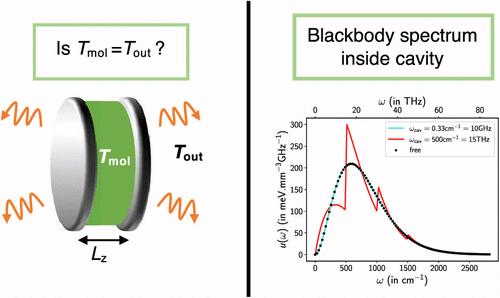
An important question in polariton chemistry is whether reacting molecules are in thermal equilibrium with their surroundings. If not, can experimental changes observed in reaction rates of molecules in a cavity (even without optical pumping) be attributed to a higher/lower temperature inside the cavity? In this work, we address this question by computing the temperature differences between reacting molecules inside a cavity and the air outside. We found this temperature difference to be negligible for most reactions. On the other hand, for phase transitions inside cavities, as the temperature of the material is actively maintained by a heating/cooling source in experiments, we show that cavities can modify observed transition temperatures when mirrors and cavity windows are ideal (nonabsorbing); however, this modification vanishes when real mirrors and windows are used. This conclusion relies on having a low contact resistance between mirrors and molecules. Finally, we find substantial differences in blackbody spectral energy density between free space and infrared cavities, which reveal resonance effects and could potentially play a role in explaining changes in the chemical reactivity in the dark.
期刊介绍:
ACS Nano, published monthly, serves as an international forum for comprehensive articles on nanoscience and nanotechnology research at the intersections of chemistry, biology, materials science, physics, and engineering. The journal fosters communication among scientists in these communities, facilitating collaboration, new research opportunities, and advancements through discoveries. ACS Nano covers synthesis, assembly, characterization, theory, and simulation of nanostructures, nanobiotechnology, nanofabrication, methods and tools for nanoscience and nanotechnology, and self- and directed-assembly. Alongside original research articles, it offers thorough reviews, perspectives on cutting-edge research, and discussions envisioning the future of nanoscience and nanotechnology.



 京公网安备 11010802042870号
京ICP备2023020795号-1
京公网安备 11010802042870号
京ICP备2023020795号-1

 分享
分享
 求助内容:
求助内容: 应助结果提醒方式:
 扫码关注我们
