Desh Deepak Dixit, Kavya L. Singampalli, Amit S. Niyogi, Amanda Montoya, Alexandre Reuben and Peter B. Lillehoj
{"title":"Rapid laser ablation-based fabrication of high-density polymer microwell arrays for high-throughput cellular studies†","authors":"Desh Deepak Dixit, Kavya L. Singampalli, Amit S. Niyogi, Amanda Montoya, Alexandre Reuben and Peter B. Lillehoj","doi":"10.1039/D4LC01058B","DOIUrl":null,"url":null,"abstract":"<p >Polymer-based microwell platforms have garnered much interest due to their usefulness in culturing and analyzing small quantities of biological cells and spheroids. Existing methods for fabricating polymer microwell arrays involve complex fabrication processes and/or are limited in their ability to create dense arrays of very small (<50 μm in diameter) microwells. Here, we present a simple and rapid technique for fabricating high-density arrays of microwells ranging from 20 to 160 μm in diameter on a variety of polymer substrates. In this approach, a polymer surface is ablated using a CO<small><sub>2</sub></small> laser that is rastered over a stainless steel mesh, which serves as a shadow mask. A theoretical laser–polymer interaction model was developed for predicting the microwell volume based on the substrate properties and laser settings. Microwell volumes predicted by the model were within 5.4% of fabricated microwell volumes determined experimentally. Cellulose acetate microwell arrays fabricated using this technique were used to culture Lewis lung carcinoma cells expressing ovalbumin (LLC-OVA), which were maintained for up to 72 h with a negligible (<5%) loss in viability. As a second proof of principle demonstration, LLC-OVA cells grown in microwell arrays were co-cultured with OT-I T cells and measurements of interferon gamma (IFN-γ), a marker for T cell activation, were performed which revealed a positive correlation between LLC-OVA cell-T cell interaction time and T cell activation. These two <em>in vitro</em> demonstrations showcase the capability of this technique in generating polymer microwell arrays for high-throughput cellular studies, including cell growth dynamics studies and cell interaction studies. Furthermore, we envision that these platforms can be used with different cell types and for other biological applications, such as spheroid formation and single cell analysis, further expanding the utility of this technique.</p>","PeriodicalId":85,"journal":{"name":"Lab on a Chip","volume":" 7","pages":" 1813-1822"},"PeriodicalIF":5.4000,"publicationDate":"2025-02-27","publicationTypes":"Journal Article","fieldsOfStudy":null,"isOpenAccess":false,"openAccessPdf":"https://www.ncbi.nlm.nih.gov/pmc/articles/PMC11880749/pdf/","citationCount":"0","resultStr":null,"platform":"Semanticscholar","paperid":null,"PeriodicalName":"Lab on a Chip","FirstCategoryId":"5","ListUrlMain":"https://pubs.rsc.org/en/content/articlelanding/2025/lc/d4lc01058b","RegionNum":2,"RegionCategory":"工程技术","ArticlePicture":[],"TitleCN":null,"AbstractTextCN":null,"PMCID":null,"EPubDate":"","PubModel":"","JCR":"Q1","JCRName":"BIOCHEMICAL RESEARCH METHODS","Score":null,"Total":0}
引用次数: 0
Abstract
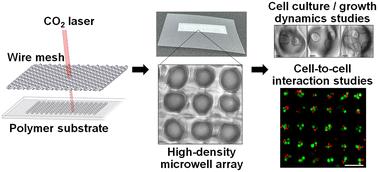
Polymer-based microwell platforms have garnered much interest due to their usefulness in culturing and analyzing small quantities of biological cells and spheroids. Existing methods for fabricating polymer microwell arrays involve complex fabrication processes and/or are limited in their ability to create dense arrays of very small (<50 μm in diameter) microwells. Here, we present a simple and rapid technique for fabricating high-density arrays of microwells ranging from 20 to 160 μm in diameter on a variety of polymer substrates. In this approach, a polymer surface is ablated using a CO2 laser that is rastered over a stainless steel mesh, which serves as a shadow mask. A theoretical laser–polymer interaction model was developed for predicting the microwell volume based on the substrate properties and laser settings. Microwell volumes predicted by the model were within 5.4% of fabricated microwell volumes determined experimentally. Cellulose acetate microwell arrays fabricated using this technique were used to culture Lewis lung carcinoma cells expressing ovalbumin (LLC-OVA), which were maintained for up to 72 h with a negligible (<5%) loss in viability. As a second proof of principle demonstration, LLC-OVA cells grown in microwell arrays were co-cultured with OT-I T cells and measurements of interferon gamma (IFN-γ), a marker for T cell activation, were performed which revealed a positive correlation between LLC-OVA cell-T cell interaction time and T cell activation. These two in vitro demonstrations showcase the capability of this technique in generating polymer microwell arrays for high-throughput cellular studies, including cell growth dynamics studies and cell interaction studies. Furthermore, we envision that these platforms can be used with different cell types and for other biological applications, such as spheroid formation and single cell analysis, further expanding the utility of this technique.
期刊介绍:
Lab on a Chip is the premiere journal that publishes cutting-edge research in the field of miniaturization. By their very nature, microfluidic/nanofluidic/miniaturized systems are at the intersection of disciplines, spanning fundamental research to high-end application, which is reflected by the broad readership of the journal. Lab on a Chip publishes two types of papers on original research: full-length research papers and communications. Papers should demonstrate innovations, which can come from technical advancements or applications addressing pressing needs in globally important areas. The journal also publishes Comments, Reviews, and Perspectives.



 京公网安备 11010802042870号
京ICP备2023020795号-1
京公网安备 11010802042870号
京ICP备2023020795号-1

 分享
分享
 求助内容:
求助内容: 应助结果提醒方式:
 扫码关注我们
