Inter-rater variability for the American Society of Anesthesiologists classification in patients undergoing hepato-pancreato-biliary surgery (MILESTONE-2): international survey among surgeons and anaesthesiologists.
Simone Augustinus, Jasper P Sijberden, Matthanja Bieze, Vandana Agarwal, Luca A Aldrighetti, Adnan Alseidi, Francisco C Bonofiglio, Kevin C P Conlon, Katia Donadello, Joris Erdmann, Cristina Ferrone, Michael Guertin, Ronald Harter, Maria E Franceschetti, Guiseppe K Fusai, Bas Groot Koerkamp, Thilo Hackert, Jin-Young Jang, Thomas Kander, Tobias Keck, Dominik Krzanicki, Ho-Jin Lee, Keith Lewis, Giuseppe Natalini, Carla Nau, Timothy M Pawlik, Henry A Pitt, Rafaella Reineke, Roberto Salvia, Eduardo de Santibanes, Shailesh V Shrikhande, Martin Smith, Attila Szijarto, Bobby Tingstedt, Alice C Wei, John Windsor, Mohammed Abu Hilal, Manuel Pardo, Markus W Hollmann, Marc G Besselink
{"title":"Inter-rater variability for the American Society of Anesthesiologists classification in patients undergoing hepato-pancreato-biliary surgery (MILESTONE-2): international survey among surgeons and anaesthesiologists.","authors":"Simone Augustinus, Jasper P Sijberden, Matthanja Bieze, Vandana Agarwal, Luca A Aldrighetti, Adnan Alseidi, Francisco C Bonofiglio, Kevin C P Conlon, Katia Donadello, Joris Erdmann, Cristina Ferrone, Michael Guertin, Ronald Harter, Maria E Franceschetti, Guiseppe K Fusai, Bas Groot Koerkamp, Thilo Hackert, Jin-Young Jang, Thomas Kander, Tobias Keck, Dominik Krzanicki, Ho-Jin Lee, Keith Lewis, Giuseppe Natalini, Carla Nau, Timothy M Pawlik, Henry A Pitt, Rafaella Reineke, Roberto Salvia, Eduardo de Santibanes, Shailesh V Shrikhande, Martin Smith, Attila Szijarto, Bobby Tingstedt, Alice C Wei, John Windsor, Mohammed Abu Hilal, Manuel Pardo, Markus W Hollmann, Marc G Besselink","doi":"10.1093/bjsopen/zrae162","DOIUrl":null,"url":null,"abstract":"<p><strong>Background: </strong>Patients undergoing hepato-pancreato-biliary surgery are typically preoperatively assessed using the American Society of Anesthesiologists (ASA) classification, which is also used for case-mix adjustment when comparing centre outcomes. Studies determining the inter-rater variability of the ASA classification within hepato-pancreato-biliary surgery are currently lacking.</p><p><strong>Methods: </strong>An international survey was collected and a case-vignette study was performed (November 2022-April 2023) regarding the ASA classification in patients undergoing hepato-pancreato-biliary surgery among anaesthesiologists and surgeons from (inter)national societies. The survey consisted of 23 questions and eight case-vignettes. Primary analysis included descriptive statistics and the inter-rater variability was calculated using Light's Kappa.</p><p><strong>Results: </strong>Overall, 1283 participants from 55 countries responded: 1073 (84%) anaesthesiologists and 210 (16%) surgeons. The ASA classification was commonly used, both clinically 1003/1283 (78%) and for research 728/762 (96%). The majority of respondents (n = 1019, 79%) declared that ASA score impacted their perioperative strategy. There inter-rater variability was fair-moderate (Kappa 0.26-0.42) in all case-vignettes. Inter-rater variability differed within and among geographic regions for each case. Over 80% (n = 1138) of respondents stated that they would take the underlying disease (for example cancer) into account, but this changed the preferred ASA score within the case-vignettes by only 1%. Type of surgery changed the preferred score in the case-vignettes (13% difference). The most common suggestions to improve the ASA classification were to clarify whether type of operation should be considered, create a more extensive definition, and provide more examples.</p><p><strong>Conclusions: </strong>Inter-rater variability was present within the ASA classification of patients undergoing hepato-pancreato-biliary surgery, which may impact perioperative strategy and hamper research results. Additional guidance to classify patients according to ASA is urgently needed. Until then, more objective measurements should be considered for case-mix adjustment within research.</p>","PeriodicalId":9028,"journal":{"name":"BJS Open","volume":"9 1","pages":""},"PeriodicalIF":4.5000,"publicationDate":"2024-12-30","publicationTypes":"Journal Article","fieldsOfStudy":null,"isOpenAccess":false,"openAccessPdf":"https://www.ncbi.nlm.nih.gov/pmc/articles/PMC11879015/pdf/","citationCount":"0","resultStr":null,"platform":"Semanticscholar","paperid":null,"PeriodicalName":"BJS Open","FirstCategoryId":"3","ListUrlMain":"https://doi.org/10.1093/bjsopen/zrae162","RegionNum":3,"RegionCategory":"医学","ArticlePicture":[],"TitleCN":null,"AbstractTextCN":null,"PMCID":null,"EPubDate":"","PubModel":"","JCR":"Q1","JCRName":"SURGERY","Score":null,"Total":0}
引用次数: 0
Abstract
Background: Patients undergoing hepato-pancreato-biliary surgery are typically preoperatively assessed using the American Society of Anesthesiologists (ASA) classification, which is also used for case-mix adjustment when comparing centre outcomes. Studies determining the inter-rater variability of the ASA classification within hepato-pancreato-biliary surgery are currently lacking.
Methods: An international survey was collected and a case-vignette study was performed (November 2022-April 2023) regarding the ASA classification in patients undergoing hepato-pancreato-biliary surgery among anaesthesiologists and surgeons from (inter)national societies. The survey consisted of 23 questions and eight case-vignettes. Primary analysis included descriptive statistics and the inter-rater variability was calculated using Light's Kappa.
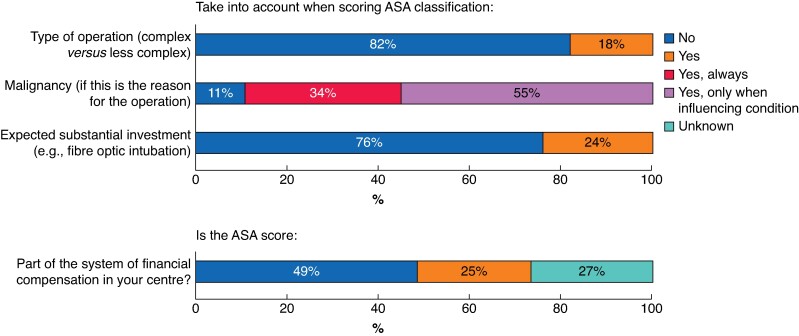
Results: Overall, 1283 participants from 55 countries responded: 1073 (84%) anaesthesiologists and 210 (16%) surgeons. The ASA classification was commonly used, both clinically 1003/1283 (78%) and for research 728/762 (96%). The majority of respondents (n = 1019, 79%) declared that ASA score impacted their perioperative strategy. There inter-rater variability was fair-moderate (Kappa 0.26-0.42) in all case-vignettes. Inter-rater variability differed within and among geographic regions for each case. Over 80% (n = 1138) of respondents stated that they would take the underlying disease (for example cancer) into account, but this changed the preferred ASA score within the case-vignettes by only 1%. Type of surgery changed the preferred score in the case-vignettes (13% difference). The most common suggestions to improve the ASA classification were to clarify whether type of operation should be considered, create a more extensive definition, and provide more examples.
Conclusions: Inter-rater variability was present within the ASA classification of patients undergoing hepato-pancreato-biliary surgery, which may impact perioperative strategy and hamper research results. Additional guidance to classify patients according to ASA is urgently needed. Until then, more objective measurements should be considered for case-mix adjustment within research.





 京公网安备 11010802042870号
京ICP备2023020795号-1
京公网安备 11010802042870号
京ICP备2023020795号-1

 分享
分享
 求助内容:
求助内容: 应助结果提醒方式:
 扫码关注我们
