{"title":"Fracture Resistance of Fiber-Reinforced vs. Conventional Resin Composite Restorations in Structurally Compromised Molars: An In Vitro Study.","authors":"Hamideh Sadat Mohammadipour, Mostafa Farajzadeh, Hediyeh Toutouni, Arya Gazerani, Salehe Sekandari","doi":"10.1155/ijod/5169253","DOIUrl":null,"url":null,"abstract":"<p><p><b>Objective:</b> The aim of this study was to evaluate reinforcing effect of different fiber-reinforced resin composites for restoring structurally compromised molars compared to conventional resin composite. <b>Methods and Materials:</b> Sixty healthy human third molars were randomly divided into six groups (<i>n</i> = 10). In G1 to G4, wide mesio-occluso-distal (MOD) cavities with an occlusal depth of 4 mm and proximal boxes with a width of 2/3 of buccolingual distance were prepared. In G5, after preparation of MOD cavities, 2 mm cusp reduction was made. The samples of G6 were remained intact (control). In G1 and G5, the conventional resin composite (G-ænial Posterior), and in G2, short fiber-reinforced resin composite (SFRC: EverX Posterior) were used. In G3 and G4, the Ribbond fibers were applied on base of cavity in buccolingual and cross-sectional direction, respectively, and followed by conventional resin composite restoration. After 24 h maintaining in distilled water at room temperature, fracture resistance of restored teeth was tested with a crosshead speed of 0.5 mm/s and fracture patterns were also evaluated by stereomicroscope (favorable: above cementoenamel junction (CEJ) and unfavorable: below CEJ). The data was analyzed using Shapiro-Wilk, one-way ANOVA, and post hoc Tukey's HSD tests. <b>Results:</b> The highest fracture strength was obtained in G2 (4051.4 ± 1293.9 N), which was significantly greater than G3 (2886.6 ± 720.4 N; <i>p</i> = 0.005) and G5 (2949.3 ± 307.5 N; <i>p</i> = 0.010). No statistically significant difference was observed between other study groups. The greatest percentage of favorable fracture was recorded in G6 (70%) and G2 (60%). <b>Conclusion:</b> The reconstruction of severely weakened molar teeth with SFRC or incorporating of polyethylene fibers in cross-sectional direction on base of resin composite restoration improved fracture strength and favorably affected fracture modes in comparison to conventional posterior resin composite with or without cusp coverage.</p>","PeriodicalId":13947,"journal":{"name":"International Journal of Dentistry","volume":"2025 ","pages":"5169253"},"PeriodicalIF":2.2000,"publicationDate":"2025-02-25","publicationTypes":"Journal Article","fieldsOfStudy":null,"isOpenAccess":false,"openAccessPdf":"https://www.ncbi.nlm.nih.gov/pmc/articles/PMC11879533/pdf/","citationCount":"0","resultStr":null,"platform":"Semanticscholar","paperid":null,"PeriodicalName":"International Journal of Dentistry","FirstCategoryId":"1085","ListUrlMain":"https://doi.org/10.1155/ijod/5169253","RegionNum":0,"RegionCategory":null,"ArticlePicture":[],"TitleCN":null,"AbstractTextCN":null,"PMCID":null,"EPubDate":"2025/1/1 0:00:00","PubModel":"eCollection","JCR":"Q2","JCRName":"DENTISTRY, ORAL SURGERY & MEDICINE","Score":null,"Total":0}
引用次数: 0
Abstract
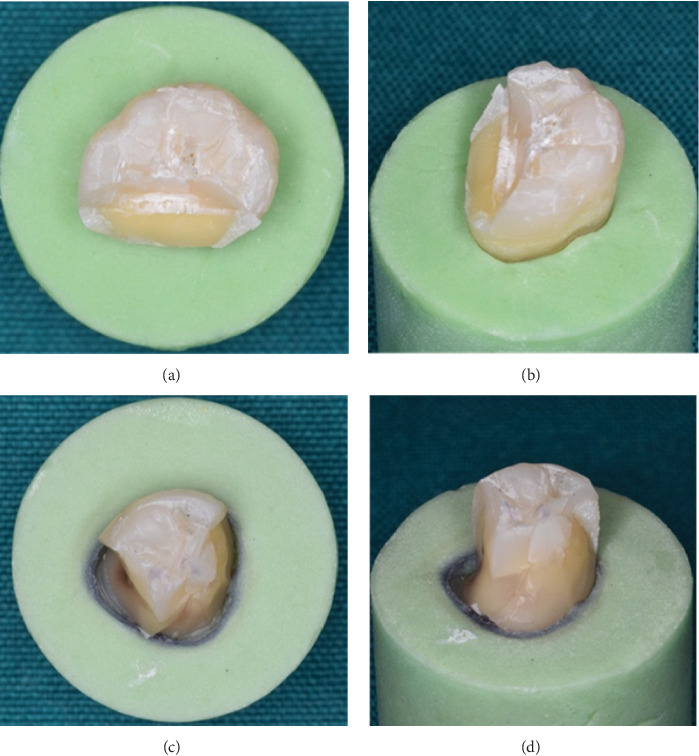
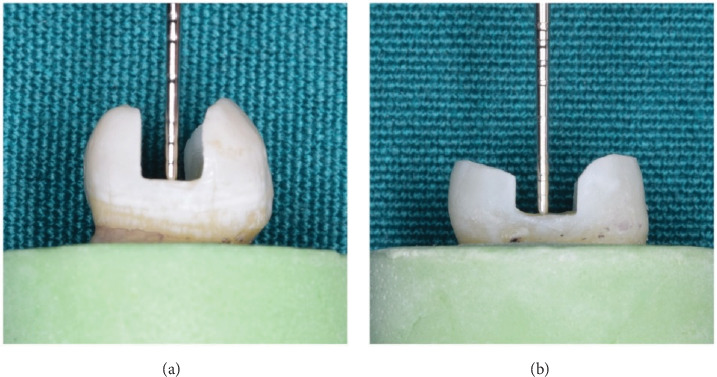
Objective: The aim of this study was to evaluate reinforcing effect of different fiber-reinforced resin composites for restoring structurally compromised molars compared to conventional resin composite. Methods and Materials: Sixty healthy human third molars were randomly divided into six groups (n = 10). In G1 to G4, wide mesio-occluso-distal (MOD) cavities with an occlusal depth of 4 mm and proximal boxes with a width of 2/3 of buccolingual distance were prepared. In G5, after preparation of MOD cavities, 2 mm cusp reduction was made. The samples of G6 were remained intact (control). In G1 and G5, the conventional resin composite (G-ænial Posterior), and in G2, short fiber-reinforced resin composite (SFRC: EverX Posterior) were used. In G3 and G4, the Ribbond fibers were applied on base of cavity in buccolingual and cross-sectional direction, respectively, and followed by conventional resin composite restoration. After 24 h maintaining in distilled water at room temperature, fracture resistance of restored teeth was tested with a crosshead speed of 0.5 mm/s and fracture patterns were also evaluated by stereomicroscope (favorable: above cementoenamel junction (CEJ) and unfavorable: below CEJ). The data was analyzed using Shapiro-Wilk, one-way ANOVA, and post hoc Tukey's HSD tests. Results: The highest fracture strength was obtained in G2 (4051.4 ± 1293.9 N), which was significantly greater than G3 (2886.6 ± 720.4 N; p = 0.005) and G5 (2949.3 ± 307.5 N; p = 0.010). No statistically significant difference was observed between other study groups. The greatest percentage of favorable fracture was recorded in G6 (70%) and G2 (60%). Conclusion: The reconstruction of severely weakened molar teeth with SFRC or incorporating of polyethylene fibers in cross-sectional direction on base of resin composite restoration improved fracture strength and favorably affected fracture modes in comparison to conventional posterior resin composite with or without cusp coverage.




 京公网安备 11010802042870号
京ICP备2023020795号-1
京公网安备 11010802042870号
京ICP备2023020795号-1

 分享
分享
 求助内容:
求助内容: 应助结果提醒方式:
 扫码关注我们
