{"title":"Unraveling the roles of pressure, oxidation state, and morphology in CO2 electroreduction to C2+ gaseous products over copper oxides†","authors":"Asghar Ali and Ali S. Alnaser","doi":"10.1039/D4NA01019A","DOIUrl":null,"url":null,"abstract":"<p >This study provides compelling experimental evidence of the synergistic effects of reaction pressure, oxidation state, and catalyst morphology on the C<small><sub>2+</sub></small> selectivity of copper (Cu) oxide catalysts in electrochemical CO<small><sub>2</sub></small> reduction (ECR). We employed femtosecond laser structuring and thermal treatments to synthesize Cu(0), Cu(<small>I</small>), Cu(<small>II</small>), and a mixed oxidation state catalyst Cu(<em>x</em>) with characteristic micro- and nano-morphologies. The optimal CO<small><sub>2</sub></small> pressure for maximizing C<small><sub>2+</sub></small> productivity in aqueous bicarbonate media was established by assessing the reaction products at different imposed pressures in a custom-designed, pressurizable two-compartment cell. Among Cu(0), Cu(<small>I</small>), and Cu(<small>II</small>), thermally produced Cu(<small>I</small>) was the only unstructured catalyst exhibiting ethylene gas-phase selectivity. Nanostructuring enhanced the C<small><sub>2+</sub></small> selectivity such that all three oxidation states could produce ethylene. More importantly, the nanostructured Cu(<em>x</em>) comprising well-dispersed Cu(0), Cu(<small>I</small>), and Cu(<small>II</small>), exhibited ethylene as well as ethane production – a characteristic associated with the synergistic effects of undercoordinated Cu states in stabilizing reaction intermediates and facilitating charge transfer to yield longer C<small><sub>2+</sub></small> products. This work provides important insights into the key factors influencing C<small><sub>2+</sub></small> selectivity in Cu-based catalysts, establishing the basis for an informed design to yield high-energy density products.</p>","PeriodicalId":18806,"journal":{"name":"Nanoscale Advances","volume":" 8","pages":" 2309-2321"},"PeriodicalIF":4.6000,"publicationDate":"2025-02-25","publicationTypes":"Journal Article","fieldsOfStudy":null,"isOpenAccess":false,"openAccessPdf":"https://www.ncbi.nlm.nih.gov/pmc/articles/PMC11873738/pdf/","citationCount":"0","resultStr":null,"platform":"Semanticscholar","paperid":null,"PeriodicalName":"Nanoscale Advances","FirstCategoryId":"88","ListUrlMain":"https://pubs.rsc.org/en/content/articlelanding/2025/na/d4na01019a","RegionNum":3,"RegionCategory":"材料科学","ArticlePicture":[],"TitleCN":null,"AbstractTextCN":null,"PMCID":null,"EPubDate":"","PubModel":"","JCR":"Q2","JCRName":"CHEMISTRY, MULTIDISCIPLINARY","Score":null,"Total":0}
引用次数: 0
Abstract
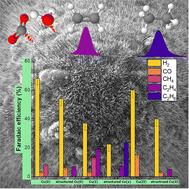
This study provides compelling experimental evidence of the synergistic effects of reaction pressure, oxidation state, and catalyst morphology on the C2+ selectivity of copper (Cu) oxide catalysts in electrochemical CO2 reduction (ECR). We employed femtosecond laser structuring and thermal treatments to synthesize Cu(0), Cu(I), Cu(II), and a mixed oxidation state catalyst Cu(x) with characteristic micro- and nano-morphologies. The optimal CO2 pressure for maximizing C2+ productivity in aqueous bicarbonate media was established by assessing the reaction products at different imposed pressures in a custom-designed, pressurizable two-compartment cell. Among Cu(0), Cu(I), and Cu(II), thermally produced Cu(I) was the only unstructured catalyst exhibiting ethylene gas-phase selectivity. Nanostructuring enhanced the C2+ selectivity such that all three oxidation states could produce ethylene. More importantly, the nanostructured Cu(x) comprising well-dispersed Cu(0), Cu(I), and Cu(II), exhibited ethylene as well as ethane production – a characteristic associated with the synergistic effects of undercoordinated Cu states in stabilizing reaction intermediates and facilitating charge transfer to yield longer C2+ products. This work provides important insights into the key factors influencing C2+ selectivity in Cu-based catalysts, establishing the basis for an informed design to yield high-energy density products.




 京公网安备 11010802042870号
京ICP备2023020795号-1
京公网安备 11010802042870号
京ICP备2023020795号-1

 分享
分享
 求助内容:
求助内容: 应助结果提醒方式:
 扫码关注我们
