Nadia Botros, Laura N Deden, Elske M van den Berg, Eric J Hazebroek
{"title":"Preoperative Mental Disorders and Hospital Healthcare Use in the First Year After Metabolic Bariatric Surgery: A Retrospective Study.","authors":"Nadia Botros, Laura N Deden, Elske M van den Berg, Eric J Hazebroek","doi":"10.1007/s11695-025-07769-w","DOIUrl":null,"url":null,"abstract":"<p><strong>Background: </strong>Mental disorders are relatively common in individuals who undergo metabolic bariatric surgery (MBS). Prior research suggests that mental disorders may relate to increased healthcare use after MBS. We retrospectively explored the association between preoperative mental health disorders and healthcare use in the first postoperative year.</p><p><strong>Methods: </strong>Patients who underwent primary MBS and had a structured preoperative psychological assessment report were included. Data on healthcare use was collected as the total number of non-routine healthcare appointments including inpatient, outpatient, and emergency department visits. Additionally, gastrointestinal (GI) healthcare use at the radiology, gastroenterology, and emergency departments was analyzed separately.</p><p><strong>Results: </strong>Of the 944 included patients, 261 (28%) had a preoperatively diagnosed mental disorder. Most prevalent were depressive disorders, anxiety disorders, and eating disorders. Patients with a preoperative mental disorder had a 15% (adjusted, CI 1.04-1.27, p = 0.005) higher rate of total healthcare use compared to those without. Among patients who had any GI-related healthcare, those with a mental disorder had a 61% higher rate of GI-related healthcare use (CI 1.02-2.55, p = 0.041). Patients with a mental disorder tended to have 20% lower odds of having no GI-related healthcare appointments (unadjusted, not statistically significant, CI 0.37-1.74, p = 0.568).</p><p><strong>Conclusion: </strong>The presence of preoperative mental disorders was weakly related to higher total non-routine hospital healthcare use in the first year after MBS. Models explained only 5-13% of the variation in appointment frequency, meaning unmeasured and/or unknown factors play a role in healthcare use.</p>","PeriodicalId":19460,"journal":{"name":"Obesity Surgery","volume":" ","pages":"1423-1430"},"PeriodicalIF":3.1000,"publicationDate":"2025-04-01","publicationTypes":"Journal Article","fieldsOfStudy":null,"isOpenAccess":false,"openAccessPdf":"https://www.ncbi.nlm.nih.gov/pmc/articles/PMC11976754/pdf/","citationCount":"0","resultStr":null,"platform":"Semanticscholar","paperid":null,"PeriodicalName":"Obesity Surgery","FirstCategoryId":"3","ListUrlMain":"https://doi.org/10.1007/s11695-025-07769-w","RegionNum":3,"RegionCategory":"医学","ArticlePicture":[],"TitleCN":null,"AbstractTextCN":null,"PMCID":null,"EPubDate":"2025/3/5 0:00:00","PubModel":"Epub","JCR":"Q1","JCRName":"SURGERY","Score":null,"Total":0}
引用次数: 0
Abstract
Background: Mental disorders are relatively common in individuals who undergo metabolic bariatric surgery (MBS). Prior research suggests that mental disorders may relate to increased healthcare use after MBS. We retrospectively explored the association between preoperative mental health disorders and healthcare use in the first postoperative year.
Methods: Patients who underwent primary MBS and had a structured preoperative psychological assessment report were included. Data on healthcare use was collected as the total number of non-routine healthcare appointments including inpatient, outpatient, and emergency department visits. Additionally, gastrointestinal (GI) healthcare use at the radiology, gastroenterology, and emergency departments was analyzed separately.
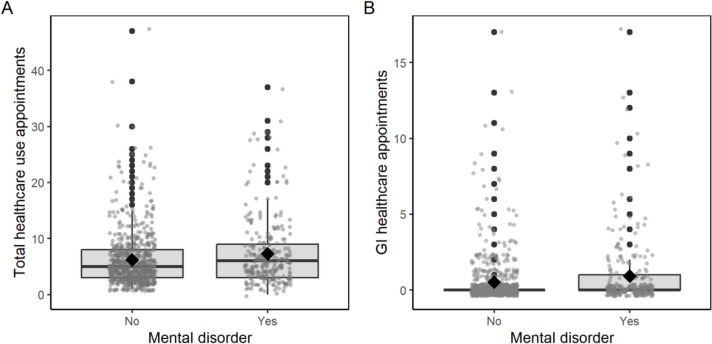
Results: Of the 944 included patients, 261 (28%) had a preoperatively diagnosed mental disorder. Most prevalent were depressive disorders, anxiety disorders, and eating disorders. Patients with a preoperative mental disorder had a 15% (adjusted, CI 1.04-1.27, p = 0.005) higher rate of total healthcare use compared to those without. Among patients who had any GI-related healthcare, those with a mental disorder had a 61% higher rate of GI-related healthcare use (CI 1.02-2.55, p = 0.041). Patients with a mental disorder tended to have 20% lower odds of having no GI-related healthcare appointments (unadjusted, not statistically significant, CI 0.37-1.74, p = 0.568).
Conclusion: The presence of preoperative mental disorders was weakly related to higher total non-routine hospital healthcare use in the first year after MBS. Models explained only 5-13% of the variation in appointment frequency, meaning unmeasured and/or unknown factors play a role in healthcare use.
背景:精神障碍在接受代谢减肥手术(MBS)的个体中相对常见。先前的研究表明,精神障碍可能与MBS后增加的医疗保健使用有关。我们回顾性地探讨了术前心理健康障碍与术后第一年医疗保健使用之间的关系。方法:纳入接受原发性MBS并有结构化术前心理评估报告的患者。医疗保健使用的数据被收集为非常规医疗保健预约的总数,包括住院、门诊和急诊就诊。此外,分别分析了放射科、胃肠病学和急诊科的胃肠(GI)保健使用情况。结果:在纳入的944例患者中,261例(28%)术前诊断为精神障碍。最普遍的是抑郁症、焦虑症和饮食失调。术前有精神障碍的患者总医疗保健使用率比无精神障碍患者高15% (CI 1.04-1.27, p = 0.005)。在接受过gi相关医疗保健的患者中,精神障碍患者使用gi相关医疗保健的比例高出61% (CI 1.02-2.55, p = 0.041)。精神障碍患者没有gi相关医疗预约的几率要低20%(未经调整,无统计学意义,CI 0.37-1.74, p = 0.568)。结论:术前精神障碍的存在与MBS术后第一年非常规性医院保健总使用率的增加呈弱相关。模型只能解释5-13%的预约频率变化,这意味着未测量和/或未知因素在医疗保健使用中起作用。
期刊介绍:
Obesity Surgery is the official journal of the International Federation for the Surgery of Obesity and metabolic disorders (IFSO). A journal for bariatric/metabolic surgeons, Obesity Surgery provides an international, interdisciplinary forum for communicating the latest research, surgical and laparoscopic techniques, for treatment of massive obesity and metabolic disorders. Topics covered include original research, clinical reports, current status, guidelines, historical notes, invited commentaries, letters to the editor, medicolegal issues, meeting abstracts, modern surgery/technical innovations, new concepts, reviews, scholarly presentations and opinions.
Obesity Surgery benefits surgeons performing obesity/metabolic surgery, general surgeons and surgical residents, endoscopists, anesthetists, support staff, nurses, dietitians, psychiatrists, psychologists, plastic surgeons, internists including endocrinologists and diabetologists, nutritional scientists, and those dealing with eating disorders.




 京公网安备 11010802042870号
京ICP备2023020795号-1
京公网安备 11010802042870号
京ICP备2023020795号-1

 分享
分享
 求助内容:
求助内容: 应助结果提醒方式:
 扫码关注我们
