Tria Amalia Ningsih , Simen Akkermans , Peter De Vreese , Edward Matthijs , Rachel Armstrong , Jan F.M. Van Impe
{"title":"Towards mineralised mycelium biocomposites: Optimising fungal growth and ureolytic biomineralisation","authors":"Tria Amalia Ningsih , Simen Akkermans , Peter De Vreese , Edward Matthijs , Rachel Armstrong , Jan F.M. Van Impe","doi":"10.1016/j.jclepro.2025.145120","DOIUrl":null,"url":null,"abstract":"<div><div>Mycelium biocomposites (MBCs) are sustainable materials that bind organic waste particles to create solid biocomposites, yet applications of these materials are constrained by their inferior structural strength relative to traditional architectural materials. This research investigated the optimal conditions for fungal growth and microbial calcium carbonate precipitation (MICP) for mineralising matrices of MBCs, with the aim of enhancing MBC properties. Three ureolytic fungal strains, i.e., <em>Trichoderma reesei</em>, <em>Neurospora crassa</em>, and <em>Penicillium chrysogenum</em>, were tested for their ability to facilitate biomineralisation. A range of calcium and urea concentrations were applied to each strain to assess their influence on growth dynamics and ability to precipitate calcium carbonate through urea hydrolysis. The growth rates, induced pH change, biomass production, and calcium uptake efficiency to form calcium carbonate were measured. The results showed that each fungal strain responded differently to calcium and urea, impacting growth rates, biomass production, and calcium carbonate precipitation. Notably, <em>T. reesei</em> achieved 87% calcium removal when urea concentration was three times than calcium, whereas <em>P. chrysogenum</em> removed 97% of calcium with five times more urea than calcium in the environment. This research provides insights into ureolytic fungal strains that are appropriate for biomineralisation under suitable conditions, to increase the applicability of MBC properties for design and engineering applications using MICP.</div></div>","PeriodicalId":349,"journal":{"name":"Journal of Cleaner Production","volume":"499 ","pages":"Article 145120"},"PeriodicalIF":10.0000,"publicationDate":"2025-03-25","publicationTypes":"Journal Article","fieldsOfStudy":null,"isOpenAccess":false,"openAccessPdf":"","citationCount":"0","resultStr":null,"platform":"Semanticscholar","paperid":null,"PeriodicalName":"Journal of Cleaner Production","FirstCategoryId":"93","ListUrlMain":"https://www.sciencedirect.com/science/article/pii/S0959652625004706","RegionNum":1,"RegionCategory":"环境科学与生态学","ArticlePicture":[],"TitleCN":null,"AbstractTextCN":null,"PMCID":null,"EPubDate":"2025/3/5 0:00:00","PubModel":"Epub","JCR":"Q1","JCRName":"ENGINEERING, ENVIRONMENTAL","Score":null,"Total":0}
引用次数: 0
Abstract
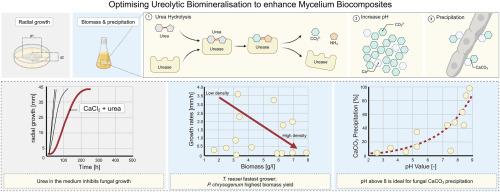
Mycelium biocomposites (MBCs) are sustainable materials that bind organic waste particles to create solid biocomposites, yet applications of these materials are constrained by their inferior structural strength relative to traditional architectural materials. This research investigated the optimal conditions for fungal growth and microbial calcium carbonate precipitation (MICP) for mineralising matrices of MBCs, with the aim of enhancing MBC properties. Three ureolytic fungal strains, i.e., Trichoderma reesei, Neurospora crassa, and Penicillium chrysogenum, were tested for their ability to facilitate biomineralisation. A range of calcium and urea concentrations were applied to each strain to assess their influence on growth dynamics and ability to precipitate calcium carbonate through urea hydrolysis. The growth rates, induced pH change, biomass production, and calcium uptake efficiency to form calcium carbonate were measured. The results showed that each fungal strain responded differently to calcium and urea, impacting growth rates, biomass production, and calcium carbonate precipitation. Notably, T. reesei achieved 87% calcium removal when urea concentration was three times than calcium, whereas P. chrysogenum removed 97% of calcium with five times more urea than calcium in the environment. This research provides insights into ureolytic fungal strains that are appropriate for biomineralisation under suitable conditions, to increase the applicability of MBC properties for design and engineering applications using MICP.
期刊介绍:
The Journal of Cleaner Production is an international, transdisciplinary journal that addresses and discusses theoretical and practical Cleaner Production, Environmental, and Sustainability issues. It aims to help societies become more sustainable by focusing on the concept of 'Cleaner Production', which aims at preventing waste production and increasing efficiencies in energy, water, resources, and human capital use. The journal serves as a platform for corporations, governments, education institutions, regions, and societies to engage in discussions and research related to Cleaner Production, environmental, and sustainability practices.




 京公网安备 11010802042870号
京ICP备2023020795号-1
京公网安备 11010802042870号
京ICP备2023020795号-1

 分享
分享
 求助内容:
求助内容: 应助结果提醒方式:
 扫码关注我们
