Activation of peroxydisulfate by alkali-activated algal biochar for the enhancement of enrofloxacin degradation in water: Role of singlet oxygen and electron transfer pathway
Qiang Kuai , Yixin Wang , Jingjing Yang , Tianyin Huang , Ying-Hong Guan , Zheng-Qian Liu , Jun Ma
{"title":"Activation of peroxydisulfate by alkali-activated algal biochar for the enhancement of enrofloxacin degradation in water: Role of singlet oxygen and electron transfer pathway","authors":"Qiang Kuai , Yixin Wang , Jingjing Yang , Tianyin Huang , Ying-Hong Guan , Zheng-Qian Liu , Jun Ma","doi":"10.1016/j.seppur.2025.132396","DOIUrl":null,"url":null,"abstract":"<div><div>The biochar has garnered significant attention for its potential in carbon sink and versatile application, such as catalyst. However, the catalytic mechanism for peroxydisufate (PDS) activation by alkali-activated biochar is not yet clear. In this work, algal biochar (BC) was synthesized using a simple one-step pyrolysis method and used as a metal-free catalyst to activate PDS. The efficacy of the BC/PDS system for the degradation of enrofloxacin (ENR) was systematically studied. The optimal conditions for BC preparation were identified as a pyrolysis temperature of 650 °C and a ratio of NaOH: algae biomass ratio as 2:1 (650NBC), resulting in a biochar with a large surface area, high defect density, more carbonyl group (C<img>O) and excellent electron transfer capabilities. Mechanistic studies using electron paramagnetic resonance (EPR), quenching experiments, and electrochemical analysis showed that both radical and non-radical pathways were involved in ENR degradation. Notably, singlet oxygen (<sup>1</sup>O<sub>2</sub>) and electron transfer pathway (ETP) play crucial roles in the degradation of ENR molecules. The alkali-activated biochar accelerated the electron transfer between PDS and ENR by increasing the electrochemical specific surface area and facilitating the formation of a metastable 650NBC-PDS* complex. Through characterization analysis, the significantly increased C<img>O groups and defect sites provide more active sites for <sup>1</sup>O<sub>2</sub> generation. Moreover, the intermediate degradation products of ENR from mass spectrometry indicated a possible pathway through the density functional theory (DFT) method. Overall, our study enhances the understanding of the mechanism in PDS activation by alkali-activated biochar, and proposes a novel approach for the recycling of solid waste.</div></div>","PeriodicalId":427,"journal":{"name":"Separation and Purification Technology","volume":"364 ","pages":"Article 132396"},"PeriodicalIF":9.0000,"publicationDate":"2025-08-30","publicationTypes":"Journal Article","fieldsOfStudy":null,"isOpenAccess":false,"openAccessPdf":"","citationCount":"0","resultStr":null,"platform":"Semanticscholar","paperid":null,"PeriodicalName":"Separation and Purification Technology","FirstCategoryId":"5","ListUrlMain":"https://www.sciencedirect.com/science/article/pii/S1383586625009931","RegionNum":1,"RegionCategory":"工程技术","ArticlePicture":[],"TitleCN":null,"AbstractTextCN":null,"PMCID":null,"EPubDate":"2025/3/6 0:00:00","PubModel":"Epub","JCR":"Q1","JCRName":"ENGINEERING, CHEMICAL","Score":null,"Total":0}
引用次数: 0
Abstract
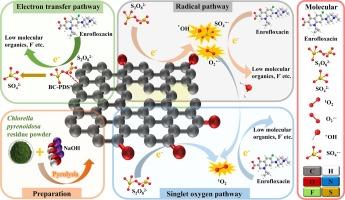
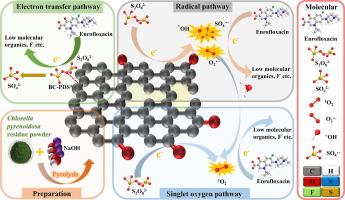
The biochar has garnered significant attention for its potential in carbon sink and versatile application, such as catalyst. However, the catalytic mechanism for peroxydisufate (PDS) activation by alkali-activated biochar is not yet clear. In this work, algal biochar (BC) was synthesized using a simple one-step pyrolysis method and used as a metal-free catalyst to activate PDS. The efficacy of the BC/PDS system for the degradation of enrofloxacin (ENR) was systematically studied. The optimal conditions for BC preparation were identified as a pyrolysis temperature of 650 °C and a ratio of NaOH: algae biomass ratio as 2:1 (650NBC), resulting in a biochar with a large surface area, high defect density, more carbonyl group (CO) and excellent electron transfer capabilities. Mechanistic studies using electron paramagnetic resonance (EPR), quenching experiments, and electrochemical analysis showed that both radical and non-radical pathways were involved in ENR degradation. Notably, singlet oxygen (1O2) and electron transfer pathway (ETP) play crucial roles in the degradation of ENR molecules. The alkali-activated biochar accelerated the electron transfer between PDS and ENR by increasing the electrochemical specific surface area and facilitating the formation of a metastable 650NBC-PDS* complex. Through characterization analysis, the significantly increased CO groups and defect sites provide more active sites for 1O2 generation. Moreover, the intermediate degradation products of ENR from mass spectrometry indicated a possible pathway through the density functional theory (DFT) method. Overall, our study enhances the understanding of the mechanism in PDS activation by alkali-activated biochar, and proposes a novel approach for the recycling of solid waste.
期刊介绍:
Separation and Purification Technology is a premier journal committed to sharing innovative methods for separation and purification in chemical and environmental engineering, encompassing both homogeneous solutions and heterogeneous mixtures. Our scope includes the separation and/or purification of liquids, vapors, and gases, as well as carbon capture and separation techniques. However, it's important to note that methods solely intended for analytical purposes are not within the scope of the journal. Additionally, disciplines such as soil science, polymer science, and metallurgy fall outside the purview of Separation and Purification Technology. Join us in advancing the field of separation and purification methods for sustainable solutions in chemical and environmental engineering.



 京公网安备 11010802042870号
京ICP备2023020795号-1
京公网安备 11010802042870号
京ICP备2023020795号-1

 分享
分享
 求助内容:
求助内容: 应助结果提醒方式:
 扫码关注我们
