Marek Sedlařík , Petr Vyroubal , Dominika Capková , Edin Omerdic , Mitchell Rae , Martin Mačák , Martin Šedina , Tomáš Kazda
{"title":"Advanced machine learning techniques for State-of-Health estimation in lithium-ion batteries: A comparative study","authors":"Marek Sedlařík , Petr Vyroubal , Dominika Capková , Edin Omerdic , Mitchell Rae , Martin Mačák , Martin Šedina , Tomáš Kazda","doi":"10.1016/j.electacta.2025.145988","DOIUrl":null,"url":null,"abstract":"<div><div>The accurate modeling and prediction of the State-of-Health (SOH) of lithium-ion (Li-ion) batteries are crucial for extending their lifespan, ensuring reliability, and minimizing the costs associated with extensive laboratory testing. This paper investigates the SOH estimation of Li-ion batteries utilizing advanced machine learning (ML) techniques. Specifically, 600 cycles were performed on Samsung INR18650–35E cells using the Constant Current Constant Voltage (CCCV) protocol. The input data for the ML methods were extracted from both charging and discharging cycles to achieve the best possible results.</div><div>Data-driven models with different methodological foundations were used to predict SOH: Gaussian Process Regression (GPR), Support Vector Regression (SVR), and from the field of Artificial Neural Networks (ANN), Feed-Forward Neural Network (FFNN) and Adaptive Neuro-Fuzzy Inference System (ANFIS), which utilizes fuzzy logic. The input features for the ML methods were analyzed using Pearson Correlation Analysis (PCA), and additional inputs for the ANFIS method were selected using Exhaustive Search (ES) to identify the optimal combination of inputs with the lowest Root Mean Square Error (RMSE). The individual ML methods were evaluated on datasets of various sizes using the features with the highest correlation to SOH and the full set of features to detect overfitting. Further experiments explored the dependency of RMSE on the amount of training data, and SOH estimation of one battery was performed using training data from another. Overall, experiments show that nearly all methods achieved RMSE below 0.5% for SOH estimation, with SVR proving the most stable technique and ANFIS excelling with meticulously optimized configurations.</div></div>","PeriodicalId":305,"journal":{"name":"Electrochimica Acta","volume":"524 ","pages":"Article 145988"},"PeriodicalIF":5.6000,"publicationDate":"2025-06-01","publicationTypes":"Journal Article","fieldsOfStudy":null,"isOpenAccess":false,"openAccessPdf":"","citationCount":"0","resultStr":null,"platform":"Semanticscholar","paperid":null,"PeriodicalName":"Electrochimica Acta","FirstCategoryId":"88","ListUrlMain":"https://www.sciencedirect.com/science/article/pii/S0013468625003512","RegionNum":3,"RegionCategory":"材料科学","ArticlePicture":[],"TitleCN":null,"AbstractTextCN":null,"PMCID":null,"EPubDate":"2025/3/6 0:00:00","PubModel":"Epub","JCR":"Q1","JCRName":"ELECTROCHEMISTRY","Score":null,"Total":0}
引用次数: 0
Abstract
The accurate modeling and prediction of the State-of-Health (SOH) of lithium-ion (Li-ion) batteries are crucial for extending their lifespan, ensuring reliability, and minimizing the costs associated with extensive laboratory testing. This paper investigates the SOH estimation of Li-ion batteries utilizing advanced machine learning (ML) techniques. Specifically, 600 cycles were performed on Samsung INR18650–35E cells using the Constant Current Constant Voltage (CCCV) protocol. The input data for the ML methods were extracted from both charging and discharging cycles to achieve the best possible results.
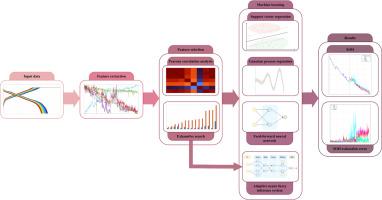
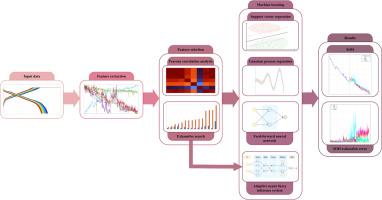
Data-driven models with different methodological foundations were used to predict SOH: Gaussian Process Regression (GPR), Support Vector Regression (SVR), and from the field of Artificial Neural Networks (ANN), Feed-Forward Neural Network (FFNN) and Adaptive Neuro-Fuzzy Inference System (ANFIS), which utilizes fuzzy logic. The input features for the ML methods were analyzed using Pearson Correlation Analysis (PCA), and additional inputs for the ANFIS method were selected using Exhaustive Search (ES) to identify the optimal combination of inputs with the lowest Root Mean Square Error (RMSE). The individual ML methods were evaluated on datasets of various sizes using the features with the highest correlation to SOH and the full set of features to detect overfitting. Further experiments explored the dependency of RMSE on the amount of training data, and SOH estimation of one battery was performed using training data from another. Overall, experiments show that nearly all methods achieved RMSE below 0.5% for SOH estimation, with SVR proving the most stable technique and ANFIS excelling with meticulously optimized configurations.
期刊介绍:
Electrochimica Acta is an international journal. It is intended for the publication of both original work and reviews in the field of electrochemistry. Electrochemistry should be interpreted to mean any of the research fields covered by the Divisions of the International Society of Electrochemistry listed below, as well as emerging scientific domains covered by ISE New Topics Committee.



 京公网安备 11010802042870号
京ICP备2023020795号-1
京公网安备 11010802042870号
京ICP备2023020795号-1

 分享
分享
 求助内容:
求助内容: 应助结果提醒方式:
 扫码关注我们
