Elizabeth Mavil-Guerrero, José Manuel Romo-Herrera, Priscila Quiñonez-Angulo, Francisco J. Flores-Ruiz, Edén Morales-Narváez, J. Félix Armando Soltero, Josué D. Mota-Morales, Karla Juarez-Moreno
{"title":"Enhanced Cell Proliferation and Maturation Using Carboxylated Bacterial Nanocellulose Scaffolds for 3D Cell Culture","authors":"Elizabeth Mavil-Guerrero, José Manuel Romo-Herrera, Priscila Quiñonez-Angulo, Francisco J. Flores-Ruiz, Edén Morales-Narváez, J. Félix Armando Soltero, Josué D. Mota-Morales, Karla Juarez-Moreno","doi":"10.1021/acsami.4c22475","DOIUrl":null,"url":null,"abstract":"Developing scaffolds for three-dimensional (3D) cell culture and tissue regeneration with biopolymers requires the creation of an optimal nanobiointerface. This interface must possess suitable surface chemistry, biomechanical properties, and fibrillar morphology across nano- to microscale levels to support cell attachment and growth, enabling a biomimetic arrangement. In this study, we developed a hydrogel scaffold made from bacterial nanocellulose (BNC) functionalized with carboxylic acid groups (BNC–COOH) through a reactive deep eutectic solvent (DES), offering a sustainable approach. The surface properties and fibrillar structure of BNC–COOH facilitated the formation of hydrogels with significantly enhanced water uptake (1.4-fold) and adhesion force (2.3-fold) compared to BNC. These hydrogels also demonstrated tissue-like rheological properties in both water with <i>G</i>′ exceeding <i>G</i>″, suggesting predominantly elastic (solid-like) characteristics and viscosities in the range of 8– 15 Pa·s. The BNC–COOH hydrogel scaffold demonstrated excellent biocompatibility, supporting significant cell growth and anchorage for the 3D growth of mammalian cells and enhancing preadipocyte growth by up to 7.3 times. Furthermore, the BNC–COOH hydrogel facilitates the maturation of 3T3-L1 preadipocytes into mature adipocytes, inducing typical morphology changes, such as decreased filopodia extensions, rounded cell shape, and lipid droplet accumulation without any additional chemical induction stimulus. Therefore, we demonstrated that a reactive DES composed of oxalic acid and choline chloride represents a mild reaction medium and a suitable approach for designing biocompatible 3D hydrogel scaffolds with improved physicochemical properties and biological activities for 3D cell culture.","PeriodicalId":5,"journal":{"name":"ACS Applied Materials & Interfaces","volume":"24 1","pages":""},"PeriodicalIF":8.2000,"publicationDate":"2025-03-05","publicationTypes":"Journal Article","fieldsOfStudy":null,"isOpenAccess":false,"openAccessPdf":"","citationCount":"0","resultStr":null,"platform":"Semanticscholar","paperid":null,"PeriodicalName":"ACS Applied Materials & Interfaces","FirstCategoryId":"88","ListUrlMain":"https://doi.org/10.1021/acsami.4c22475","RegionNum":2,"RegionCategory":"材料科学","ArticlePicture":[],"TitleCN":null,"AbstractTextCN":null,"PMCID":null,"EPubDate":"","PubModel":"","JCR":"Q1","JCRName":"MATERIALS SCIENCE, MULTIDISCIPLINARY","Score":null,"Total":0}
引用次数: 0
Abstract
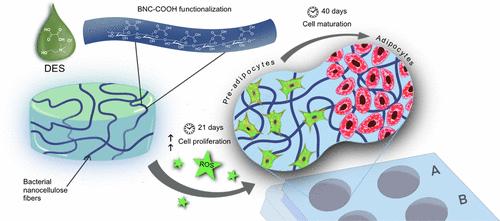
Developing scaffolds for three-dimensional (3D) cell culture and tissue regeneration with biopolymers requires the creation of an optimal nanobiointerface. This interface must possess suitable surface chemistry, biomechanical properties, and fibrillar morphology across nano- to microscale levels to support cell attachment and growth, enabling a biomimetic arrangement. In this study, we developed a hydrogel scaffold made from bacterial nanocellulose (BNC) functionalized with carboxylic acid groups (BNC–COOH) through a reactive deep eutectic solvent (DES), offering a sustainable approach. The surface properties and fibrillar structure of BNC–COOH facilitated the formation of hydrogels with significantly enhanced water uptake (1.4-fold) and adhesion force (2.3-fold) compared to BNC. These hydrogels also demonstrated tissue-like rheological properties in both water with G′ exceeding G″, suggesting predominantly elastic (solid-like) characteristics and viscosities in the range of 8– 15 Pa·s. The BNC–COOH hydrogel scaffold demonstrated excellent biocompatibility, supporting significant cell growth and anchorage for the 3D growth of mammalian cells and enhancing preadipocyte growth by up to 7.3 times. Furthermore, the BNC–COOH hydrogel facilitates the maturation of 3T3-L1 preadipocytes into mature adipocytes, inducing typical morphology changes, such as decreased filopodia extensions, rounded cell shape, and lipid droplet accumulation without any additional chemical induction stimulus. Therefore, we demonstrated that a reactive DES composed of oxalic acid and choline chloride represents a mild reaction medium and a suitable approach for designing biocompatible 3D hydrogel scaffolds with improved physicochemical properties and biological activities for 3D cell culture.
期刊介绍:
ACS Applied Materials & Interfaces is a leading interdisciplinary journal that brings together chemists, engineers, physicists, and biologists to explore the development and utilization of newly-discovered materials and interfacial processes for specific applications. Our journal has experienced remarkable growth since its establishment in 2009, both in terms of the number of articles published and the impact of the research showcased. We are proud to foster a truly global community, with the majority of published articles originating from outside the United States, reflecting the rapid growth of applied research worldwide.



 京公网安备 11010802042870号
京ICP备2023020795号-1
京公网安备 11010802042870号
京ICP备2023020795号-1

 分享
分享
 求助内容:
求助内容: 应助结果提醒方式:
 扫码关注我们
