{"title":"Strain Engineering towards Enriched Surface Patterns in Graphene Twistronics","authors":"Zi-Chen Huang, K. M. Liew","doi":"10.1021/acsami.5c00840","DOIUrl":null,"url":null,"abstract":"The remarkable electronic properties of twisted bilayer graphene (TBG) are pivotal to the realm of twistronics and are significantly regulated by surface wrinkling. In this context, strain engineering provides a novel paradigm for exploring twist–strain–electron coupling. However, prevailing studies have heavily overlooked the effects of twist angle and out-of-plane strain on the surface wrinkling of TBG. To bridge this gap, we present a pioneering strain engineering strategy that encapsulates both in-plane and out-of-plane strains to customize the surface patterns of TBG, with out-of-plane strain regulated via interlayer sp<sup>3</sup> bonding. Starting from this method, we for the first time identify multiphase surface patterns transitioning from herringbone to hexagonal structures through extensive molecular dynamics simulations and develop an original phase diagram to intuitively illustrate pattern transitions under varying twist angles and interlayer bonding densities. To delve deeply into the mechanisms driving these transitions, we establish comprehensive scaling laws by linking pattern energies to strain, twist angle, and interlayer bonding density, thereby defining the critical conditions for phase transitions. Moreover, our results highlight that atomic reconstruction at small twist angles leads to markedly different pattern transition behaviors and geometric features. By synergistically manipulating twist and strain, our work is expected to illuminate the field of twistronics and provide valuable insights for designing novel, tailored electronic devices based on wrinkle-related TBG systems.","PeriodicalId":5,"journal":{"name":"ACS Applied Materials & Interfaces","volume":"11 1","pages":""},"PeriodicalIF":8.2000,"publicationDate":"2025-03-05","publicationTypes":"Journal Article","fieldsOfStudy":null,"isOpenAccess":false,"openAccessPdf":"","citationCount":"0","resultStr":null,"platform":"Semanticscholar","paperid":null,"PeriodicalName":"ACS Applied Materials & Interfaces","FirstCategoryId":"88","ListUrlMain":"https://doi.org/10.1021/acsami.5c00840","RegionNum":2,"RegionCategory":"材料科学","ArticlePicture":[],"TitleCN":null,"AbstractTextCN":null,"PMCID":null,"EPubDate":"","PubModel":"","JCR":"Q1","JCRName":"MATERIALS SCIENCE, MULTIDISCIPLINARY","Score":null,"Total":0}
引用次数: 0
Abstract
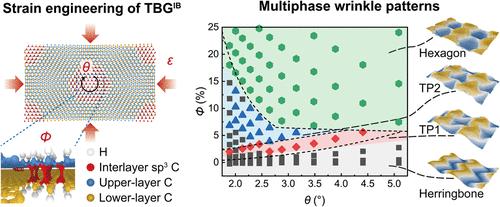
The remarkable electronic properties of twisted bilayer graphene (TBG) are pivotal to the realm of twistronics and are significantly regulated by surface wrinkling. In this context, strain engineering provides a novel paradigm for exploring twist–strain–electron coupling. However, prevailing studies have heavily overlooked the effects of twist angle and out-of-plane strain on the surface wrinkling of TBG. To bridge this gap, we present a pioneering strain engineering strategy that encapsulates both in-plane and out-of-plane strains to customize the surface patterns of TBG, with out-of-plane strain regulated via interlayer sp3 bonding. Starting from this method, we for the first time identify multiphase surface patterns transitioning from herringbone to hexagonal structures through extensive molecular dynamics simulations and develop an original phase diagram to intuitively illustrate pattern transitions under varying twist angles and interlayer bonding densities. To delve deeply into the mechanisms driving these transitions, we establish comprehensive scaling laws by linking pattern energies to strain, twist angle, and interlayer bonding density, thereby defining the critical conditions for phase transitions. Moreover, our results highlight that atomic reconstruction at small twist angles leads to markedly different pattern transition behaviors and geometric features. By synergistically manipulating twist and strain, our work is expected to illuminate the field of twistronics and provide valuable insights for designing novel, tailored electronic devices based on wrinkle-related TBG systems.
期刊介绍:
ACS Applied Materials & Interfaces is a leading interdisciplinary journal that brings together chemists, engineers, physicists, and biologists to explore the development and utilization of newly-discovered materials and interfacial processes for specific applications. Our journal has experienced remarkable growth since its establishment in 2009, both in terms of the number of articles published and the impact of the research showcased. We are proud to foster a truly global community, with the majority of published articles originating from outside the United States, reflecting the rapid growth of applied research worldwide.




 京公网安备 11010802042870号
京ICP备2023020795号-1
京公网安备 11010802042870号
京ICP备2023020795号-1

 分享
分享
 求助内容:
求助内容: 应助结果提醒方式:
 扫码关注我们
