Daniel J. McCabe MD , Heath Gibbs BA , Alessandra A. Pratt PhD, MS , Rachel Culbreth PhD , Amanda M. Sutphin BSHCA, EMT-P , Stephanie Abston BS , Shao Li MPH , Paul Wax MD , Jeffrey Brent MD, PhD , Sharan Campleman PhD, MPH , Kim Aldy DO, MS , Alyssa Falise PhD, MSPH , Alex F. Manini MD, MS , ToxIC Fentalog Study Group
{"title":"Risk of Delayed Intubation After Presumed Opioid Overdose in the Emergency Department","authors":"Daniel J. McCabe MD , Heath Gibbs BA , Alessandra A. Pratt PhD, MS , Rachel Culbreth PhD , Amanda M. Sutphin BSHCA, EMT-P , Stephanie Abston BS , Shao Li MPH , Paul Wax MD , Jeffrey Brent MD, PhD , Sharan Campleman PhD, MPH , Kim Aldy DO, MS , Alyssa Falise PhD, MSPH , Alex F. Manini MD, MS , ToxIC Fentalog Study Group","doi":"10.1016/j.annemergmed.2025.01.022","DOIUrl":null,"url":null,"abstract":"<div><h3>Study objective</h3><div>The objective of this study was to evaluate the optimal duration of monitoring for patients with presumed opioid overdoses prior to a non-ICU admission, particularly in the context of the increasing prevalence of fentanyl analogs and other potent synthetic opioids. Given the critical role of emergency physicians in managing this public health crisis, the study aims to inform clinical decisionmaking regarding patient disposition after the initial overdose treatment.</div></div><div><h3>Methods</h3><div>The Fentalog Study, conducted through the American College of Medical Toxicology’s Toxicology Investigators Consortium, is a prospective, multi-institutional project designed to identify patients presenting to the emergency department with acute opioid overdose, gather clinical details, and confirm substances through biologic testing. This study is a secondary analysis of the Fentalog Study that assessed the risk of “delayed intubation,” defined as any intubation occurring after 4 hours of arrival to the emergency department.</div></div><div><h3>Results</h3><div>Of the 1,591 patients included, only 9 (0.6%) required delayed intubation. Eight of these patients had nonrespiratory-related conditions contributing to the need for intubation. One patient only had respiratory-related conditions, had respiratory acidosis, and received a total of 6.4 mg naloxone before intubation.</div></div><div><h3>Conclusion</h3><div>This study provides evidence that delayed intubation after 4 hours of monitoring in patients with presumed opioid overdose is exceedingly rare.</div></div>","PeriodicalId":8236,"journal":{"name":"Annals of emergency medicine","volume":"85 6","pages":"Pages 498-504"},"PeriodicalIF":5.0000,"publicationDate":"2025-03-04","publicationTypes":"Journal Article","fieldsOfStudy":null,"isOpenAccess":false,"openAccessPdf":"","citationCount":"0","resultStr":null,"platform":"Semanticscholar","paperid":null,"PeriodicalName":"Annals of emergency medicine","FirstCategoryId":"3","ListUrlMain":"https://www.sciencedirect.com/science/article/pii/S0196064425000605","RegionNum":1,"RegionCategory":"医学","ArticlePicture":[],"TitleCN":null,"AbstractTextCN":null,"PMCID":null,"EPubDate":"","PubModel":"","JCR":"Q1","JCRName":"EMERGENCY MEDICINE","Score":null,"Total":0}
引用次数: 0
Abstract
Study objective
The objective of this study was to evaluate the optimal duration of monitoring for patients with presumed opioid overdoses prior to a non-ICU admission, particularly in the context of the increasing prevalence of fentanyl analogs and other potent synthetic opioids. Given the critical role of emergency physicians in managing this public health crisis, the study aims to inform clinical decisionmaking regarding patient disposition after the initial overdose treatment.
Methods
The Fentalog Study, conducted through the American College of Medical Toxicology’s Toxicology Investigators Consortium, is a prospective, multi-institutional project designed to identify patients presenting to the emergency department with acute opioid overdose, gather clinical details, and confirm substances through biologic testing. This study is a secondary analysis of the Fentalog Study that assessed the risk of “delayed intubation,” defined as any intubation occurring after 4 hours of arrival to the emergency department.
Results
Of the 1,591 patients included, only 9 (0.6%) required delayed intubation. Eight of these patients had nonrespiratory-related conditions contributing to the need for intubation. One patient only had respiratory-related conditions, had respiratory acidosis, and received a total of 6.4 mg naloxone before intubation.
Conclusion
This study provides evidence that delayed intubation after 4 hours of monitoring in patients with presumed opioid overdose is exceedingly rare.
期刊介绍:
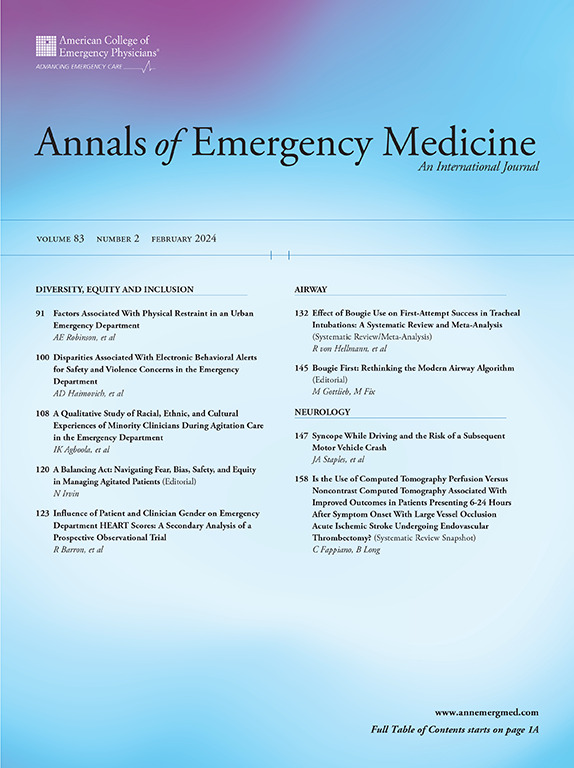
Annals of Emergency Medicine, the official journal of the American College of Emergency Physicians, is an international, peer-reviewed journal dedicated to improving the quality of care by publishing the highest quality science for emergency medicine and related medical specialties. Annals publishes original research, clinical reports, opinion, and educational information related to the practice, teaching, and research of emergency medicine. In addition to general emergency medicine topics, Annals regularly publishes articles on out-of-hospital emergency medical services, pediatric emergency medicine, injury and disease prevention, health policy and ethics, disaster management, toxicology, and related topics.



 京公网安备 11010802042870号
京ICP备2023020795号-1
京公网安备 11010802042870号
京ICP备2023020795号-1

 分享
分享
 求助内容:
求助内容: 应助结果提醒方式:
 扫码关注我们
