Alessandro Mengozzi, Silvia Armenia, Nicolò De Biase, Lavinia Del Punta, Federica Cappelli, Emiliano Duranti, Virginia Nannipieri, Rossana Remollino, Domenico Tricò, Agostino Virdis, Stefano Taddei, Nicola Riccardo Pugliese, Stefano Masi
{"title":"Circulating mitochondrial DNA signature in cardiometabolic patients.","authors":"Alessandro Mengozzi, Silvia Armenia, Nicolò De Biase, Lavinia Del Punta, Federica Cappelli, Emiliano Duranti, Virginia Nannipieri, Rossana Remollino, Domenico Tricò, Agostino Virdis, Stefano Taddei, Nicola Riccardo Pugliese, Stefano Masi","doi":"10.1186/s12933-025-02656-1","DOIUrl":null,"url":null,"abstract":"<p><strong>Background: </strong>Mitochondrial dysfunction is a hallmark of cardiometabolic diseases. Circulating mitochondrial DNA (mtDNA) profiles could refine risk stratification, but current methods do not account for different fractions of circulating mtDNA. We investigated whether patients with type 2 diabetes and/or heart failure (HF) have a specific signature of the total circulating mtDNA profile, including intracellular and cell-free fractions.</p><p><strong>Methods: </strong>We performed a complete clinical assessment, including blood tests, 12-lead ECG and ultrasound at rest and during cardiopulmonary exercise. Ultrasound congestion was defined at rest as inferior vena cava of ≥ 21 mm, lung B-lines ≥ 4, or discontinuous renal venous flow. In fasting whole blood and plasma samples collected at rest, we simultaneously measured the copy number of the cellular and cell-free components of mtDNA by real-time quantitative polymerase chain reaction (qPCR) using custom standards. We calculated the ratio of cell mtDNA to cell-free mtDNA as an index of mitochondrial efficiency.</p><p><strong>Results: </strong>We enrolled 120 consecutive patients: 50 (42%) with HF and preserved ejection fraction (HFpEF), 40 (33%) with HF and reduced ejection fraction (HFrEF) and 30 (25%) at risk of developing HF; 42/120 (35%) had diabetes. Cell-free mtDNA was increased in patients with HF (with higher levels in HFrEF than HFpEF) and those with diabetes. Cell-free mtDNA was also higher in patients with systemic inflammation (expressed by high-sensitivity C-reactive protein [hs-CRP] ≥ 0.2 mg/dL with neutrophil-lymphocyte ratio [NLR] > 3) and more ultrasound signs of congestion. The cell/cell-free mtDNA ratio showed opposite trends (all p < 0.05), but there were no significant differences in cell mtDNA. Cell-free mtDNA and mtDNA ratio independently predicted the presence of ≥ 2 ultrasound signs of congestion and effort intolerance (peak oxygen consumption < 16 mL/kg/min) at ROC analysis and using multivariable regressions after adjustment for age, sex, hs-CRP, NLR, high-sensitivity Troponin T and NT-proBNP.</p><p><strong>Conclusions: </strong>Patients with HF and diabetes have an altered circulating mtDNA signature characterised by higher cell-free mtDNA and lower mtDNA ratio, whereas cellular mtDNA remains unaffected. Cell-free mtDNA and mtDNA ratio are associated with impaired response to exercise, higher systemic inflammation and increased congestion. Circulating mitochondrial profile could be a new biomarker of mitochondrial status in cardiometabolic diseases.</p>","PeriodicalId":9374,"journal":{"name":"Cardiovascular Diabetology","volume":"24 1","pages":"106"},"PeriodicalIF":10.6000,"publicationDate":"2025-03-05","publicationTypes":"Journal Article","fieldsOfStudy":null,"isOpenAccess":false,"openAccessPdf":"https://www.ncbi.nlm.nih.gov/pmc/articles/PMC11884014/pdf/","citationCount":"0","resultStr":null,"platform":"Semanticscholar","paperid":null,"PeriodicalName":"Cardiovascular Diabetology","FirstCategoryId":"3","ListUrlMain":"https://doi.org/10.1186/s12933-025-02656-1","RegionNum":1,"RegionCategory":"医学","ArticlePicture":[],"TitleCN":null,"AbstractTextCN":null,"PMCID":null,"EPubDate":"","PubModel":"","JCR":"Q1","JCRName":"CARDIAC & CARDIOVASCULAR SYSTEMS","Score":null,"Total":0}
引用次数: 0
Abstract
Background: Mitochondrial dysfunction is a hallmark of cardiometabolic diseases. Circulating mitochondrial DNA (mtDNA) profiles could refine risk stratification, but current methods do not account for different fractions of circulating mtDNA. We investigated whether patients with type 2 diabetes and/or heart failure (HF) have a specific signature of the total circulating mtDNA profile, including intracellular and cell-free fractions.
Methods: We performed a complete clinical assessment, including blood tests, 12-lead ECG and ultrasound at rest and during cardiopulmonary exercise. Ultrasound congestion was defined at rest as inferior vena cava of ≥ 21 mm, lung B-lines ≥ 4, or discontinuous renal venous flow. In fasting whole blood and plasma samples collected at rest, we simultaneously measured the copy number of the cellular and cell-free components of mtDNA by real-time quantitative polymerase chain reaction (qPCR) using custom standards. We calculated the ratio of cell mtDNA to cell-free mtDNA as an index of mitochondrial efficiency.
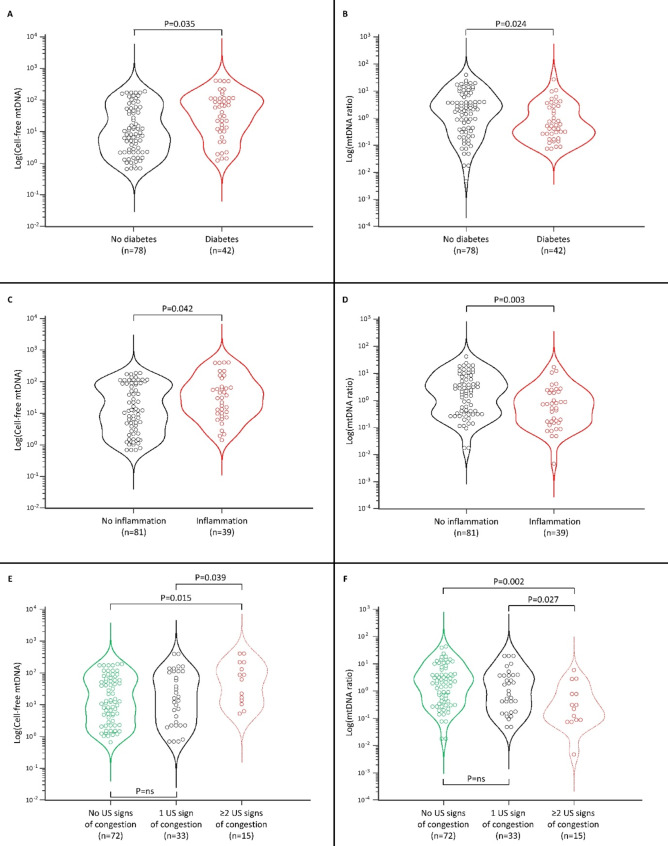
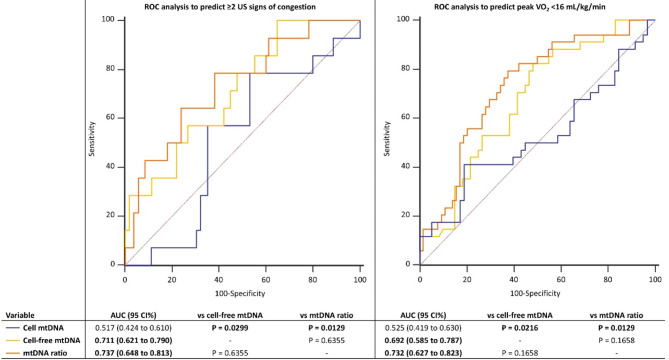
Results: We enrolled 120 consecutive patients: 50 (42%) with HF and preserved ejection fraction (HFpEF), 40 (33%) with HF and reduced ejection fraction (HFrEF) and 30 (25%) at risk of developing HF; 42/120 (35%) had diabetes. Cell-free mtDNA was increased in patients with HF (with higher levels in HFrEF than HFpEF) and those with diabetes. Cell-free mtDNA was also higher in patients with systemic inflammation (expressed by high-sensitivity C-reactive protein [hs-CRP] ≥ 0.2 mg/dL with neutrophil-lymphocyte ratio [NLR] > 3) and more ultrasound signs of congestion. The cell/cell-free mtDNA ratio showed opposite trends (all p < 0.05), but there were no significant differences in cell mtDNA. Cell-free mtDNA and mtDNA ratio independently predicted the presence of ≥ 2 ultrasound signs of congestion and effort intolerance (peak oxygen consumption < 16 mL/kg/min) at ROC analysis and using multivariable regressions after adjustment for age, sex, hs-CRP, NLR, high-sensitivity Troponin T and NT-proBNP.
Conclusions: Patients with HF and diabetes have an altered circulating mtDNA signature characterised by higher cell-free mtDNA and lower mtDNA ratio, whereas cellular mtDNA remains unaffected. Cell-free mtDNA and mtDNA ratio are associated with impaired response to exercise, higher systemic inflammation and increased congestion. Circulating mitochondrial profile could be a new biomarker of mitochondrial status in cardiometabolic diseases.
期刊介绍:
Cardiovascular Diabetology is a journal that welcomes manuscripts exploring various aspects of the relationship between diabetes, cardiovascular health, and the metabolic syndrome. We invite submissions related to clinical studies, genetic investigations, experimental research, pharmacological studies, epidemiological analyses, and molecular biology research in this field.




 京公网安备 11010802042870号
京ICP备2023020795号-1
京公网安备 11010802042870号
京ICP备2023020795号-1

 分享
分享
 求助内容:
求助内容: 应助结果提醒方式:
 扫码关注我们
