Xiaoran Yu, Huan Wang, Sheng Ma, Yanhui Dong, Yinghua Ma, Yi Song, Jun Ma, Zhiyong Zou
{"title":"Impact of parental myopia on myopia in schoolchildren and adolescents in China: A national cross-sectional survey.","authors":"Xiaoran Yu, Huan Wang, Sheng Ma, Yanhui Dong, Yinghua Ma, Yi Song, Jun Ma, Zhiyong Zou","doi":"10.1097/CM9.0000000000003515","DOIUrl":null,"url":null,"abstract":"<p><strong>Background: </strong>Parental myopia is an important risk factor for myopia in Chinese children and adolescents. This study aimed to assess the influence of parental myopia and the severity of myopia on offspring and to evaluate whether adopting healthy lifestyles can mitigate the effects of parental myopia on offspring.</p><p><strong>Methods: </strong>This cross-sectional study analyzed data from children and adolescents aged 6-17 years with complete vision assessments and parental history of myopia from six provinces in China during 2013-2014. Parental demographic information, children's outdoor activity time, sleep time, and sedentary time were collected via questionnaire. Parental myopia was classified as no myopia, paternal myopia, maternal myopia, and both. The offspring were categorized into 10 groups based on parental myopia prescription. Associations of the above factors with myopia in children and adolescents were evaluated by logistic regression analysis.</p><p><strong>Results: </strong>Among 40,864 children and adolescents (50.3% boys and 49.7% girls), 22,537 (55.2%) were diagnosed with myopia. In comparison to offspring devoid of parental myopia, children with one parent affected by myopia exhibited odds ratio (OR) of 1.75 (95% confidence interval [CI]: 1.62-1.88) for myopia, while those with both parents affected showed OR of 2.27 (95% CI: 2.02-2.55) after adjusted for lifestyle factors. The likelihood of myopia in offspring increased with increasing severity of parental myopia, with a 3.08-fold increase in risk observed when both parents presented high myopia. Nonetheless, children adhering to two or more healthy lifestyle factors demonstrated a diminished risk of myopia compared with those with fewer than two lifestyle factors, especially among offspring of non-myopic or mildly myopic parents.</p><p><strong>Conclusions: </strong>Parental myopia has a dose-dependent association with their offspring. Healthy lifestyles may reduce the impact of parental factors on myopia in offspring. The observed associations suggest that although the genetic burden of parental myopia cannot be ignored, healthy lifestyles and nurturing are also very important.</p>","PeriodicalId":10183,"journal":{"name":"Chinese Medical Journal","volume":" ","pages":"3168-3175"},"PeriodicalIF":7.3000,"publicationDate":"2025-12-05","publicationTypes":"Journal Article","fieldsOfStudy":null,"isOpenAccess":false,"openAccessPdf":"https://www.ncbi.nlm.nih.gov/pmc/articles/PMC12700733/pdf/","citationCount":"0","resultStr":null,"platform":"Semanticscholar","paperid":null,"PeriodicalName":"Chinese Medical Journal","FirstCategoryId":"3","ListUrlMain":"https://doi.org/10.1097/CM9.0000000000003515","RegionNum":3,"RegionCategory":"医学","ArticlePicture":[],"TitleCN":null,"AbstractTextCN":null,"PMCID":null,"EPubDate":"2025/3/6 0:00:00","PubModel":"Epub","JCR":"Q1","JCRName":"MEDICINE, GENERAL & INTERNAL","Score":null,"Total":0}
引用次数: 0
Abstract
Background: Parental myopia is an important risk factor for myopia in Chinese children and adolescents. This study aimed to assess the influence of parental myopia and the severity of myopia on offspring and to evaluate whether adopting healthy lifestyles can mitigate the effects of parental myopia on offspring.
Methods: This cross-sectional study analyzed data from children and adolescents aged 6-17 years with complete vision assessments and parental history of myopia from six provinces in China during 2013-2014. Parental demographic information, children's outdoor activity time, sleep time, and sedentary time were collected via questionnaire. Parental myopia was classified as no myopia, paternal myopia, maternal myopia, and both. The offspring were categorized into 10 groups based on parental myopia prescription. Associations of the above factors with myopia in children and adolescents were evaluated by logistic regression analysis.
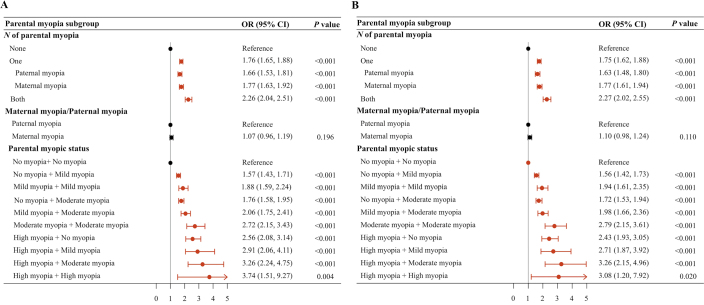
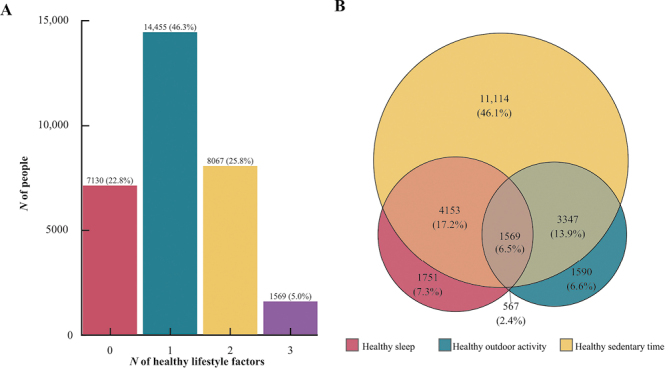
Results: Among 40,864 children and adolescents (50.3% boys and 49.7% girls), 22,537 (55.2%) were diagnosed with myopia. In comparison to offspring devoid of parental myopia, children with one parent affected by myopia exhibited odds ratio (OR) of 1.75 (95% confidence interval [CI]: 1.62-1.88) for myopia, while those with both parents affected showed OR of 2.27 (95% CI: 2.02-2.55) after adjusted for lifestyle factors. The likelihood of myopia in offspring increased with increasing severity of parental myopia, with a 3.08-fold increase in risk observed when both parents presented high myopia. Nonetheless, children adhering to two or more healthy lifestyle factors demonstrated a diminished risk of myopia compared with those with fewer than two lifestyle factors, especially among offspring of non-myopic or mildly myopic parents.
Conclusions: Parental myopia has a dose-dependent association with their offspring. Healthy lifestyles may reduce the impact of parental factors on myopia in offspring. The observed associations suggest that although the genetic burden of parental myopia cannot be ignored, healthy lifestyles and nurturing are also very important.
期刊介绍:
The Chinese Medical Journal (CMJ) is published semimonthly in English by the Chinese Medical Association, and is a peer reviewed general medical journal for all doctors, researchers, and health workers regardless of their medical specialty or type of employment. Established in 1887, it is the oldest medical periodical in China and is distributed worldwide. The journal functions as a window into China’s medical sciences and reflects the advances and progress in China’s medical sciences and technology. It serves the objective of international academic exchange. The journal includes Original Articles, Editorial, Review Articles, Medical Progress, Brief Reports, Case Reports, Viewpoint, Clinical Exchange, Letter,and News,etc. CMJ is abstracted or indexed in many databases including Biological Abstracts, Chemical Abstracts, Index Medicus/Medline, Science Citation Index (SCI), Current Contents, Cancerlit, Health Plan & Administration, Embase, Social Scisearch, Aidsline, Toxline, Biocommercial Abstracts, Arts and Humanities Search, Nuclear Science Abstracts, Water Resources Abstracts, Cab Abstracts, Occupation Safety & Health, etc. In 2007, the impact factor of the journal by SCI is 0.636, and the total citation is 2315.




 京公网安备 11010802042870号
京ICP备2023020795号-1
京公网安备 11010802042870号
京ICP备2023020795号-1

 分享
分享
 求助内容:
求助内容: 应助结果提醒方式:
 扫码关注我们
