Siyu Wang, Tao Yang, Tiantian Li, Lei Shi, Ruonan Xu, Chao Zhang, Zerui Wang, Ziying Zhang, Ming Shi, Zhe Xu, Fu-Sheng Wang
{"title":"Safety and efficacy of human umbilical cord-derived mesenchymal stem cells in COVID-19 patients: A real-world observation.","authors":"Siyu Wang, Tao Yang, Tiantian Li, Lei Shi, Ruonan Xu, Chao Zhang, Zerui Wang, Ziying Zhang, Ming Shi, Zhe Xu, Fu-Sheng Wang","doi":"10.1097/CM9.0000000000003459","DOIUrl":null,"url":null,"abstract":"<p><strong>Background: </strong>The effects of human umbilical cord-derived mesenchymal stem cell (UC-MSC) treatment on coronavirus disease 2019 (COVID-19) patients have been preliminarily characterized. However, real-world data on the safety and efficacy of intravenous transfusions of MSCs in hospitalized COVID-19 patients at the convalescent stage remain to be reported.</p><p><strong>Methods: </strong>This was a single-arm, multicenter, real-word study in which a contemporaneous external control was included as the control group. Besides, severe and critical COVID-19 patients were considered together as the severe group, given the small number of critical patients. For a total of 110 patients, 21 moderate patients and 31 severe patients were enrolled in the MSC treatment group, while 26 moderate patients and 32 severe patients were enrolled in the control group. All patients received standard treatment. The MSC treatment patients additionally received intravenous infusions of MSCs at a dose of 4 × 10 7 cells on days 0, 3, and 6, respectively. The clinical outcomes, including adverse events (AEs), lung lesion proportion on chest computed tomography, pulmonary function, 6-min walking distance (6-MWD), clinical symptoms, and laboratory parameters, were measured on days 28, 90, 180, 270, and 360 during the follow-up visits.</p><p><strong>Results: </strong>In patients with moderate COVID-19, MSC treatment improved pulmonary function parameters, including forced expiratory volume in the first second (FEV1) and maximum forced vital capacity (VCmax) on days 28 (FEV1, 2.75 [2.35, 3.23] vs . 2.11 [1.96, 2.35], P = 0.008; VCmax, 2.92 [2.55, 3.60] vs . 2.47 [2.18, 2.68], P = 0.041), 90 (FEV1, 2.93 [2.63, 3.27] vs . 2.38 [2.24, 2.63], P = 0.017; VCmax, 3.52 [3.02, 3.80] vs . 2.59 [2.45, 3.15], P = 0.017), and 360 (FEV1, 2.91 [2.75, 3.18] vs . 2.30 [2.16, 2.70], P = 0.019; VCmax,3.61 [3.35, 3.97] vs . 2.69 [2.56, 3.23], P = 0.036) compared with the controls. In addition, in severe patients, MSC treatment notably reduced the proportion of ground-glass lesions in the whole lung volume on day 90 ( P = 0.045) compared with the controls. No difference in the incidence of AEs was observed between the two groups. Similarly, no significant differences were found in the 6-MWD, D-dimer levels, or interleukin-6 concentrations between the MSC and control groups.</p><p><strong>Conclusions: </strong>Our results demonstrate the safety and potential of MSC treatment for improved lung lesions and pulmonary function in convalescent COVID-19 patients. However, comprehensive and long-term studies are required to confirm the efficacy of MSC treatment.</p><p><strong>Trial registration: </strong>Chinese Clinical Trial Registry, ChiCTR2000031430.</p>","PeriodicalId":10183,"journal":{"name":"Chinese Medical Journal","volume":" ","pages":"2984-2992"},"PeriodicalIF":7.3000,"publicationDate":"2025-11-20","publicationTypes":"Journal Article","fieldsOfStudy":null,"isOpenAccess":false,"openAccessPdf":"https://www.ncbi.nlm.nih.gov/pmc/articles/PMC12634258/pdf/","citationCount":"0","resultStr":null,"platform":"Semanticscholar","paperid":null,"PeriodicalName":"Chinese Medical Journal","FirstCategoryId":"3","ListUrlMain":"https://doi.org/10.1097/CM9.0000000000003459","RegionNum":3,"RegionCategory":"医学","ArticlePicture":[],"TitleCN":null,"AbstractTextCN":null,"PMCID":null,"EPubDate":"2025/3/7 0:00:00","PubModel":"Epub","JCR":"Q1","JCRName":"MEDICINE, GENERAL & INTERNAL","Score":null,"Total":0}
引用次数: 0
Abstract
Background: The effects of human umbilical cord-derived mesenchymal stem cell (UC-MSC) treatment on coronavirus disease 2019 (COVID-19) patients have been preliminarily characterized. However, real-world data on the safety and efficacy of intravenous transfusions of MSCs in hospitalized COVID-19 patients at the convalescent stage remain to be reported.
Methods: This was a single-arm, multicenter, real-word study in which a contemporaneous external control was included as the control group. Besides, severe and critical COVID-19 patients were considered together as the severe group, given the small number of critical patients. For a total of 110 patients, 21 moderate patients and 31 severe patients were enrolled in the MSC treatment group, while 26 moderate patients and 32 severe patients were enrolled in the control group. All patients received standard treatment. The MSC treatment patients additionally received intravenous infusions of MSCs at a dose of 4 × 10 7 cells on days 0, 3, and 6, respectively. The clinical outcomes, including adverse events (AEs), lung lesion proportion on chest computed tomography, pulmonary function, 6-min walking distance (6-MWD), clinical symptoms, and laboratory parameters, were measured on days 28, 90, 180, 270, and 360 during the follow-up visits.
Results: In patients with moderate COVID-19, MSC treatment improved pulmonary function parameters, including forced expiratory volume in the first second (FEV1) and maximum forced vital capacity (VCmax) on days 28 (FEV1, 2.75 [2.35, 3.23] vs . 2.11 [1.96, 2.35], P = 0.008; VCmax, 2.92 [2.55, 3.60] vs . 2.47 [2.18, 2.68], P = 0.041), 90 (FEV1, 2.93 [2.63, 3.27] vs . 2.38 [2.24, 2.63], P = 0.017; VCmax, 3.52 [3.02, 3.80] vs . 2.59 [2.45, 3.15], P = 0.017), and 360 (FEV1, 2.91 [2.75, 3.18] vs . 2.30 [2.16, 2.70], P = 0.019; VCmax,3.61 [3.35, 3.97] vs . 2.69 [2.56, 3.23], P = 0.036) compared with the controls. In addition, in severe patients, MSC treatment notably reduced the proportion of ground-glass lesions in the whole lung volume on day 90 ( P = 0.045) compared with the controls. No difference in the incidence of AEs was observed between the two groups. Similarly, no significant differences were found in the 6-MWD, D-dimer levels, or interleukin-6 concentrations between the MSC and control groups.
Conclusions: Our results demonstrate the safety and potential of MSC treatment for improved lung lesions and pulmonary function in convalescent COVID-19 patients. However, comprehensive and long-term studies are required to confirm the efficacy of MSC treatment.
Trial registration: Chinese Clinical Trial Registry, ChiCTR2000031430.
期刊介绍:
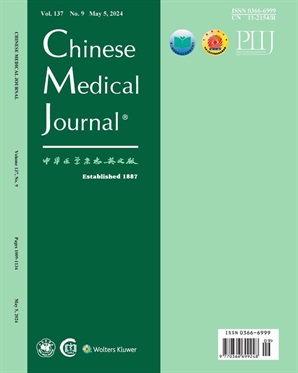
The Chinese Medical Journal (CMJ) is published semimonthly in English by the Chinese Medical Association, and is a peer reviewed general medical journal for all doctors, researchers, and health workers regardless of their medical specialty or type of employment. Established in 1887, it is the oldest medical periodical in China and is distributed worldwide. The journal functions as a window into China’s medical sciences and reflects the advances and progress in China’s medical sciences and technology. It serves the objective of international academic exchange. The journal includes Original Articles, Editorial, Review Articles, Medical Progress, Brief Reports, Case Reports, Viewpoint, Clinical Exchange, Letter,and News,etc. CMJ is abstracted or indexed in many databases including Biological Abstracts, Chemical Abstracts, Index Medicus/Medline, Science Citation Index (SCI), Current Contents, Cancerlit, Health Plan & Administration, Embase, Social Scisearch, Aidsline, Toxline, Biocommercial Abstracts, Arts and Humanities Search, Nuclear Science Abstracts, Water Resources Abstracts, Cab Abstracts, Occupation Safety & Health, etc. In 2007, the impact factor of the journal by SCI is 0.636, and the total citation is 2315.





 京公网安备 11010802042870号
京ICP备2023020795号-1
京公网安备 11010802042870号
京ICP备2023020795号-1

 分享
分享
 求助内容:
求助内容: 应助结果提醒方式:
 扫码关注我们
