Zhenjiang Zhao, Mei Yu, Chao Han, Zhong Yang, Peng Teng, Jinyan Zhong, Songmei Li, Jianhua Liu
{"title":"Effect of HAGBs for ultra-high strength stainless steel on pitting /microcrack initiation with synergy between strain and corrosion environment","authors":"Zhenjiang Zhao, Mei Yu, Chao Han, Zhong Yang, Peng Teng, Jinyan Zhong, Songmei Li, Jianhua Liu","doi":"10.1016/j.jmst.2024.12.077","DOIUrl":null,"url":null,"abstract":"In this work, the effect of high angle grain boundaries (HAGBs), including prior austenite grain boundaries (PAGB), packet grain boundaries (PGB) and block grain boundaries (BGB), on the priority of pitting and microcrack initiation for 10Cr13Co13Mo5Ni3W1VE ultra-high strength stainless steel (UHSS) has been clarified. PAGB had the highest carbide distribution coefficient and was the main location where pitting preferentially initiated for the UHSS in 3.5 wt.% NaCl solution without strain. It was shown that nano-carbides were the key factor of pitting initiation for the UHSS without strain. However, BGB was the key factor of pitting/microcrack initiation for the UHSS with strain, which was attributed to the high-density dislocations accumulated at BGB and then enhanced the local electrochemical activity of the UHSS surface. The change of the key factor for the pitting initiation in the UHSS was the result of the synergy between strain and corrosion environment. This study provides guidance for designing advanced UHSS with high service stability and safety.","PeriodicalId":16154,"journal":{"name":"Journal of Materials Science & Technology","volume":"11 1","pages":""},"PeriodicalIF":14.3000,"publicationDate":"2025-03-07","publicationTypes":"Journal Article","fieldsOfStudy":null,"isOpenAccess":false,"openAccessPdf":"","citationCount":"0","resultStr":null,"platform":"Semanticscholar","paperid":null,"PeriodicalName":"Journal of Materials Science & Technology","FirstCategoryId":"88","ListUrlMain":"https://doi.org/10.1016/j.jmst.2024.12.077","RegionNum":1,"RegionCategory":"材料科学","ArticlePicture":[],"TitleCN":null,"AbstractTextCN":null,"PMCID":null,"EPubDate":"","PubModel":"","JCR":"Q1","JCRName":"MATERIALS SCIENCE, MULTIDISCIPLINARY","Score":null,"Total":0}
引用次数: 0
Abstract
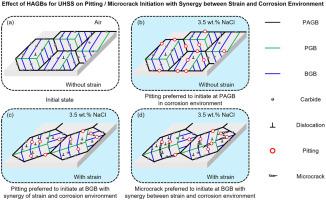
In this work, the effect of high angle grain boundaries (HAGBs), including prior austenite grain boundaries (PAGB), packet grain boundaries (PGB) and block grain boundaries (BGB), on the priority of pitting and microcrack initiation for 10Cr13Co13Mo5Ni3W1VE ultra-high strength stainless steel (UHSS) has been clarified. PAGB had the highest carbide distribution coefficient and was the main location where pitting preferentially initiated for the UHSS in 3.5 wt.% NaCl solution without strain. It was shown that nano-carbides were the key factor of pitting initiation for the UHSS without strain. However, BGB was the key factor of pitting/microcrack initiation for the UHSS with strain, which was attributed to the high-density dislocations accumulated at BGB and then enhanced the local electrochemical activity of the UHSS surface. The change of the key factor for the pitting initiation in the UHSS was the result of the synergy between strain and corrosion environment. This study provides guidance for designing advanced UHSS with high service stability and safety.
期刊介绍:
Journal of Materials Science & Technology strives to promote global collaboration in the field of materials science and technology. It primarily publishes original research papers, invited review articles, letters, research notes, and summaries of scientific achievements. The journal covers a wide range of materials science and technology topics, including metallic materials, inorganic nonmetallic materials, and composite materials.




 京公网安备 11010802042870号
京ICP备2023020795号-1
京公网安备 11010802042870号
京ICP备2023020795号-1

 分享
分享
 求助内容:
求助内容: 应助结果提醒方式:
 扫码关注我们
