Zitong Wang, Juanying Ou, Junze Liang, Yuan Song, Caihuan Huang, Fu Liu, Shiyi Ou, Jie Zheng
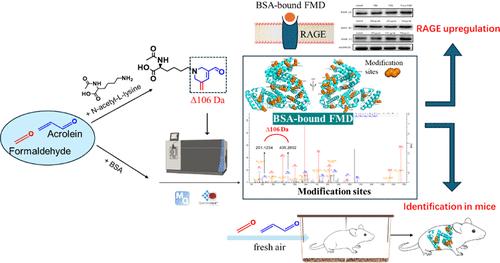
{"title":"Co-Exposure to Formaldehyde and Acrolein Generates a New Protein Adduct Activating RAGE","authors":"Zitong Wang, Juanying Ou, Junze Liang, Yuan Song, Caihuan Huang, Fu Liu, Shiyi Ou, Jie Zheng","doi":"10.1021/acs.jafc.4c12811","DOIUrl":null,"url":null,"abstract":"Reactive carbonyl species (RCS), sourced exogenously and endogenously, can modify proteins to generate advanced glycation end products (AGEs), which can lead to cell damage and various diseases. To date, it has not been reported that two or more RCSs can modify a single amino acid residue in proteins. The aim of the present study is to investigate whether and how formaldehyde and acrolein simultaneously modify lysine residues in proteins and whether the resulting adducts are capable of binding to the AGE receptor (RAGE). We found that the two aldehydes can comodify lysine residues in bovine serum albumin (BSA), generating a novel adduct, 5-formyl-3-methylene-2,6-dihydropyridin-lysine (FMD-lysine). In a protein band obtained from SDS−PAGE, the modified sites account for 55% of the 60 lysine residues in BSA when the molar ratio of BSA: formaldehyde: acrolein was 1:10:10. This new adduct was identified by mass spectrometry in proteins from various organs in mice after inhalation exposure to the two aldehydes. A total of 231 FMD modification sites were detected across the heart (35), liver (29), lung (33), kidney (34), hippocampus (38), brain tissues (32), plasma (8), and aorta (22). Moreover, N-acetyl-<span>l</span>-lysine-FMD (N-lys-FMD) stimulated more RAGE expression in RAW264.7 cells than the two common endogenous AGEs, N<sup>ε</sup>-carboxymethyl lysine and N<sup>ε</sup>-carboxyethyl lysine. Additionally, BSA-bound FMD induced a higher RAGE expression than N-lys-FMD. The activation of RAGE by FMD-lysine may trigger an inflammatory response <i>in vivo</i>. Thus, protein-bound FMD-lysine may serve as a promising target for monitoring both endogenous and exogenous exposure to formaldehyde and acrolein.","PeriodicalId":41,"journal":{"name":"Journal of Agricultural and Food Chemistry","volume":"212 1","pages":""},"PeriodicalIF":6.2000,"publicationDate":"2025-03-07","publicationTypes":"Journal Article","fieldsOfStudy":null,"isOpenAccess":false,"openAccessPdf":"","citationCount":"0","resultStr":null,"platform":"Semanticscholar","paperid":null,"PeriodicalName":"Journal of Agricultural and Food Chemistry","FirstCategoryId":"97","ListUrlMain":"https://doi.org/10.1021/acs.jafc.4c12811","RegionNum":1,"RegionCategory":"农林科学","ArticlePicture":[],"TitleCN":null,"AbstractTextCN":null,"PMCID":null,"EPubDate":"","PubModel":"","JCR":"Q1","JCRName":"AGRICULTURE, MULTIDISCIPLINARY","Score":null,"Total":0}
引用次数: 0
Abstract
Reactive carbonyl species (RCS), sourced exogenously and endogenously, can modify proteins to generate advanced glycation end products (AGEs), which can lead to cell damage and various diseases. To date, it has not been reported that two or more RCSs can modify a single amino acid residue in proteins. The aim of the present study is to investigate whether and how formaldehyde and acrolein simultaneously modify lysine residues in proteins and whether the resulting adducts are capable of binding to the AGE receptor (RAGE). We found that the two aldehydes can comodify lysine residues in bovine serum albumin (BSA), generating a novel adduct, 5-formyl-3-methylene-2,6-dihydropyridin-lysine (FMD-lysine). In a protein band obtained from SDS−PAGE, the modified sites account for 55% of the 60 lysine residues in BSA when the molar ratio of BSA: formaldehyde: acrolein was 1:10:10. This new adduct was identified by mass spectrometry in proteins from various organs in mice after inhalation exposure to the two aldehydes. A total of 231 FMD modification sites were detected across the heart (35), liver (29), lung (33), kidney (34), hippocampus (38), brain tissues (32), plasma (8), and aorta (22). Moreover, N-acetyl-l-lysine-FMD (N-lys-FMD) stimulated more RAGE expression in RAW264.7 cells than the two common endogenous AGEs, Nε-carboxymethyl lysine and Nε-carboxyethyl lysine. Additionally, BSA-bound FMD induced a higher RAGE expression than N-lys-FMD. The activation of RAGE by FMD-lysine may trigger an inflammatory response in vivo. Thus, protein-bound FMD-lysine may serve as a promising target for monitoring both endogenous and exogenous exposure to formaldehyde and acrolein.
期刊介绍:
The Journal of Agricultural and Food Chemistry publishes high-quality, cutting edge original research representing complete studies and research advances dealing with the chemistry and biochemistry of agriculture and food. The Journal also encourages papers with chemistry and/or biochemistry as a major component combined with biological/sensory/nutritional/toxicological evaluation related to agriculture and/or food.



 京公网安备 11010802042870号
京ICP备2023020795号-1
京公网安备 11010802042870号
京ICP备2023020795号-1

 分享
分享
 求助内容:
求助内容: 应助结果提醒方式:
 扫码关注我们
