Francesc Corbera-Rubio , Alje S. Boersma , Weren de Vet , Martin Pabst , Paul W.J.J. van der Wielen , Maartje A.H.J. van Kessel , Mark C.M. van Loosdrecht , Doris van Halem , Sebastian Lücker , Michele Laureni
{"title":"Biological methane removal by groundwater trickling biofiltration for emissions reduction","authors":"Francesc Corbera-Rubio , Alje S. Boersma , Weren de Vet , Martin Pabst , Paul W.J.J. van der Wielen , Maartje A.H.J. van Kessel , Mark C.M. van Loosdrecht , Doris van Halem , Sebastian Lücker , Michele Laureni","doi":"10.1016/j.watres.2025.123450","DOIUrl":null,"url":null,"abstract":"<div><div>Methane removal is an essential step in drinking water production from methane-rich groundwaters. Conventional aeration-based stripping results in significant direct methane emissions, contributing up to one-third of a treatment plant's total carbon footprint. To address this, a full-scale trickling filter was operated for biological methane oxidation upstream of a submerged sand filter, and its performance was compared to a conventional aeration–submerged sand filtration set-up. Full-scale data were combined with <em>ex-situ</em> batch assays and metagenome-resolved metaproteomics to quantify the individual contribution of the main (a)biotic processes and characterize the enriched microbial communities. Both treatment setups fully removed methane, iron, ammonium, and manganese, yet the underlying mechanisms differed significantly. Methane was completely removed from the effluent after trickling filtration, with stripping and biological oxidation each accounting for half of the removal, thereby halving overall methane emissions. Methane-oxidizing bacteria not only outcompeted nitrifiers in the trickling filter, but also likely contributed directly to ammonia oxidation. In contrast to the submerged filter preceded by methane stripping, signatures of biological iron oxidation were almost completely absent in the trickling filter, suggesting that the presence of methane directly or indirectly promotes chemical iron oxidation. All systems had similar <em>ex-situ</em> manganese oxidation capacities, yet removal occurred only in the submerged filters but not the trickling filter. Ultimately, our results demonstrate that trickling filtration is effective in promoting biological methane oxidation at comparable produced drinking water quality, highlighting its potential for advancing sustainable drinking water production.</div></div>","PeriodicalId":443,"journal":{"name":"Water Research","volume":"279 ","pages":"Article 123450"},"PeriodicalIF":12.4000,"publicationDate":"2025-03-06","publicationTypes":"Journal Article","fieldsOfStudy":null,"isOpenAccess":false,"openAccessPdf":"","citationCount":"0","resultStr":null,"platform":"Semanticscholar","paperid":null,"PeriodicalName":"Water Research","FirstCategoryId":"93","ListUrlMain":"https://www.sciencedirect.com/science/article/pii/S004313542500363X","RegionNum":1,"RegionCategory":"环境科学与生态学","ArticlePicture":[],"TitleCN":null,"AbstractTextCN":null,"PMCID":null,"EPubDate":"","PubModel":"","JCR":"Q1","JCRName":"ENGINEERING, ENVIRONMENTAL","Score":null,"Total":0}
引用次数: 0
Abstract
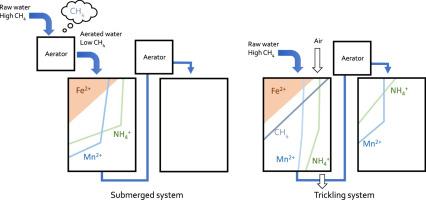
Methane removal is an essential step in drinking water production from methane-rich groundwaters. Conventional aeration-based stripping results in significant direct methane emissions, contributing up to one-third of a treatment plant's total carbon footprint. To address this, a full-scale trickling filter was operated for biological methane oxidation upstream of a submerged sand filter, and its performance was compared to a conventional aeration–submerged sand filtration set-up. Full-scale data were combined with ex-situ batch assays and metagenome-resolved metaproteomics to quantify the individual contribution of the main (a)biotic processes and characterize the enriched microbial communities. Both treatment setups fully removed methane, iron, ammonium, and manganese, yet the underlying mechanisms differed significantly. Methane was completely removed from the effluent after trickling filtration, with stripping and biological oxidation each accounting for half of the removal, thereby halving overall methane emissions. Methane-oxidizing bacteria not only outcompeted nitrifiers in the trickling filter, but also likely contributed directly to ammonia oxidation. In contrast to the submerged filter preceded by methane stripping, signatures of biological iron oxidation were almost completely absent in the trickling filter, suggesting that the presence of methane directly or indirectly promotes chemical iron oxidation. All systems had similar ex-situ manganese oxidation capacities, yet removal occurred only in the submerged filters but not the trickling filter. Ultimately, our results demonstrate that trickling filtration is effective in promoting biological methane oxidation at comparable produced drinking water quality, highlighting its potential for advancing sustainable drinking water production.
期刊介绍:
Water Research, along with its open access companion journal Water Research X, serves as a platform for publishing original research papers covering various aspects of the science and technology related to the anthropogenic water cycle, water quality, and its management worldwide. The audience targeted by the journal comprises biologists, chemical engineers, chemists, civil engineers, environmental engineers, limnologists, and microbiologists. The scope of the journal include:
•Treatment processes for water and wastewaters (municipal, agricultural, industrial, and on-site treatment), including resource recovery and residuals management;
•Urban hydrology including sewer systems, stormwater management, and green infrastructure;
•Drinking water treatment and distribution;
•Potable and non-potable water reuse;
•Sanitation, public health, and risk assessment;
•Anaerobic digestion, solid and hazardous waste management, including source characterization and the effects and control of leachates and gaseous emissions;
•Contaminants (chemical, microbial, anthropogenic particles such as nanoparticles or microplastics) and related water quality sensing, monitoring, fate, and assessment;
•Anthropogenic impacts on inland, tidal, coastal and urban waters, focusing on surface and ground waters, and point and non-point sources of pollution;
•Environmental restoration, linked to surface water, groundwater and groundwater remediation;
•Analysis of the interfaces between sediments and water, and between water and atmosphere, focusing specifically on anthropogenic impacts;
•Mathematical modelling, systems analysis, machine learning, and beneficial use of big data related to the anthropogenic water cycle;
•Socio-economic, policy, and regulations studies.




 京公网安备 11010802042870号
京ICP备2023020795号-1
京公网安备 11010802042870号
京ICP备2023020795号-1

 分享
分享
 求助内容:
求助内容: 应助结果提醒方式:
 扫码关注我们
