Xiaoya Ma, Chi Zhang, Lingxiao Yang, S. Blair Hedges, Bojian Zhong
{"title":"New insights on angiosperm crown age based on Bayesian node dating and skyline fossilized birth-death approaches","authors":"Xiaoya Ma, Chi Zhang, Lingxiao Yang, S. Blair Hedges, Bojian Zhong","doi":"10.1038/s41467-025-57687-9","DOIUrl":null,"url":null,"abstract":"<p>Despite considerable work in recent years, pinpointing the time when angiosperms originated has been challenging. However, the rapid development of molecular clock methodology has provided new tools to resolve this conundrum. In particular, the fossilized birth-death model establishes a rich interplay between molecules and stratigraphy by incorporating fossils explicitly into dating analyses. In this study, we apply Bayesian node dating and the skyline fossilized birth-death model, which differ in how the calibration is applied, to estimate the crown age of angiosperms. Node dating analyses with different calibration strategies show that the posterior distribution is strongly constrained by the effective prior at the node of crown angiosperms, dominated by the maximum age constraint. Using the skyline fossilized birth-death model, we reveal that assigning different priors for origin time resulted in similar crown ages for angiosperms. Moreover, the oldest fossils play a significant role in time estimates, and the dating results are robust to sampling assumptions of extant taxa. Our dating analyses indicate a largely Triassic crown age (255–202 Ma) for angiosperms, the period when mammals, dinosaurs, and squamate reptiles first appeared, and highlight the potential of morphological data to redefine the timeline of angiosperms.</p>","PeriodicalId":19066,"journal":{"name":"Nature Communications","volume":"33 1","pages":""},"PeriodicalIF":15.7000,"publicationDate":"2025-03-07","publicationTypes":"Journal Article","fieldsOfStudy":null,"isOpenAccess":false,"openAccessPdf":"","citationCount":"0","resultStr":null,"platform":"Semanticscholar","paperid":null,"PeriodicalName":"Nature Communications","FirstCategoryId":"103","ListUrlMain":"https://doi.org/10.1038/s41467-025-57687-9","RegionNum":1,"RegionCategory":"综合性期刊","ArticlePicture":[],"TitleCN":null,"AbstractTextCN":null,"PMCID":null,"EPubDate":"","PubModel":"","JCR":"Q1","JCRName":"MULTIDISCIPLINARY SCIENCES","Score":null,"Total":0}
引用次数: 0
Abstract
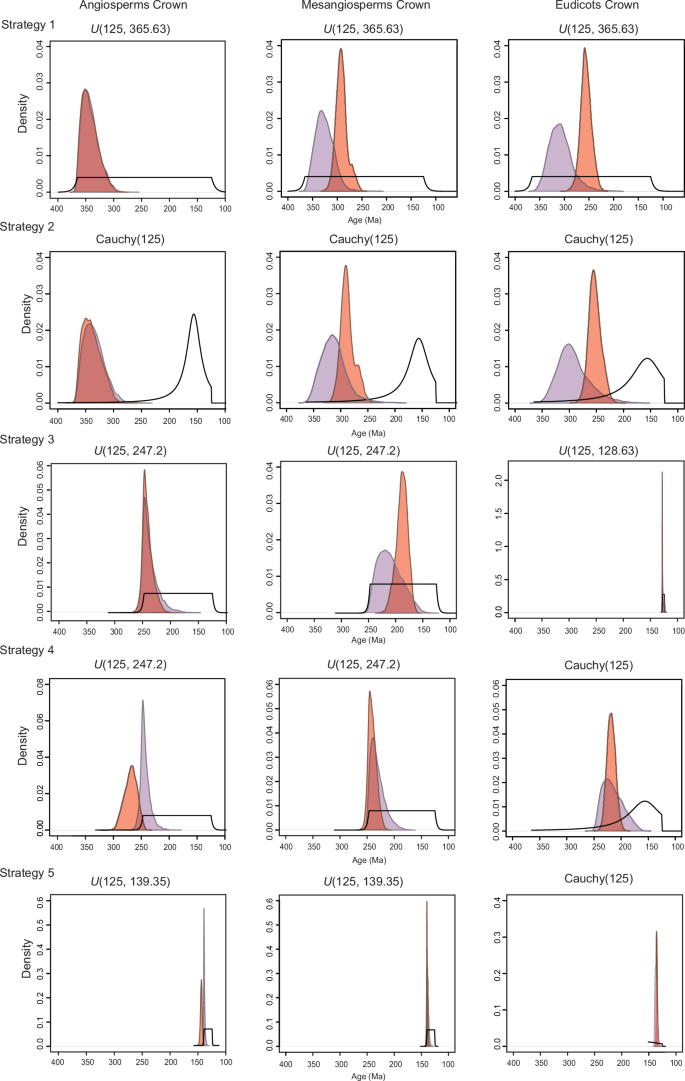
Despite considerable work in recent years, pinpointing the time when angiosperms originated has been challenging. However, the rapid development of molecular clock methodology has provided new tools to resolve this conundrum. In particular, the fossilized birth-death model establishes a rich interplay between molecules and stratigraphy by incorporating fossils explicitly into dating analyses. In this study, we apply Bayesian node dating and the skyline fossilized birth-death model, which differ in how the calibration is applied, to estimate the crown age of angiosperms. Node dating analyses with different calibration strategies show that the posterior distribution is strongly constrained by the effective prior at the node of crown angiosperms, dominated by the maximum age constraint. Using the skyline fossilized birth-death model, we reveal that assigning different priors for origin time resulted in similar crown ages for angiosperms. Moreover, the oldest fossils play a significant role in time estimates, and the dating results are robust to sampling assumptions of extant taxa. Our dating analyses indicate a largely Triassic crown age (255–202 Ma) for angiosperms, the period when mammals, dinosaurs, and squamate reptiles first appeared, and highlight the potential of morphological data to redefine the timeline of angiosperms.
期刊介绍:
Nature Communications, an open-access journal, publishes high-quality research spanning all areas of the natural sciences. Papers featured in the journal showcase significant advances relevant to specialists in each respective field. With a 2-year impact factor of 16.6 (2022) and a median time of 8 days from submission to the first editorial decision, Nature Communications is committed to rapid dissemination of research findings. As a multidisciplinary journal, it welcomes contributions from biological, health, physical, chemical, Earth, social, mathematical, applied, and engineering sciences, aiming to highlight important breakthroughs within each domain.



 京公网安备 11010802042870号
京ICP备2023020795号-1
京公网安备 11010802042870号
京ICP备2023020795号-1

 分享
分享
 求助内容:
求助内容: 应助结果提醒方式:
 扫码关注我们
