Wenjia Tan , Xinru Li , Jiajing Zhu , Yihan Zhao , Wenzhao Wang , Feng Li
{"title":"Triphenylmethyl-based carbon biradical nanoparticles for magnetic resonance imaging","authors":"Wenjia Tan , Xinru Li , Jiajing Zhu , Yihan Zhao , Wenzhao Wang , Feng Li","doi":"10.1016/j.aca.2025.343897","DOIUrl":null,"url":null,"abstract":"<div><div>In recent years, luminescent carbon radicals have emerged as a promising functionalized material, with a primary focus on harnessing the potential of mono-radicals. The greater spin density exhibited by a single molecule in biradicals undoubtedly provides greater research value for its magnetic properties. Conventional metallic contrast agents represent the predominant choice in magnetic resonance imaging (MRI) of clinical applications. However, the accumulation of metal ions within the body poses potential safety risks. Hence, the exploration of innovative metal-free organic magnetic nanomaterials offers a safer alternative. This work introduces an innovative approach, presenting the first metal-free carbon-radical-based MRI contrast agent by encapsulating luminescent triphenylmethyl biradicals into nanoparticles (TTM-PhTTM NPs). These biradical NPs exhibit high water solubility, low cytotoxicity, and stability in highly reductive environments. Notably, TTM-PhTTM NPs maintained a strong electron paramagnetic resonance (EPR) signal even after exposure to ascorbic acid for 24 h, and cell viability remained above 80 % even at concentrations up to 1400 μg/mL. Moreover, TTM-PhTTM NPs demonstrated a T<sub>1</sub> longitudinal relaxation rate of 0.35 mM<sup>−1</sup>s<sup>−1</sup>, one of the highest recorded for metal-free organic magnetic nanomaterials. Following a 6-h incubation period, significant enhancements in imaging contrast were observed, with T<sub>1</sub> signal intensities increasing as the concentration of TTM-PhTTM NPs increased. This study paves the way for the utilization of stable, biocompatible carbon-based radicals as MRI contrast agents, underscoring their potential for safe and effective biomedical imaging applications and providing a solid foundation for further development of carbon radical-based imaging technologies.</div></div>","PeriodicalId":240,"journal":{"name":"Analytica Chimica Acta","volume":"1352 ","pages":"Article 343897"},"PeriodicalIF":6.0000,"publicationDate":"2025-03-07","publicationTypes":"Journal Article","fieldsOfStudy":null,"isOpenAccess":false,"openAccessPdf":"","citationCount":"0","resultStr":null,"platform":"Semanticscholar","paperid":null,"PeriodicalName":"Analytica Chimica Acta","FirstCategoryId":"92","ListUrlMain":"https://www.sciencedirect.com/science/article/pii/S0003267025002910","RegionNum":2,"RegionCategory":"化学","ArticlePicture":[],"TitleCN":null,"AbstractTextCN":null,"PMCID":null,"EPubDate":"","PubModel":"","JCR":"Q1","JCRName":"CHEMISTRY, ANALYTICAL","Score":null,"Total":0}
引用次数: 0
Abstract
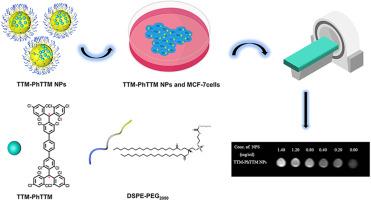
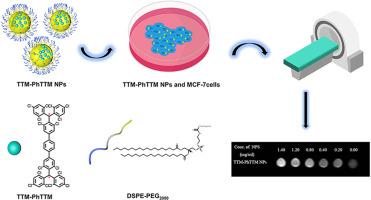
In recent years, luminescent carbon radicals have emerged as a promising functionalized material, with a primary focus on harnessing the potential of mono-radicals. The greater spin density exhibited by a single molecule in biradicals undoubtedly provides greater research value for its magnetic properties. Conventional metallic contrast agents represent the predominant choice in magnetic resonance imaging (MRI) of clinical applications. However, the accumulation of metal ions within the body poses potential safety risks. Hence, the exploration of innovative metal-free organic magnetic nanomaterials offers a safer alternative. This work introduces an innovative approach, presenting the first metal-free carbon-radical-based MRI contrast agent by encapsulating luminescent triphenylmethyl biradicals into nanoparticles (TTM-PhTTM NPs). These biradical NPs exhibit high water solubility, low cytotoxicity, and stability in highly reductive environments. Notably, TTM-PhTTM NPs maintained a strong electron paramagnetic resonance (EPR) signal even after exposure to ascorbic acid for 24 h, and cell viability remained above 80 % even at concentrations up to 1400 μg/mL. Moreover, TTM-PhTTM NPs demonstrated a T1 longitudinal relaxation rate of 0.35 mM−1s−1, one of the highest recorded for metal-free organic magnetic nanomaterials. Following a 6-h incubation period, significant enhancements in imaging contrast were observed, with T1 signal intensities increasing as the concentration of TTM-PhTTM NPs increased. This study paves the way for the utilization of stable, biocompatible carbon-based radicals as MRI contrast agents, underscoring their potential for safe and effective biomedical imaging applications and providing a solid foundation for further development of carbon radical-based imaging technologies.
期刊介绍:
Analytica Chimica Acta has an open access mirror journal Analytica Chimica Acta: X, sharing the same aims and scope, editorial team, submission system and rigorous peer review.
Analytica Chimica Acta provides a forum for the rapid publication of original research, and critical, comprehensive reviews dealing with all aspects of fundamental and applied modern analytical chemistry. The journal welcomes the submission of research papers which report studies concerning the development of new and significant analytical methodologies. In determining the suitability of submitted articles for publication, particular scrutiny will be placed on the degree of novelty and impact of the research and the extent to which it adds to the existing body of knowledge in analytical chemistry.



 京公网安备 11010802042870号
京ICP备2023020795号-1
京公网安备 11010802042870号
京ICP备2023020795号-1

 分享
分享
 求助内容:
求助内容: 应助结果提醒方式:
 扫码关注我们
