High Return to Competition Rate After On-Field Rehabilitation in Competitive Male Soccer Players After ACL Reconstruction: GPS Tracking in 100 Consecutive Cases.
Filippo Picinini, Francesco Della Villa, Jamie Tallent, Stephen David Patterson, Lorenzo Galassi, Matteo Parigino, Giovanni La Rosa, Gianni Nanni, Jesus Olmo, Matthew Stride, Fabrizio Aggio, Matthew Buckthorpe
{"title":"High Return to Competition Rate After On-Field Rehabilitation in Competitive Male Soccer Players After ACL Reconstruction: GPS Tracking in 100 Consecutive Cases.","authors":"Filippo Picinini, Francesco Della Villa, Jamie Tallent, Stephen David Patterson, Lorenzo Galassi, Matteo Parigino, Giovanni La Rosa, Gianni Nanni, Jesus Olmo, Matthew Stride, Fabrizio Aggio, Matthew Buckthorpe","doi":"10.1177/23259671251320093","DOIUrl":null,"url":null,"abstract":"<p><strong>Background: </strong>Despite published guidelines describing on-field rehabilitation (OFR) frameworks for soccer, available evidence for practitioners who work with players with anterior cruciate ligament reconstruction (ACLR) is limited.</p><p><strong>Purpose: </strong>To document the activity and workloads completed by a large cohort of amateur and professional soccer players during OFR following ACLR after completing their indoor rehabilitation and to establish their return to competition (RTC) outcomes.</p><p><strong>Study design: </strong>Case series; Level of evidence, 4.</p><p><strong>Methods: </strong>OFR measurements/activities, global positioning system (GPS), and heart rate data were collected from 100 male 11-a-side soccer players with ACLR undergoing a criteria-based rehabilitation process, concluding with a 5-stage OFR program. Consent was obtained directly from the players involved in this study before completing a follow-up questionnaire to document RTC outcomes. Differences between the level of play (professional and amateur) and 5 OFR stages were investigated using separate linear mixed models.</p><p><strong>Results: </strong>A minimum 9-month follow-up was possible for 97 players (97%), with a median time of 2.3 years after ACLR and 84% RTC, with higher rates in professionals (100%) than amateurs (80%). Ten (10%) players sustained an ACL reinjury. Professionals completed more OFR sessions (20.6 ± 7.7 vs 13.2 ± 7.7; <i>P</i> < .001) over a shorter period (44.7 ± 30.3 vs 59.3 ± 28.5 days; <i>P</i> = .044) and achieved higher workloads mostly in the high-intensity GPS metrics in each OFR stage. Typical external workload outputs in the final OFR stage aligned with team training demands for the total distance (TD) (106%), high-intensity distance (HID) (104%), peak speed (PS) (88%), acceleration distance (ACC) (110%), and deceleration distance (DEC) (48%), but they were lower compared with match play demands (TD: 44%; HID: 51%; PS: 82%; ACC: 63%; and DEC: 26%).</p><p><strong>Conclusion: </strong>High RTC rates were reported in those players who participated in OFR after indoor rehabilitation. Completion of all five OFR stages almost prepared them for team training demands; however, workloads remain low compared to match play.</p>","PeriodicalId":19646,"journal":{"name":"Orthopaedic Journal of Sports Medicine","volume":"13 3","pages":"23259671251320093"},"PeriodicalIF":2.5000,"publicationDate":"2025-03-04","publicationTypes":"Journal Article","fieldsOfStudy":null,"isOpenAccess":false,"openAccessPdf":"https://www.ncbi.nlm.nih.gov/pmc/articles/PMC11881939/pdf/","citationCount":"0","resultStr":null,"platform":"Semanticscholar","paperid":null,"PeriodicalName":"Orthopaedic Journal of Sports Medicine","FirstCategoryId":"3","ListUrlMain":"https://doi.org/10.1177/23259671251320093","RegionNum":3,"RegionCategory":"医学","ArticlePicture":[],"TitleCN":null,"AbstractTextCN":null,"PMCID":null,"EPubDate":"2025/3/1 0:00:00","PubModel":"eCollection","JCR":"Q2","JCRName":"ORTHOPEDICS","Score":null,"Total":0}
引用次数: 0
Abstract
Background: Despite published guidelines describing on-field rehabilitation (OFR) frameworks for soccer, available evidence for practitioners who work with players with anterior cruciate ligament reconstruction (ACLR) is limited.
Purpose: To document the activity and workloads completed by a large cohort of amateur and professional soccer players during OFR following ACLR after completing their indoor rehabilitation and to establish their return to competition (RTC) outcomes.
Study design: Case series; Level of evidence, 4.
Methods: OFR measurements/activities, global positioning system (GPS), and heart rate data were collected from 100 male 11-a-side soccer players with ACLR undergoing a criteria-based rehabilitation process, concluding with a 5-stage OFR program. Consent was obtained directly from the players involved in this study before completing a follow-up questionnaire to document RTC outcomes. Differences between the level of play (professional and amateur) and 5 OFR stages were investigated using separate linear mixed models.
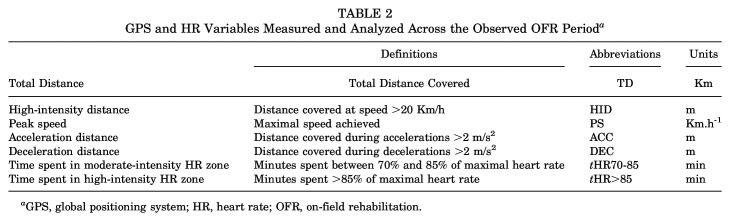
Results: A minimum 9-month follow-up was possible for 97 players (97%), with a median time of 2.3 years after ACLR and 84% RTC, with higher rates in professionals (100%) than amateurs (80%). Ten (10%) players sustained an ACL reinjury. Professionals completed more OFR sessions (20.6 ± 7.7 vs 13.2 ± 7.7; P < .001) over a shorter period (44.7 ± 30.3 vs 59.3 ± 28.5 days; P = .044) and achieved higher workloads mostly in the high-intensity GPS metrics in each OFR stage. Typical external workload outputs in the final OFR stage aligned with team training demands for the total distance (TD) (106%), high-intensity distance (HID) (104%), peak speed (PS) (88%), acceleration distance (ACC) (110%), and deceleration distance (DEC) (48%), but they were lower compared with match play demands (TD: 44%; HID: 51%; PS: 82%; ACC: 63%; and DEC: 26%).
Conclusion: High RTC rates were reported in those players who participated in OFR after indoor rehabilitation. Completion of all five OFR stages almost prepared them for team training demands; however, workloads remain low compared to match play.
期刊介绍:
The Orthopaedic Journal of Sports Medicine (OJSM), developed by the American Orthopaedic Society for Sports Medicine (AOSSM), is a global, peer-reviewed, open access journal that combines the interests of researchers and clinical practitioners across orthopaedic sports medicine, arthroscopy, and knee arthroplasty.
Topics include original research in the areas of:
-Orthopaedic Sports Medicine, including surgical and nonsurgical treatment of orthopaedic sports injuries
-Arthroscopic Surgery (Shoulder/Elbow/Wrist/Hip/Knee/Ankle/Foot)
-Relevant translational research
-Sports traumatology/epidemiology
-Knee and shoulder arthroplasty
The OJSM also publishes relevant systematic reviews and meta-analyses.
This journal is a member of the Committee on Publication Ethics (COPE).





 京公网安备 11010802042870号
京ICP备2023020795号-1
京公网安备 11010802042870号
京ICP备2023020795号-1

 分享
分享
 求助内容:
求助内容: 应助结果提醒方式:
 扫码关注我们
