Joaquin A Anguera, Karin Snowberg, Steven M Paul, Bruce A Cooper, Kate Oppegaard, Carolyn Harris, Christine Miaskowski
{"title":"A pilot study of a targeted cognitive intervention for cancer survivors.","authors":"Joaquin A Anguera, Karin Snowberg, Steven M Paul, Bruce A Cooper, Kate Oppegaard, Carolyn Harris, Christine Miaskowski","doi":"10.1007/s00520-025-09321-z","DOIUrl":null,"url":null,"abstract":"<p><strong>Purpose: </strong>The primary aims of this four week pilot randomized clinical trial (RCT) involving a targeted cognitive intervention (TCI, n = 25) compared to an expectancy matched active control intervention (EMACI, n = 24), in a sample of cancer survivors were to: determine recruitment and retention rates; evaluate preliminary efficacy to improve three objective measures of cognitive function (i.e., attention, working memory, multi-tasking); evaluate adherence rates for and satisfaction with the interventions, and evaluate for treatment-related adverse events (e.g., nausea, motion sickness).</p><p><strong>Methods: </strong>Cancer survivors were recruited from previous studies through email. Following a screening call, survivors who consented to participate were oriented to the study measures and procedures via Zoom. Survivors were randomized to the TCI or EMACI and mailed an iPad with the software for their specific intervention and the Adaptive Cognitive Evaluation Explorer (ACE-X, the objective measure of cognitive function). Survivors used the intervention for 25 min per day at least 5 days per week. Differences in objective measures of attention, working memory, and multi-tasking were evaluated using multilevel regression analyses.</p><p><strong>Results: </strong>For the sustained attention measure, a significant cross-level interaction was found in favor of the TCI group. While improvements in multi-tasking occurred in both groups, while not statistically significant, the trend was larger for the TCI group. Equally important, in both groups, adherence with the intervention was high and adverse effects were minimal.</p><p><strong>Conclusions: </strong>These preliminary findings provide promising evidence of feasibility, acceptability, and efficacy that warrant evaluation in a RCT with a larger sample of cancer survivors.</p>","PeriodicalId":22046,"journal":{"name":"Supportive Care in Cancer","volume":"33 4","pages":"255"},"PeriodicalIF":3.0000,"publicationDate":"2025-03-07","publicationTypes":"Journal Article","fieldsOfStudy":null,"isOpenAccess":false,"openAccessPdf":"https://www.ncbi.nlm.nih.gov/pmc/articles/PMC11889051/pdf/","citationCount":"0","resultStr":null,"platform":"Semanticscholar","paperid":null,"PeriodicalName":"Supportive Care in Cancer","FirstCategoryId":"3","ListUrlMain":"https://doi.org/10.1007/s00520-025-09321-z","RegionNum":3,"RegionCategory":"医学","ArticlePicture":[],"TitleCN":null,"AbstractTextCN":null,"PMCID":null,"EPubDate":"","PubModel":"","JCR":"Q2","JCRName":"HEALTH CARE SCIENCES & SERVICES","Score":null,"Total":0}
引用次数: 0
Abstract
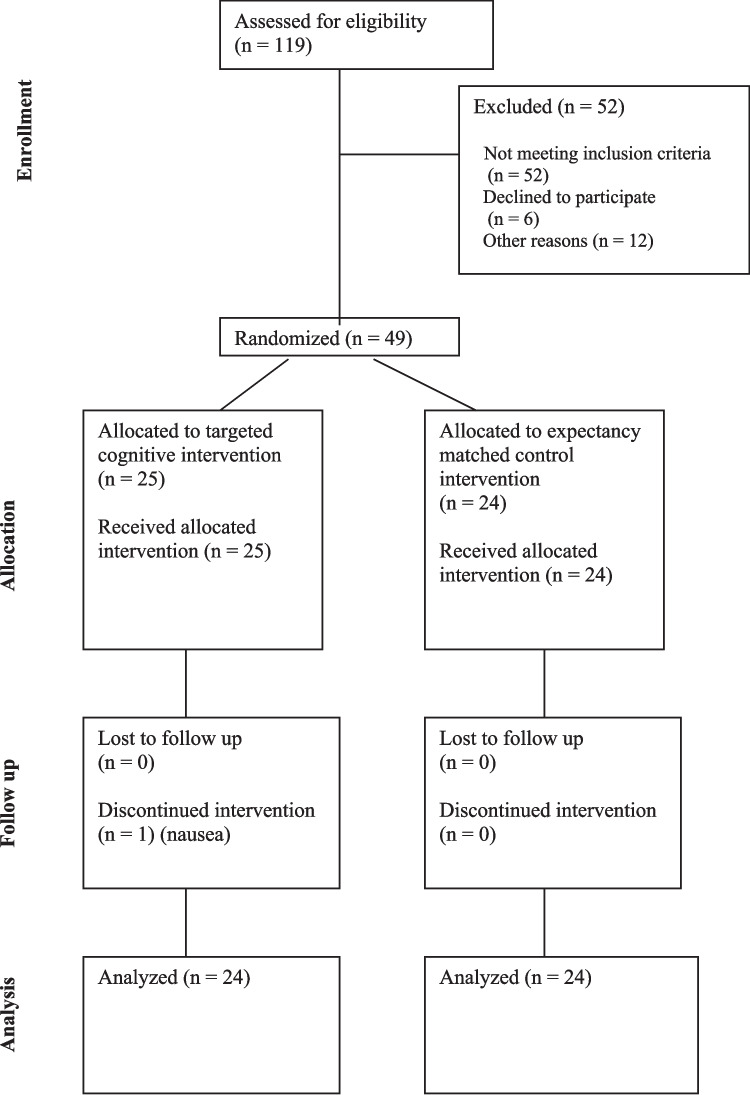
Purpose: The primary aims of this four week pilot randomized clinical trial (RCT) involving a targeted cognitive intervention (TCI, n = 25) compared to an expectancy matched active control intervention (EMACI, n = 24), in a sample of cancer survivors were to: determine recruitment and retention rates; evaluate preliminary efficacy to improve three objective measures of cognitive function (i.e., attention, working memory, multi-tasking); evaluate adherence rates for and satisfaction with the interventions, and evaluate for treatment-related adverse events (e.g., nausea, motion sickness).
Methods: Cancer survivors were recruited from previous studies through email. Following a screening call, survivors who consented to participate were oriented to the study measures and procedures via Zoom. Survivors were randomized to the TCI or EMACI and mailed an iPad with the software for their specific intervention and the Adaptive Cognitive Evaluation Explorer (ACE-X, the objective measure of cognitive function). Survivors used the intervention for 25 min per day at least 5 days per week. Differences in objective measures of attention, working memory, and multi-tasking were evaluated using multilevel regression analyses.
Results: For the sustained attention measure, a significant cross-level interaction was found in favor of the TCI group. While improvements in multi-tasking occurred in both groups, while not statistically significant, the trend was larger for the TCI group. Equally important, in both groups, adherence with the intervention was high and adverse effects were minimal.
Conclusions: These preliminary findings provide promising evidence of feasibility, acceptability, and efficacy that warrant evaluation in a RCT with a larger sample of cancer survivors.
目的:这项为期四周的先导随机临床试验(RCT)涉及靶向认知干预(TCI, n = 25)与预期匹配的主动对照干预(EMACI, n = 24),在癌症幸存者样本中,主要目的是:确定招募和保留率;评估改善三项客观认知功能(即注意力、工作记忆、多任务处理)的初步效果;评估干预措施的依从率和满意度,并评估与治疗相关的不良事件(如恶心、晕动病)。方法:通过电子邮件从以前的研究中招募癌症幸存者。在筛选电话之后,同意参加的幸存者通过Zoom了解了研究的措施和程序。幸存者被随机分配到TCI或EMACI中,并邮寄一个iPad,附带用于他们特定干预的软件和适应性认知评估探索者(ACE-X,认知功能的客观测量)。幸存者每周至少5天每天进行25分钟的干预。使用多水平回归分析评估了注意力、工作记忆和多任务的客观测量差异。结果:对于持续注意测量,发现显著的跨水平相互作用有利于TCI组。虽然两组在多任务处理方面都有改善,但没有统计学意义,但TCI组的趋势更大。同样重要的是,在两组中,干预的依从性很高,不良反应最小。结论:这些初步发现提供了可行性、可接受性和有效性的有希望的证据,值得在更大样本的癌症幸存者的RCT中进行评估。
期刊介绍:
Supportive Care in Cancer provides members of the Multinational Association of Supportive Care in Cancer (MASCC) and all other interested individuals, groups and institutions with the most recent scientific and social information on all aspects of supportive care in cancer patients. It covers primarily medical, technical and surgical topics concerning supportive therapy and care which may supplement or substitute basic cancer treatment at all stages of the disease.
Nursing, rehabilitative, psychosocial and spiritual issues of support are also included.




 京公网安备 11010802042870号
京ICP备2023020795号-1
京公网安备 11010802042870号
京ICP备2023020795号-1

 分享
分享
 求助内容:
求助内容: 应助结果提醒方式:
 扫码关注我们
