A bio-mimicking cobalt tetramenthol-substituted phthalocyanine-based electrochemical sensor for selective and sensitive detection of tert-butylhydroquinone†
Manjunatha Palanna, Mahesh Itagi, Lokesh Koodlur Sannegowda, Bhakti Kulkarni, Kiran Hiremath, Muthu Austeria and R. Geetha Balakrishna
{"title":"A bio-mimicking cobalt tetramenthol-substituted phthalocyanine-based electrochemical sensor for selective and sensitive detection of tert-butylhydroquinone†","authors":"Manjunatha Palanna, Mahesh Itagi, Lokesh Koodlur Sannegowda, Bhakti Kulkarni, Kiran Hiremath, Muthu Austeria and R. Geetha Balakrishna","doi":"10.1039/D4TB02043J","DOIUrl":null,"url":null,"abstract":"<p >Healthy eating choices and adequate nutritional foods are the most important factors in extending a person's life expectancy. Synthetic antioxidants are frequently used in the food industry as preservatives despite their toxicity and hence have drawn much attention for their accurate monitoring. This study explores the newly designed cobalt tetramenthol substituted phthalocyanine (CoTMPc) for the electrocatalytic detection of an artificial food preservative, <em>i.e.</em>, tertiary butylhydroquinone (TBHQ). A highly selective, cost-effective electrochemical probe is developed for the nanomolar detection of TBHQ. Its efficacy is evaluated and validated by different electrochemical techniques, namely cyclic voltammetry (CV), differential pulse voltammetry (DPV), and chronoamperometry (CA) and the CA results demonstrated a good sensitivity of 1.3102 μA nM<small><sup>−1</sup></small> cm<small><sup>−2</sup></small> with a linear range of 20–200 nM and a detection limit (LOD) of 4.5 nM in comparison to other techniques. The developed sensor was successfully applied to real samples. The CoTMPc electrode exhibited superior sensitivity, excellent selectivity, repeatability, and reproducibility, with anti-interference ability, over a broad linear range towards TBHQ detection. The mechanism of electrochemical detection is supported by fluorescence resonance energy/electron transfer and provides insights into the design of high-performing electroactive molecules that induce specificity and selectivity.</p>","PeriodicalId":83,"journal":{"name":"Journal of Materials Chemistry B","volume":" 13","pages":" 4188-4200"},"PeriodicalIF":6.1000,"publicationDate":"2025-03-07","publicationTypes":"Journal Article","fieldsOfStudy":null,"isOpenAccess":false,"openAccessPdf":"","citationCount":"0","resultStr":null,"platform":"Semanticscholar","paperid":null,"PeriodicalName":"Journal of Materials Chemistry B","FirstCategoryId":"1","ListUrlMain":"https://pubs.rsc.org/en/content/articlelanding/2025/tb/d4tb02043j","RegionNum":3,"RegionCategory":"医学","ArticlePicture":[],"TitleCN":null,"AbstractTextCN":null,"PMCID":null,"EPubDate":"","PubModel":"","JCR":"Q1","JCRName":"MATERIALS SCIENCE, BIOMATERIALS","Score":null,"Total":0}
引用次数: 0
Abstract
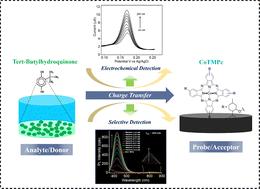
Healthy eating choices and adequate nutritional foods are the most important factors in extending a person's life expectancy. Synthetic antioxidants are frequently used in the food industry as preservatives despite their toxicity and hence have drawn much attention for their accurate monitoring. This study explores the newly designed cobalt tetramenthol substituted phthalocyanine (CoTMPc) for the electrocatalytic detection of an artificial food preservative, i.e., tertiary butylhydroquinone (TBHQ). A highly selective, cost-effective electrochemical probe is developed for the nanomolar detection of TBHQ. Its efficacy is evaluated and validated by different electrochemical techniques, namely cyclic voltammetry (CV), differential pulse voltammetry (DPV), and chronoamperometry (CA) and the CA results demonstrated a good sensitivity of 1.3102 μA nM−1 cm−2 with a linear range of 20–200 nM and a detection limit (LOD) of 4.5 nM in comparison to other techniques. The developed sensor was successfully applied to real samples. The CoTMPc electrode exhibited superior sensitivity, excellent selectivity, repeatability, and reproducibility, with anti-interference ability, over a broad linear range towards TBHQ detection. The mechanism of electrochemical detection is supported by fluorescence resonance energy/electron transfer and provides insights into the design of high-performing electroactive molecules that induce specificity and selectivity.
期刊介绍:
Journal of Materials Chemistry A, B & C cover high quality studies across all fields of materials chemistry. The journals focus on those theoretical or experimental studies that report new understanding, applications, properties and synthesis of materials. Journal of Materials Chemistry A, B & C are separated by the intended application of the material studied. Broadly, applications in energy and sustainability are of interest to Journal of Materials Chemistry A, applications in biology and medicine are of interest to Journal of Materials Chemistry B, and applications in optical, magnetic and electronic devices are of interest to Journal of Materials Chemistry C.Journal of Materials Chemistry B is a Transformative Journal and Plan S compliant. Example topic areas within the scope of Journal of Materials Chemistry B are listed below. This list is neither exhaustive nor exclusive:
Antifouling coatings
Biocompatible materials
Bioelectronics
Bioimaging
Biomimetics
Biomineralisation
Bionics
Biosensors
Diagnostics
Drug delivery
Gene delivery
Immunobiology
Nanomedicine
Regenerative medicine & Tissue engineering
Scaffolds
Soft robotics
Stem cells
Therapeutic devices





 京公网安备 11010802042870号
京ICP备2023020795号-1
京公网安备 11010802042870号
京ICP备2023020795号-1

 分享
分享
 求助内容:
求助内容: 应助结果提醒方式:
 扫码关注我们
