Chen Yuan, Jie Wang, Claudia Li, Guanlong Geng, Jian Song, Naitao Yang, Sibudjing Kawi, Mingming Wang, Xiaoyao Tan, Shaomin Liu
{"title":"Metallic Nickel Hollow Fiber Membrane Reactors to Convert Methane and Carbon Dioxide for Hydrogen and Syngas Production via Dry Reforming","authors":"Chen Yuan, Jie Wang, Claudia Li, Guanlong Geng, Jian Song, Naitao Yang, Sibudjing Kawi, Mingming Wang, Xiaoyao Tan, Shaomin Liu","doi":"10.1021/acs.iecr.4c04860","DOIUrl":null,"url":null,"abstract":"CH<sub>4</sub> and CO<sub>2</sub> are two major greenhouse gases, and converting them into useful chemicals (hydrogen and syngas) via dry reforming would be one of the best strategies. The utilization of membrane reactors enables the integration of H<sub>2</sub> production and separation into a single unit. Herein, we investigated the hollow fiber (HF) membrane reactor performance for H<sub>2</sub> production through dry reforming of methane (DRM) at various operating conditions. Ni hollow fiber membranes alleviate carbon deposition in DRM processes by leveraging their inherent catalytic properties, high thermal stability, optimized surface design, and unique hollow fiber geometry, ensuring sustained operation and durability. With the incorporation of a catalyst, the catalytic membrane reactors could maintain high conversion rates exceeding 95% even for a higher feed flow rate at 900 °C. For the operation of 80 h, the membrane reactors gave a very stable performance with a total H<sub>2</sub> formation rate of 94 mL min<sup>–1</sup>, while both H<sub>2</sub> and CO selectivity fluctuated up and down within 92–96%. The fabricated Ni membrane exhibited excellent thermal cycling operation performance and possessed high resistance to poisoning agents such as CO, CO<sub>2</sub>, and H<sub>2</sub>O. These findings provide a solid foundation for the widespread application of Ni-based membranes in cleaner H<sub>2</sub> production via reforming reactions by minimizing the carbon footprint and further contributing to global decarbonization initiatives.","PeriodicalId":39,"journal":{"name":"Industrial & Engineering Chemistry Research","volume":"3 1","pages":""},"PeriodicalIF":3.9000,"publicationDate":"2025-03-08","publicationTypes":"Journal Article","fieldsOfStudy":null,"isOpenAccess":false,"openAccessPdf":"","citationCount":"0","resultStr":null,"platform":"Semanticscholar","paperid":null,"PeriodicalName":"Industrial & Engineering Chemistry Research","FirstCategoryId":"5","ListUrlMain":"https://doi.org/10.1021/acs.iecr.4c04860","RegionNum":3,"RegionCategory":"工程技术","ArticlePicture":[],"TitleCN":null,"AbstractTextCN":null,"PMCID":null,"EPubDate":"","PubModel":"","JCR":"Q2","JCRName":"ENGINEERING, CHEMICAL","Score":null,"Total":0}
引用次数: 0
Abstract
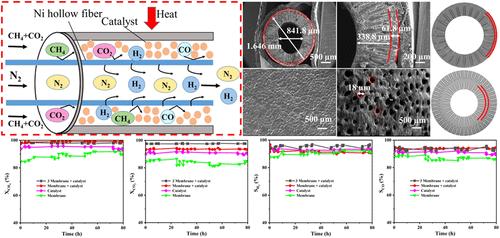
CH4 and CO2 are two major greenhouse gases, and converting them into useful chemicals (hydrogen and syngas) via dry reforming would be one of the best strategies. The utilization of membrane reactors enables the integration of H2 production and separation into a single unit. Herein, we investigated the hollow fiber (HF) membrane reactor performance for H2 production through dry reforming of methane (DRM) at various operating conditions. Ni hollow fiber membranes alleviate carbon deposition in DRM processes by leveraging their inherent catalytic properties, high thermal stability, optimized surface design, and unique hollow fiber geometry, ensuring sustained operation and durability. With the incorporation of a catalyst, the catalytic membrane reactors could maintain high conversion rates exceeding 95% even for a higher feed flow rate at 900 °C. For the operation of 80 h, the membrane reactors gave a very stable performance with a total H2 formation rate of 94 mL min–1, while both H2 and CO selectivity fluctuated up and down within 92–96%. The fabricated Ni membrane exhibited excellent thermal cycling operation performance and possessed high resistance to poisoning agents such as CO, CO2, and H2O. These findings provide a solid foundation for the widespread application of Ni-based membranes in cleaner H2 production via reforming reactions by minimizing the carbon footprint and further contributing to global decarbonization initiatives.
甲烷和二氧化碳是两种主要的温室气体,通过干重整将它们转化为有用的化学物质(氢和合成气)将是最好的策略之一。膜反应器的使用使氢气生产和分离集成到一个单元中。本文研究了不同操作条件下中空纤维膜反应器(HF)甲烷干重整制氢的性能。Ni中空纤维膜利用其固有的催化性能、高热稳定性、优化的表面设计和独特的中空纤维几何形状,减轻了DRM工艺中的碳沉积,确保了持续运行和耐用性。在900℃时,加入催化剂后,即使进料流量较高,催化膜反应器也能保持95%以上的高转化率。在运行80 h时,膜反应器表现出非常稳定的性能,H2的总生成速率为94 mL min-1,而H2和CO的选择性在92-96%之间上下波动。制备的Ni膜具有良好的热循环操作性能,对CO、CO2和H2O等毒物具有较高的抗性。这些发现为镍基膜在重整反应中的广泛应用提供了坚实的基础,通过最大限度地减少碳足迹,进一步促进全球脱碳倡议。
期刊介绍:
ndustrial & Engineering Chemistry, with variations in title and format, has been published since 1909 by the American Chemical Society. Industrial & Engineering Chemistry Research is a weekly publication that reports industrial and academic research in the broad fields of applied chemistry and chemical engineering with special focus on fundamentals, processes, and products.



 京公网安备 11010802042870号
京ICP备2023020795号-1
京公网安备 11010802042870号
京ICP备2023020795号-1

 分享
分享
 求助内容:
求助内容: 应助结果提醒方式:
 扫码关注我们
