{"title":"Wetting Behavior of Zn Droplets on Fe Surfaces: Insights from Molecular Dynamics Simulations","authors":"Luyao Cheng, Haojie Mei, Boqiang Wu, Liang Chen, Feifei Wang, Guiqin Yang, Jinfu Li, Lingti Kong","doi":"10.1021/acs.langmuir.4c05308","DOIUrl":null,"url":null,"abstract":"The liquid metal embrittlement (LME) induced by Zn melts in advanced high strength steels has seriously hindered their wide application in various industries. Microscopically, wetting is the precursor for LME; it is therefore crucial to understand the wetting of Zn melts on Fe surfaces. Molecular dynamics simulations were conducted to investigate the wetting behavior of Zn droplets on Fe(001), Fe(110), and Fe(111) surfaces from both thermodynamics and dynamics aspects. The simulation results reveal that the surface energy of solid Fe is significantly greater than the surface tension of liquid Zn and the interfacial energy of Fe–Zn solid–liquid interface at the pertinent temperatures. Consequently, Zn droplets tend to completely envelop the Fe substrates as they spread toward the equilibrium state. Specifically, Fe(111) surfaces possess the highest surface energy, whereas Fe(110) surfaces have the lowest surface energy. Meanwhile, the solid–liquid interfacial energy is minimal for Fe(111)/Zn and maximal for Fe(110)/Zn. These differences contribute to the strongest spreading driving force for Zn droplets on Fe(111) surfaces and the weakest on Fe(110). During the initial spreading stage, Zn droplets form precursor films on all Fe surfaces. Nonetheless, on Fe(111), the dissolution reaction between the substrates and the droplets destabilizes the precursor films, ultimately resulting in complete wetting. Conversely, no dissolution is observed between Zn droplets and the Fe(001) or Fe(110) surface. As a result, the equilibrium Zn droplet consists of a prefreezing precursor film that grows epitaxially on the substrate and a main body of the droplet exhibiting a convex hull shape corresponding to pseudopartial wetting. These findings provide new insights into the wetting behavior of metal droplets on metal surfaces, particularly for understanding the liquid metal embrittlement induced by Zn melts in steels.","PeriodicalId":50,"journal":{"name":"Langmuir","volume":"20 1","pages":""},"PeriodicalIF":3.9000,"publicationDate":"2025-03-08","publicationTypes":"Journal Article","fieldsOfStudy":null,"isOpenAccess":false,"openAccessPdf":"","citationCount":"0","resultStr":null,"platform":"Semanticscholar","paperid":null,"PeriodicalName":"Langmuir","FirstCategoryId":"92","ListUrlMain":"https://doi.org/10.1021/acs.langmuir.4c05308","RegionNum":2,"RegionCategory":"化学","ArticlePicture":[],"TitleCN":null,"AbstractTextCN":null,"PMCID":null,"EPubDate":"","PubModel":"","JCR":"Q2","JCRName":"CHEMISTRY, MULTIDISCIPLINARY","Score":null,"Total":0}
引用次数: 0
Abstract
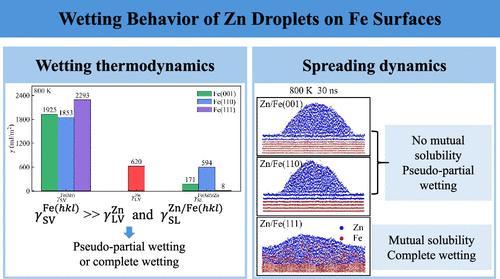
The liquid metal embrittlement (LME) induced by Zn melts in advanced high strength steels has seriously hindered their wide application in various industries. Microscopically, wetting is the precursor for LME; it is therefore crucial to understand the wetting of Zn melts on Fe surfaces. Molecular dynamics simulations were conducted to investigate the wetting behavior of Zn droplets on Fe(001), Fe(110), and Fe(111) surfaces from both thermodynamics and dynamics aspects. The simulation results reveal that the surface energy of solid Fe is significantly greater than the surface tension of liquid Zn and the interfacial energy of Fe–Zn solid–liquid interface at the pertinent temperatures. Consequently, Zn droplets tend to completely envelop the Fe substrates as they spread toward the equilibrium state. Specifically, Fe(111) surfaces possess the highest surface energy, whereas Fe(110) surfaces have the lowest surface energy. Meanwhile, the solid–liquid interfacial energy is minimal for Fe(111)/Zn and maximal for Fe(110)/Zn. These differences contribute to the strongest spreading driving force for Zn droplets on Fe(111) surfaces and the weakest on Fe(110). During the initial spreading stage, Zn droplets form precursor films on all Fe surfaces. Nonetheless, on Fe(111), the dissolution reaction between the substrates and the droplets destabilizes the precursor films, ultimately resulting in complete wetting. Conversely, no dissolution is observed between Zn droplets and the Fe(001) or Fe(110) surface. As a result, the equilibrium Zn droplet consists of a prefreezing precursor film that grows epitaxially on the substrate and a main body of the droplet exhibiting a convex hull shape corresponding to pseudopartial wetting. These findings provide new insights into the wetting behavior of metal droplets on metal surfaces, particularly for understanding the liquid metal embrittlement induced by Zn melts in steels.
期刊介绍:
Langmuir is an interdisciplinary journal publishing articles in the following subject categories:
Colloids: surfactants and self-assembly, dispersions, emulsions, foams
Interfaces: adsorption, reactions, films, forces
Biological Interfaces: biocolloids, biomolecular and biomimetic materials
Materials: nano- and mesostructured materials, polymers, gels, liquid crystals
Electrochemistry: interfacial charge transfer, charge transport, electrocatalysis, electrokinetic phenomena, bioelectrochemistry
Devices and Applications: sensors, fluidics, patterning, catalysis, photonic crystals
However, when high-impact, original work is submitted that does not fit within the above categories, decisions to accept or decline such papers will be based on one criteria: What Would Irving Do?
Langmuir ranks #2 in citations out of 136 journals in the category of Physical Chemistry with 113,157 total citations. The journal received an Impact Factor of 4.384*.
This journal is also indexed in the categories of Materials Science (ranked #1) and Multidisciplinary Chemistry (ranked #5).



 京公网安备 11010802042870号
京ICP备2023020795号-1
京公网安备 11010802042870号
京ICP备2023020795号-1

 分享
分享
 求助内容:
求助内容: 应助结果提醒方式:
 扫码关注我们
