Simon Woll, Dennis Birkenmaier, Gergely Biri, Rebecca Nissen, Luisa Lutz, Marc Schroth, Ulrich W Ebner-Priemer, Marco Giurgiu
{"title":"Applying AI in the Context of the Association Between Device-Based Assessment of Physical Activity and Mental Health: Systematic Review.","authors":"Simon Woll, Dennis Birkenmaier, Gergely Biri, Rebecca Nissen, Luisa Lutz, Marc Schroth, Ulrich W Ebner-Priemer, Marco Giurgiu","doi":"10.2196/59660","DOIUrl":null,"url":null,"abstract":"<p><strong>Background: </strong>Wearable technology is used by consumers worldwide for continuous activity monitoring in daily life but more recently also for classifying or predicting mental health parameters like stress or depression levels. Previous studies identified, based on traditional approaches, that physical activity is a relevant factor in the prevention or management of mental health. However, upcoming artificial intelligence methods have not yet been fully established in the research field of physical activity and mental health.</p><p><strong>Objective: </strong>This systematic review aims to provide a comprehensive overview of studies that integrated passive monitoring of physical activity data measured via wearable technology in machine learning algorithms for the detection, prediction, or classification of mental health states and traits.</p><p><strong>Methods: </strong>We conducted a review of studies processing wearable data to gain insights into mental health parameters. Eligibility criteria were (1) the study uses wearables or smartphones to acquire physical behavior and optionally other sensor measurement data, (2) the study must use machine learning to process the acquired data, and (3) the study had to be published in a peer-reviewed English language journal. Studies were identified via a systematic search in 5 electronic databases.</p><p><strong>Results: </strong>Of 11,057 unique search results, 49 published papers between 2016 and 2023 were included. Most studies examined the connection between wearable sensor data and stress (n=15, 31%) or depression (n=14, 29%). In total, 71% (n=35) of the studies had less than 100 participants, and 47% (n=23) had less than 14 days of data recording. More than half of the studies (n=27, 55%) used step count as movement measurement, and 44% (n=21) used raw accelerometer values. The quality of the studies was assessed, scoring between 0 and 18 points in 9 categories (maximum 2 points per category). On average, studies were rated 6.47 (SD 3.1) points.</p><p><strong>Conclusions: </strong>The use of wearable technology for the detection, prediction, or classification of mental health states and traits is promising and offers a variety of applications across different settings and target groups. However, based on the current state of literature, the application of artificial intelligence cannot realize its full potential mostly due to a lack of methodological shortcomings and data availability. Future research endeavors may focus on the following suggestions to improve the quality of new applications in this context: first, by using raw data instead of already preprocessed data. Second, by using only relevant data based on empirical evidence. In particular, crafting optimal feature sets rather than using many individual detached features and consultation with in-field professionals. Third, by validating and replicating the existing approaches (ie, applying the model to unseen data). Fourth, depending on the research aim (ie, generalization vs personalization) maximizing the sample size or the duration over which data are collected.</p>","PeriodicalId":14756,"journal":{"name":"JMIR mHealth and uHealth","volume":"13 ","pages":"e59660"},"PeriodicalIF":6.2000,"publicationDate":"2025-03-06","publicationTypes":"Journal Article","fieldsOfStudy":null,"isOpenAccess":false,"openAccessPdf":"https://www.ncbi.nlm.nih.gov/pmc/articles/PMC11926455/pdf/","citationCount":"0","resultStr":null,"platform":"Semanticscholar","paperid":null,"PeriodicalName":"JMIR mHealth and uHealth","FirstCategoryId":"3","ListUrlMain":"https://doi.org/10.2196/59660","RegionNum":2,"RegionCategory":"医学","ArticlePicture":[],"TitleCN":null,"AbstractTextCN":null,"PMCID":null,"EPubDate":"","PubModel":"","JCR":"Q1","JCRName":"HEALTH CARE SCIENCES & SERVICES","Score":null,"Total":0}
引用次数: 0
Abstract
Background: Wearable technology is used by consumers worldwide for continuous activity monitoring in daily life but more recently also for classifying or predicting mental health parameters like stress or depression levels. Previous studies identified, based on traditional approaches, that physical activity is a relevant factor in the prevention or management of mental health. However, upcoming artificial intelligence methods have not yet been fully established in the research field of physical activity and mental health.
Objective: This systematic review aims to provide a comprehensive overview of studies that integrated passive monitoring of physical activity data measured via wearable technology in machine learning algorithms for the detection, prediction, or classification of mental health states and traits.
Methods: We conducted a review of studies processing wearable data to gain insights into mental health parameters. Eligibility criteria were (1) the study uses wearables or smartphones to acquire physical behavior and optionally other sensor measurement data, (2) the study must use machine learning to process the acquired data, and (3) the study had to be published in a peer-reviewed English language journal. Studies were identified via a systematic search in 5 electronic databases.
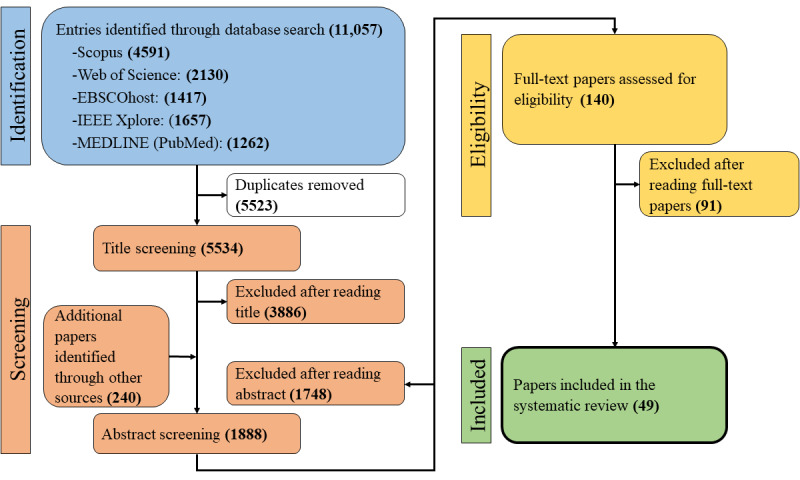
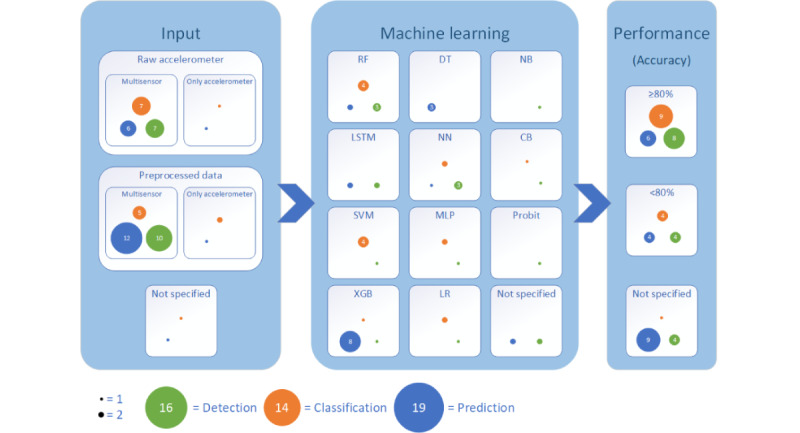
Results: Of 11,057 unique search results, 49 published papers between 2016 and 2023 were included. Most studies examined the connection between wearable sensor data and stress (n=15, 31%) or depression (n=14, 29%). In total, 71% (n=35) of the studies had less than 100 participants, and 47% (n=23) had less than 14 days of data recording. More than half of the studies (n=27, 55%) used step count as movement measurement, and 44% (n=21) used raw accelerometer values. The quality of the studies was assessed, scoring between 0 and 18 points in 9 categories (maximum 2 points per category). On average, studies were rated 6.47 (SD 3.1) points.
Conclusions: The use of wearable technology for the detection, prediction, or classification of mental health states and traits is promising and offers a variety of applications across different settings and target groups. However, based on the current state of literature, the application of artificial intelligence cannot realize its full potential mostly due to a lack of methodological shortcomings and data availability. Future research endeavors may focus on the following suggestions to improve the quality of new applications in this context: first, by using raw data instead of already preprocessed data. Second, by using only relevant data based on empirical evidence. In particular, crafting optimal feature sets rather than using many individual detached features and consultation with in-field professionals. Third, by validating and replicating the existing approaches (ie, applying the model to unseen data). Fourth, depending on the research aim (ie, generalization vs personalization) maximizing the sample size or the duration over which data are collected.
期刊介绍:
JMIR mHealth and uHealth (JMU, ISSN 2291-5222) is a spin-off journal of JMIR, the leading eHealth journal (Impact Factor 2016: 5.175). JMIR mHealth and uHealth is indexed in PubMed, PubMed Central, and Science Citation Index Expanded (SCIE), and in June 2017 received a stunning inaugural Impact Factor of 4.636.
The journal focusses on health and biomedical applications in mobile and tablet computing, pervasive and ubiquitous computing, wearable computing and domotics.
JMIR mHealth and uHealth publishes since 2013 and was the first mhealth journal in Pubmed. It publishes even faster and has a broader scope with including papers which are more technical or more formative/developmental than what would be published in the Journal of Medical Internet Research.




 京公网安备 11010802042870号
京ICP备2023020795号-1
京公网安备 11010802042870号
京ICP备2023020795号-1

 分享
分享
 求助内容:
求助内容: 应助结果提醒方式:
 扫码关注我们
