Haitao Ren , Zainab Amjad , Atif Saleem , Muhammad Usman , Kukybayeva Dina , Muhammad Haris , Junkang Guo
{"title":"Scalable interlinked hierarchical porous biochar-nanosheets for efficient removal of thallium from aquatic environment","authors":"Haitao Ren , Zainab Amjad , Atif Saleem , Muhammad Usman , Kukybayeva Dina , Muhammad Haris , Junkang Guo","doi":"10.1016/j.jhazmat.2025.137879","DOIUrl":null,"url":null,"abstract":"<div><div>The scalable development of engineered<img>carbonaceous materials for commercialization at industrial scale is a formidable issue. Herein, a scalable and innovative chemical exfoliation approach was introduced to develop interlinked<img>hierarchical biochar<img>nanosheets (BC<img>Ns) framework form agricultural wastes. The developed BC<img>Ns exhibited higher surface area (1048.63 m<sup>2</sup> g<sup>−1</sup>) and rational pore structure with average pore size of 2.051 nm. The resulted BC<img>Ns showed superior Tl(I) adsorption performance with a maximum adsorption capacity of 448.21 mg g<sup>−1</sup>. BC<img>Ns maintained its removal potential > 80 % in presence of higher concentration (0.2 mmol L<sup>−1</sup>) of co<img>existing ions (Na<sup>+</sup>, Ca<sup>2+</sup>, Mg<sup>2+</sup>, Zn<sup>2+</sup> and Ni<sup>2+</sup>) and organic acids (humic and fluvic acid). Importantly, the BC<img>Ns manifested remarkable recyclability (81.3 %) after 18 adsorption<img>desorption cycles. Furthermore, a fixed bed column trial exhibited that ∼929 bed volumes of the feedstock stream (1.0 mg L<sup>−1</sup>) could be efficiently treated, highlighting the potential of BC<img>Ns to treat toxic metals polluted water matrices in continuous flow mode at pilot scale. Overall, the present work has significant potential to produce engineered carbon materials at higher scale, paving the way for commercialization of more cost<img>effective products from biomass for various water treatment technology.</div></div>","PeriodicalId":361,"journal":{"name":"Journal of Hazardous Materials","volume":"491 ","pages":"Article 137879"},"PeriodicalIF":11.3000,"publicationDate":"2025-07-05","publicationTypes":"Journal Article","fieldsOfStudy":null,"isOpenAccess":false,"openAccessPdf":"","citationCount":"0","resultStr":null,"platform":"Semanticscholar","paperid":null,"PeriodicalName":"Journal of Hazardous Materials","FirstCategoryId":"93","ListUrlMain":"https://www.sciencedirect.com/science/article/pii/S0304389425007939","RegionNum":1,"RegionCategory":"环境科学与生态学","ArticlePicture":[],"TitleCN":null,"AbstractTextCN":null,"PMCID":null,"EPubDate":"2025/3/8 0:00:00","PubModel":"Epub","JCR":"Q1","JCRName":"ENGINEERING, ENVIRONMENTAL","Score":null,"Total":0}
引用次数: 0
Abstract
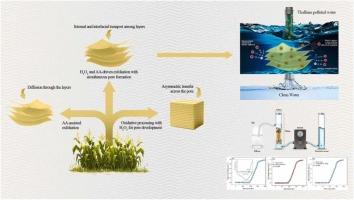
The scalable development of engineeredcarbonaceous materials for commercialization at industrial scale is a formidable issue. Herein, a scalable and innovative chemical exfoliation approach was introduced to develop interlinkedhierarchical biocharnanosheets (BCNs) framework form agricultural wastes. The developed BCNs exhibited higher surface area (1048.63 m2 g−1) and rational pore structure with average pore size of 2.051 nm. The resulted BCNs showed superior Tl(I) adsorption performance with a maximum adsorption capacity of 448.21 mg g−1. BCNs maintained its removal potential > 80 % in presence of higher concentration (0.2 mmol L−1) of coexisting ions (Na+, Ca2+, Mg2+, Zn2+ and Ni2+) and organic acids (humic and fluvic acid). Importantly, the BCNs manifested remarkable recyclability (81.3 %) after 18 adsorptiondesorption cycles. Furthermore, a fixed bed column trial exhibited that ∼929 bed volumes of the feedstock stream (1.0 mg L−1) could be efficiently treated, highlighting the potential of BCNs to treat toxic metals polluted water matrices in continuous flow mode at pilot scale. Overall, the present work has significant potential to produce engineered carbon materials at higher scale, paving the way for commercialization of more costeffective products from biomass for various water treatment technology.
期刊介绍:
The Journal of Hazardous Materials serves as a global platform for promoting cutting-edge research in the field of Environmental Science and Engineering. Our publication features a wide range of articles, including full-length research papers, review articles, and perspectives, with the aim of enhancing our understanding of the dangers and risks associated with various materials concerning public health and the environment. It is important to note that the term "environmental contaminants" refers specifically to substances that pose hazardous effects through contamination, while excluding those that do not have such impacts on the environment or human health. Moreover, we emphasize the distinction between wastes and hazardous materials in order to provide further clarity on the scope of the journal. We have a keen interest in exploring specific compounds and microbial agents that have adverse effects on the environment.



 京公网安备 11010802042870号
京ICP备2023020795号-1
京公网安备 11010802042870号
京ICP备2023020795号-1

 分享
分享
 求助内容:
求助内容: 应助结果提醒方式:
 扫码关注我们
