Construction of phenothiazine-decorated ZnO quantum dots with intelligent response to bacterial pH/amidase microenvironment for inducing bacterial ferroptosis-like death
Wu-Bin Shao, Rong-Shuang Luo, Yan-Wei Huang, Long Cheng, Dan Zeng, Xiang Zhou, Li-Wei Liu, Song Yang
{"title":"Construction of phenothiazine-decorated ZnO quantum dots with intelligent response to bacterial pH/amidase microenvironment for inducing bacterial ferroptosis-like death","authors":"Wu-Bin Shao, Rong-Shuang Luo, Yan-Wei Huang, Long Cheng, Dan Zeng, Xiang Zhou, Li-Wei Liu, Song Yang","doi":"10.1016/j.cej.2025.161352","DOIUrl":null,"url":null,"abstract":"Growing antimicrobial resistance has become a global crisis for global health and food security. To avoid or reduce antimicrobial resistance, stimuli-responsive materials are becoming advanced and multifunctional tools for fighting against microbial infection. In this study, a smart nanocarrier, namely ZnO QDs-PTZ (phenothiazine-decorated ZnO quantum dots), was designed by means of organic–inorganic hybridization. The mechanistic study of ZnO QDs-PTZ nanocarrier were made by electron microscope and transcriptome sequence analysis, implied that it was capable of responding to bacterial pH/amidase microenvironments, and could trigger a synergistic bactericidal effect though bacterial ferroptosis-like death induced by iron enrichment, cell membrane damage by lipid peroxidation, and glutathione depletion. Further, the designed nanocarrier demonstrated high water dispersibility, foliar wettability, and good absorption behavior in plants, resulting in excellent assay outcomes <em>in vitro</em> [ZnO QDs-PTZ A with minimum bactericidal concentration (MBC) and minimum inhibitory concentration (MIC) values of 12.5 and 18.8 μg mL<sup>−1</sup>] and <em>in vivo</em> (curative effectiveness: 66.3 %; protective effectiveness: 65.5 %). Additionally, their non-toxic characteristics were verified in rice seedling germination, rice plants, and zebrafish. Overall, this study proposes an antibacterial substitute constructed by phenothiazine and ZnO quantum dots via ferroptosis-like death-inducing/membrane-targeted synergistic bactericidal effects, which may provide a foreground for controlling intractable bacterial infection, and also provides new insights into the potential of organic–inorganic hybrid nanomaterials characterized by safe, pH/amidase-responsive release ability.","PeriodicalId":270,"journal":{"name":"Chemical Engineering Journal","volume":"155 1","pages":""},"PeriodicalIF":13.2000,"publicationDate":"2025-03-09","publicationTypes":"Journal Article","fieldsOfStudy":null,"isOpenAccess":false,"openAccessPdf":"","citationCount":"0","resultStr":null,"platform":"Semanticscholar","paperid":null,"PeriodicalName":"Chemical Engineering Journal","FirstCategoryId":"5","ListUrlMain":"https://doi.org/10.1016/j.cej.2025.161352","RegionNum":1,"RegionCategory":"工程技术","ArticlePicture":[],"TitleCN":null,"AbstractTextCN":null,"PMCID":null,"EPubDate":"","PubModel":"","JCR":"Q1","JCRName":"ENGINEERING, CHEMICAL","Score":null,"Total":0}
引用次数: 0
Abstract
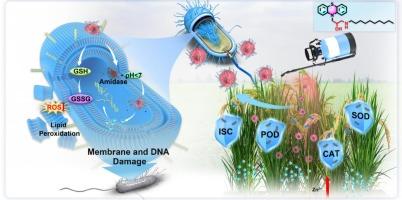
Growing antimicrobial resistance has become a global crisis for global health and food security. To avoid or reduce antimicrobial resistance, stimuli-responsive materials are becoming advanced and multifunctional tools for fighting against microbial infection. In this study, a smart nanocarrier, namely ZnO QDs-PTZ (phenothiazine-decorated ZnO quantum dots), was designed by means of organic–inorganic hybridization. The mechanistic study of ZnO QDs-PTZ nanocarrier were made by electron microscope and transcriptome sequence analysis, implied that it was capable of responding to bacterial pH/amidase microenvironments, and could trigger a synergistic bactericidal effect though bacterial ferroptosis-like death induced by iron enrichment, cell membrane damage by lipid peroxidation, and glutathione depletion. Further, the designed nanocarrier demonstrated high water dispersibility, foliar wettability, and good absorption behavior in plants, resulting in excellent assay outcomes in vitro [ZnO QDs-PTZ A with minimum bactericidal concentration (MBC) and minimum inhibitory concentration (MIC) values of 12.5 and 18.8 μg mL−1] and in vivo (curative effectiveness: 66.3 %; protective effectiveness: 65.5 %). Additionally, their non-toxic characteristics were verified in rice seedling germination, rice plants, and zebrafish. Overall, this study proposes an antibacterial substitute constructed by phenothiazine and ZnO quantum dots via ferroptosis-like death-inducing/membrane-targeted synergistic bactericidal effects, which may provide a foreground for controlling intractable bacterial infection, and also provides new insights into the potential of organic–inorganic hybrid nanomaterials characterized by safe, pH/amidase-responsive release ability.
期刊介绍:
The Chemical Engineering Journal is an international research journal that invites contributions of original and novel fundamental research. It aims to provide an international platform for presenting original fundamental research, interpretative reviews, and discussions on new developments in chemical engineering. The journal welcomes papers that describe novel theory and its practical application, as well as those that demonstrate the transfer of techniques from other disciplines. It also welcomes reports on carefully conducted experimental work that is soundly interpreted. The main focus of the journal is on original and rigorous research results that have broad significance. The Catalysis section within the Chemical Engineering Journal focuses specifically on Experimental and Theoretical studies in the fields of heterogeneous catalysis, molecular catalysis, and biocatalysis. These studies have industrial impact on various sectors such as chemicals, energy, materials, foods, healthcare, and environmental protection.



 京公网安备 11010802042870号
京ICP备2023020795号-1
京公网安备 11010802042870号
京ICP备2023020795号-1

 分享
分享
 求助内容:
求助内容: 应助结果提醒方式:
 扫码关注我们
