{"title":"Comprehensive identification of hub mRNAs and lncRNAs in colorectal cancer using galaxy: an in silico transcriptome analysis.","authors":"Mohsen Yari, Milad Eidi, Mohammad-Amin Omrani, Zahra Fazeli, Mohammad Rahmanian, Soudeh Ghafouri-Fard","doi":"10.1007/s12672-025-02026-z","DOIUrl":null,"url":null,"abstract":"<p><p>Colorectal cancer (CRC) is the second leading cause of cancer-related mortality. Using the Galaxy platform, the present study aimed to assess the differentially expressed genes (DEGs) in CRC patients. The expression data was obtained from the Gene Expression Omnibus database (GSE137327). DEGs were analyzed using Gene Ontology (GO) and GeneMANIA databases to detect the most critical biological pathways and processes. Protein-Protein Interaction Studies (PPIS) identified four hub genes (CCN1, CCL2, FLNC, MYH11). This article presents findings on three mRNAs (CEMIP, MMP7, and DPEP1) and also two notable lncRNAs, EVADR and DLX6-AS1, that have an impact on CRC pathogenesis and play a role in the epithelial-mesenchymal transition in tumor cells. The identified genes and lncRNAs are putative therapeutic targets and diagnostic markers. For instance, CRISPR/Cas9 editing systems can be designed in order to modulate expression of these genes, or edit them for the purpose of inducing sensitivity to conventional therapies. Besides, these genes can be incorporated into clinical prognostic models, offering panels of genes to choose appropriate personalized methods of treatment. Together, these genes represent novel markers and possible therapeutic targets for CRC.</p>","PeriodicalId":11148,"journal":{"name":"Discover. Oncology","volume":"16 1","pages":"282"},"PeriodicalIF":2.9000,"publicationDate":"2025-03-08","publicationTypes":"Journal Article","fieldsOfStudy":null,"isOpenAccess":false,"openAccessPdf":"https://www.ncbi.nlm.nih.gov/pmc/articles/PMC11890851/pdf/","citationCount":"0","resultStr":null,"platform":"Semanticscholar","paperid":null,"PeriodicalName":"Discover. Oncology","FirstCategoryId":"3","ListUrlMain":"https://doi.org/10.1007/s12672-025-02026-z","RegionNum":4,"RegionCategory":"医学","ArticlePicture":[],"TitleCN":null,"AbstractTextCN":null,"PMCID":null,"EPubDate":"","PubModel":"","JCR":"Q3","JCRName":"ENDOCRINOLOGY & METABOLISM","Score":null,"Total":0}
引用次数: 0
Abstract
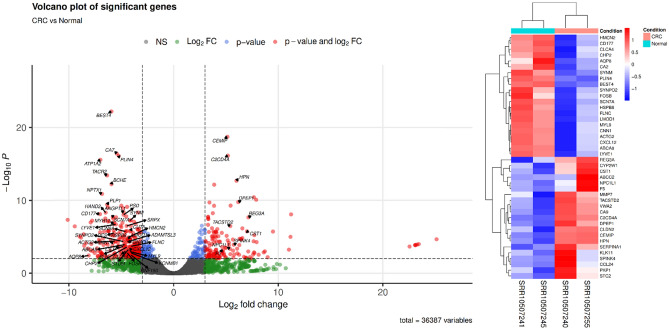
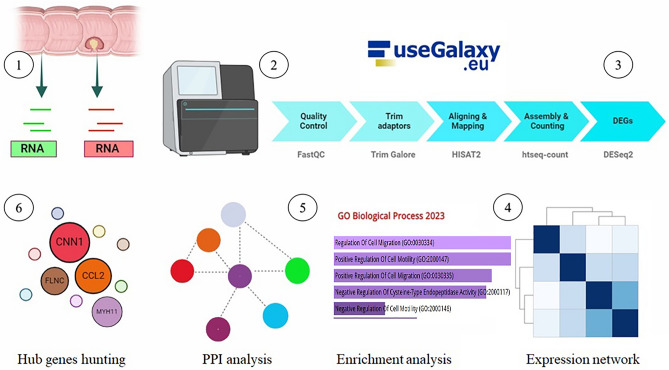
Colorectal cancer (CRC) is the second leading cause of cancer-related mortality. Using the Galaxy platform, the present study aimed to assess the differentially expressed genes (DEGs) in CRC patients. The expression data was obtained from the Gene Expression Omnibus database (GSE137327). DEGs were analyzed using Gene Ontology (GO) and GeneMANIA databases to detect the most critical biological pathways and processes. Protein-Protein Interaction Studies (PPIS) identified four hub genes (CCN1, CCL2, FLNC, MYH11). This article presents findings on three mRNAs (CEMIP, MMP7, and DPEP1) and also two notable lncRNAs, EVADR and DLX6-AS1, that have an impact on CRC pathogenesis and play a role in the epithelial-mesenchymal transition in tumor cells. The identified genes and lncRNAs are putative therapeutic targets and diagnostic markers. For instance, CRISPR/Cas9 editing systems can be designed in order to modulate expression of these genes, or edit them for the purpose of inducing sensitivity to conventional therapies. Besides, these genes can be incorporated into clinical prognostic models, offering panels of genes to choose appropriate personalized methods of treatment. Together, these genes represent novel markers and possible therapeutic targets for CRC.





 京公网安备 11010802042870号
京ICP备2023020795号-1
京公网安备 11010802042870号
京ICP备2023020795号-1

 分享
分享
 求助内容:
求助内容: 应助结果提醒方式:
 扫码关注我们
