Size- and crystallinity-dependent oxygen vacancy engineering to modulate Fe active sites for enhanced reversible nitrogen fixation in Lithium-nitrogen batteries
Nengbiao Zhang , Luming Yin , Letian Chen , Bingbing Ma , Yuantonghe Li , Xinyi Zhang , Junqing Liu , Zhen Zhou
{"title":"Size- and crystallinity-dependent oxygen vacancy engineering to modulate Fe active sites for enhanced reversible nitrogen fixation in Lithium-nitrogen batteries","authors":"Nengbiao Zhang , Luming Yin , Letian Chen , Bingbing Ma , Yuantonghe Li , Xinyi Zhang , Junqing Liu , Zhen Zhou","doi":"10.1016/j.ensm.2025.104171","DOIUrl":null,"url":null,"abstract":"<div><div>Lithium-nitrogen (Li-N<sub>2</sub>) battery is not only an electrochemical energy storage platform, but also an environmentally friendly nitrogen fixation technology. However, a great challenge remains in regulating catalyst activity to accelerate cathode reaction kinetics. Herein, we proposed an oxygen vacancy-mediated modulation of Fe active sites in FeO<em><sub>x</sub></em> nano-particle catalysts and Fe single-atom catalysts to enhance nitrogen reduction reaction in Li-N<sub>2</sub> batteries. High-concentration oxygen vacancy is generated through a size- and crystallinity-dependent oxygen vacancy engineering based on the precise atomic layer deposition of reducible oxides. The oxygen vacancy on FeO<em><sub>x</sub></em> drives the electron redistribution of Fe<sup>3+</sup> d-orbitals to provide electron-donating Fe active sites for N<sub>2</sub> fixation. Meanwhile, oxygen vacancy-rich MoO<em><sub>y</sub></em> is used as a support to anchor Fe single atoms. Adjacent oxygen vacancy drives the stable coordination between Fe single atoms and O atoms to facilitate the directional electron transfer from MoO<em><sub>y</sub></em> to Fe to N<sub>2</sub>. Therefore, the Li-N<sub>2</sub> batteries exhibit large discharge capacity, excellent rate performance, and reliable cycle stability. In addition, the formation and decomposition of the discharge product Li<sub>3</sub>N indicate a reversible N<sub>2</sub> fixation. This work provides a precise regulation mechanism of catalytic active sites based on oxygen vacancy engineering, which is expected to promote the development of high-performance Li-N<sub>2</sub> batteries.</div></div>","PeriodicalId":306,"journal":{"name":"Energy Storage Materials","volume":"76 ","pages":"Article 104171"},"PeriodicalIF":20.2000,"publicationDate":"2025-03-01","publicationTypes":"Journal Article","fieldsOfStudy":null,"isOpenAccess":false,"openAccessPdf":"","citationCount":"0","resultStr":null,"platform":"Semanticscholar","paperid":null,"PeriodicalName":"Energy Storage Materials","FirstCategoryId":"88","ListUrlMain":"https://www.sciencedirect.com/science/article/pii/S2405829725001710","RegionNum":1,"RegionCategory":"材料科学","ArticlePicture":[],"TitleCN":null,"AbstractTextCN":null,"PMCID":null,"EPubDate":"2025/3/9 0:00:00","PubModel":"Epub","JCR":"Q1","JCRName":"CHEMISTRY, PHYSICAL","Score":null,"Total":0}
引用次数: 0
Abstract
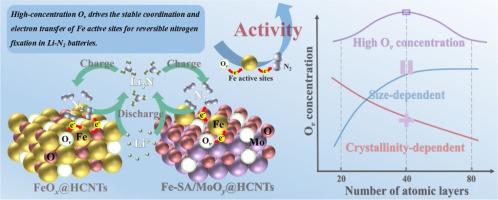
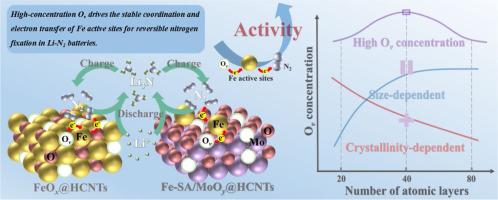
Lithium-nitrogen (Li-N2) battery is not only an electrochemical energy storage platform, but also an environmentally friendly nitrogen fixation technology. However, a great challenge remains in regulating catalyst activity to accelerate cathode reaction kinetics. Herein, we proposed an oxygen vacancy-mediated modulation of Fe active sites in FeOx nano-particle catalysts and Fe single-atom catalysts to enhance nitrogen reduction reaction in Li-N2 batteries. High-concentration oxygen vacancy is generated through a size- and crystallinity-dependent oxygen vacancy engineering based on the precise atomic layer deposition of reducible oxides. The oxygen vacancy on FeOx drives the electron redistribution of Fe3+ d-orbitals to provide electron-donating Fe active sites for N2 fixation. Meanwhile, oxygen vacancy-rich MoOy is used as a support to anchor Fe single atoms. Adjacent oxygen vacancy drives the stable coordination between Fe single atoms and O atoms to facilitate the directional electron transfer from MoOy to Fe to N2. Therefore, the Li-N2 batteries exhibit large discharge capacity, excellent rate performance, and reliable cycle stability. In addition, the formation and decomposition of the discharge product Li3N indicate a reversible N2 fixation. This work provides a precise regulation mechanism of catalytic active sites based on oxygen vacancy engineering, which is expected to promote the development of high-performance Li-N2 batteries.
期刊介绍:
Energy Storage Materials is a global interdisciplinary journal dedicated to sharing scientific and technological advancements in materials and devices for advanced energy storage and related energy conversion, such as in metal-O2 batteries. The journal features comprehensive research articles, including full papers and short communications, as well as authoritative feature articles and reviews by leading experts in the field.
Energy Storage Materials covers a wide range of topics, including the synthesis, fabrication, structure, properties, performance, and technological applications of energy storage materials. Additionally, the journal explores strategies, policies, and developments in the field of energy storage materials and devices for sustainable energy.
Published papers are selected based on their scientific and technological significance, their ability to provide valuable new knowledge, and their relevance to the international research community.



 京公网安备 11010802042870号
京ICP备2023020795号-1
京公网安备 11010802042870号
京ICP备2023020795号-1

 分享
分享
 求助内容:
求助内容: 应助结果提醒方式:
 扫码关注我们
