Li Zhou, Xiaoqiao Jiao, Bo Yang, Wenting Yuan, Wangchao Zhao, Lifang Zhang, Weilin Huang, Shiqian Long, Jiwen Xu, Huizhong Shen, Chen Wang
{"title":"The Impact of Indoor Environments on the Abundance of Urban Outdoor VOCs","authors":"Li Zhou, Xiaoqiao Jiao, Bo Yang, Wenting Yuan, Wangchao Zhao, Lifang Zhang, Weilin Huang, Shiqian Long, Jiwen Xu, Huizhong Shen, Chen Wang","doi":"10.1021/acs.est.4c13133","DOIUrl":null,"url":null,"abstract":"With the upcoming transition to clean electric vehicles, the sources of volatile organic compounds (VOCs) in the ambient environment are rapidly changing and highly uncertain. Here, through systematic characterization of emissions from a typical apartment in a Chinese megacity (Shenzhen), we show that indoor environments contribute significantly to the levels of ambient (i.e., outdoor) VOCs. In particular, we observe that the majority of indoor VOCs originate from unoccupied spaces, demonstrating temperature-dependent release from indoor surface reservoirs. The total indoor-to-outdoor VOC emission rates varied from 53 to 2300 mg day<sup>–1</sup> (median 230 mg day<sup>–1</sup>) during unoccupied periods, influenced by both the air exchange rate and indoor temperature. Reanalysis of literature data from various building studies worldwide corroborates our findings and reveals that indoor-to-outdoor emissions scale with room volume, with an average emission rate of 0.33 ± 0.03 mg h<sup>–1</sup> m<sup>–3</sup>. Our study implies that indoor-to-outdoor emissions significantly contribute to urban VOC levels, rivaling traditional urban sources, e.g., power generation and biomass burning. This is particularly true for oxygenated VOCs, such as methanol, amounting to ∼60% of transportation emissions. The findings change our understanding of the role of indoor VOC contributions to outdoor air quality, whose importance will increase as controls on industrial and transportation emissions intensify.","PeriodicalId":36,"journal":{"name":"环境科学与技术","volume":"31 1","pages":""},"PeriodicalIF":11.3000,"publicationDate":"2025-03-10","publicationTypes":"Journal Article","fieldsOfStudy":null,"isOpenAccess":false,"openAccessPdf":"","citationCount":"0","resultStr":null,"platform":"Semanticscholar","paperid":null,"PeriodicalName":"环境科学与技术","FirstCategoryId":"1","ListUrlMain":"https://doi.org/10.1021/acs.est.4c13133","RegionNum":1,"RegionCategory":"环境科学与生态学","ArticlePicture":[],"TitleCN":null,"AbstractTextCN":null,"PMCID":null,"EPubDate":"","PubModel":"","JCR":"Q1","JCRName":"ENGINEERING, ENVIRONMENTAL","Score":null,"Total":0}
引用次数: 0
Abstract
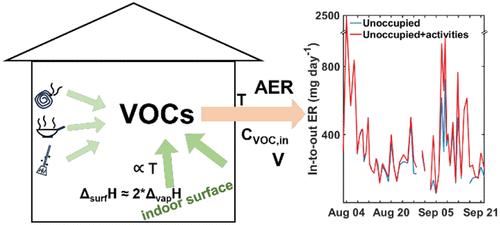
With the upcoming transition to clean electric vehicles, the sources of volatile organic compounds (VOCs) in the ambient environment are rapidly changing and highly uncertain. Here, through systematic characterization of emissions from a typical apartment in a Chinese megacity (Shenzhen), we show that indoor environments contribute significantly to the levels of ambient (i.e., outdoor) VOCs. In particular, we observe that the majority of indoor VOCs originate from unoccupied spaces, demonstrating temperature-dependent release from indoor surface reservoirs. The total indoor-to-outdoor VOC emission rates varied from 53 to 2300 mg day–1 (median 230 mg day–1) during unoccupied periods, influenced by both the air exchange rate and indoor temperature. Reanalysis of literature data from various building studies worldwide corroborates our findings and reveals that indoor-to-outdoor emissions scale with room volume, with an average emission rate of 0.33 ± 0.03 mg h–1 m–3. Our study implies that indoor-to-outdoor emissions significantly contribute to urban VOC levels, rivaling traditional urban sources, e.g., power generation and biomass burning. This is particularly true for oxygenated VOCs, such as methanol, amounting to ∼60% of transportation emissions. The findings change our understanding of the role of indoor VOC contributions to outdoor air quality, whose importance will increase as controls on industrial and transportation emissions intensify.
期刊介绍:
Environmental Science & Technology (ES&T) is a co-sponsored academic and technical magazine by the Hubei Provincial Environmental Protection Bureau and the Hubei Provincial Academy of Environmental Sciences.
Environmental Science & Technology (ES&T) holds the status of Chinese core journals, scientific papers source journals of China, Chinese Science Citation Database source journals, and Chinese Academic Journal Comprehensive Evaluation Database source journals. This publication focuses on the academic field of environmental protection, featuring articles related to environmental protection and technical advancements.



 京公网安备 11010802042870号
京ICP备2023020795号-1
京公网安备 11010802042870号
京ICP备2023020795号-1

 分享
分享
 求助内容:
求助内容: 应助结果提醒方式:
 扫码关注我们
