{"title":"Application of novel continuous foam collection methods for removal of PFAS from cascade generated foam at wastewater treatment plants","authors":"Ethan S. Coffin, Donald M. Reeves","doi":"10.1016/j.jhazmat.2025.137888","DOIUrl":null,"url":null,"abstract":"<div><div>Three foam collection methods – passive overflow, mesh skimmer, and mesh-belt skimmer – were iteratively designed and evaluated for continuous collection of foam forming at a wastewater treatment plant (WWTP) cascade for removal of per- and polyfluorinated alkyl substances (PFAS). Surface tension, PFAS concentrations, and foamate collection rates were measured to assess their performance. Foam collection using a novel mesh skimmer and mesh-belt skimmer increased PFAS enrichment over that of the in situ foam, as the mesh facilitated drainage of PFAS-depleted liquid during collection. Enhanced enrichment and scalable foam collection with the mesh-belt skimmer may remove and concentrate most long-chain PFAS (>90 %) in under 270,000 L/d of foamate or 0.26 % of the wastewater volume when scaled up. For comparison, an estimated 900,000 L/d of foamate would need to be collected with the passive overflow method to achieve 90 % PFOS removal, but would only capture 20 % PFOA and 22 % PFHxS. Limiting the volume of final collected foamate is critical as it requires additional treatment, which can be cost prohibitive at large volumes. While a pilot scale study is required to accurately assess removal, the advantages provided by the mesh-belt skimmer suggest feasible foam collection for PFAS removal at the full WWTP scale.</div></div>","PeriodicalId":361,"journal":{"name":"Journal of Hazardous Materials","volume":"491 ","pages":"Article 137888"},"PeriodicalIF":11.3000,"publicationDate":"2025-03-10","publicationTypes":"Journal Article","fieldsOfStudy":null,"isOpenAccess":false,"openAccessPdf":"","citationCount":"0","resultStr":null,"platform":"Semanticscholar","paperid":null,"PeriodicalName":"Journal of Hazardous Materials","FirstCategoryId":"93","ListUrlMain":"https://www.sciencedirect.com/science/article/pii/S0304389425008027","RegionNum":1,"RegionCategory":"环境科学与生态学","ArticlePicture":[],"TitleCN":null,"AbstractTextCN":null,"PMCID":null,"EPubDate":"","PubModel":"","JCR":"Q1","JCRName":"ENGINEERING, ENVIRONMENTAL","Score":null,"Total":0}
引用次数: 0
Abstract
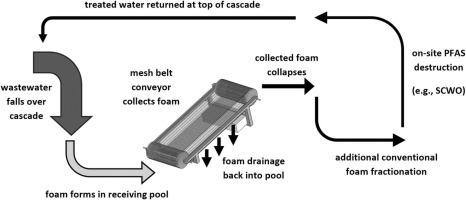
Three foam collection methods – passive overflow, mesh skimmer, and mesh-belt skimmer – were iteratively designed and evaluated for continuous collection of foam forming at a wastewater treatment plant (WWTP) cascade for removal of per- and polyfluorinated alkyl substances (PFAS). Surface tension, PFAS concentrations, and foamate collection rates were measured to assess their performance. Foam collection using a novel mesh skimmer and mesh-belt skimmer increased PFAS enrichment over that of the in situ foam, as the mesh facilitated drainage of PFAS-depleted liquid during collection. Enhanced enrichment and scalable foam collection with the mesh-belt skimmer may remove and concentrate most long-chain PFAS (>90 %) in under 270,000 L/d of foamate or 0.26 % of the wastewater volume when scaled up. For comparison, an estimated 900,000 L/d of foamate would need to be collected with the passive overflow method to achieve 90 % PFOS removal, but would only capture 20 % PFOA and 22 % PFHxS. Limiting the volume of final collected foamate is critical as it requires additional treatment, which can be cost prohibitive at large volumes. While a pilot scale study is required to accurately assess removal, the advantages provided by the mesh-belt skimmer suggest feasible foam collection for PFAS removal at the full WWTP scale.
期刊介绍:
The Journal of Hazardous Materials serves as a global platform for promoting cutting-edge research in the field of Environmental Science and Engineering. Our publication features a wide range of articles, including full-length research papers, review articles, and perspectives, with the aim of enhancing our understanding of the dangers and risks associated with various materials concerning public health and the environment. It is important to note that the term "environmental contaminants" refers specifically to substances that pose hazardous effects through contamination, while excluding those that do not have such impacts on the environment or human health. Moreover, we emphasize the distinction between wastes and hazardous materials in order to provide further clarity on the scope of the journal. We have a keen interest in exploring specific compounds and microbial agents that have adverse effects on the environment.



 京公网安备 11010802042870号
京ICP备2023020795号-1
京公网安备 11010802042870号
京ICP备2023020795号-1

 分享
分享
 求助内容:
求助内容: 应助结果提醒方式:
 扫码关注我们
