Júlia German-Cortés , Raquel Herrero , Natalia Torroglosa , Alexandra Pumarola , Narine Fischer-Albiol , Sofia Campos-Moreno , Sofia Sabaté , Àngels Alcina , Sandra Mancilla , Belén García , Monserrat Llaguno-Munive , Zamira V. Díaz-Riascos , Cláudia Martins , Simó Schwartz Jr , Roser Ferrer-Costa , Ibane Abasolo , Pilar Sánchez-Gómez , Bruno Sarmento , Diana Rafael , Fernanda Andrade
{"title":"Preclinical evaluation of several polymeric micelles identifies Soluplus®-docetaxel as the most effective candidate in multiple glioblastoma models","authors":"Júlia German-Cortés , Raquel Herrero , Natalia Torroglosa , Alexandra Pumarola , Narine Fischer-Albiol , Sofia Campos-Moreno , Sofia Sabaté , Àngels Alcina , Sandra Mancilla , Belén García , Monserrat Llaguno-Munive , Zamira V. Díaz-Riascos , Cláudia Martins , Simó Schwartz Jr , Roser Ferrer-Costa , Ibane Abasolo , Pilar Sánchez-Gómez , Bruno Sarmento , Diana Rafael , Fernanda Andrade","doi":"10.1016/j.jconrel.2025.113616","DOIUrl":null,"url":null,"abstract":"<div><div>Glioblastoma multiforme (GBM) is one of the most lethal cancers, with limited treatment options due to the blood-brain barrier (BBB), systemic toxicity, and treatment resistance. Nanomedicine offers potential solutions to these challenges. This study explores Pluronic® F127 and Soluplus®-based micelles as carriers for Lomustine, Gefitinib, and Docetaxel to determine the optimal system for GBM therapy. Micelles were physicochemically characterized and biologically validated using U87-MG and U251-MG GBM cell lines in 2D and 3D models, assessing internalization, safety, and therapeutic efficacy. Soluplus® micelles (SM) showed favorable properties for intravenous administration, including low polydispersity, efficient drug release in the tumoral microenvironment, minimal cell toxicity, and a BBB-crossing rate of 15 %. Among the drugs tested, Docetaxel showed the lowest IC<sub>50</sub> values in both 2D cell models and demonstrated superior efficacy in 3D cultures when delivered by SM. Molecular analysis confirmed that SM-D impacts key GBM-related pathways, affecting markers like E-cadherin, EPCAM, L1CAM, or EGFR. <em>In vivo</em>, SM-D significantly reduced tumor mass and cancer cell density, showing a favorable safety profile compared to free Docetaxel, as evidenced by reduced weight loss and histological assessments. Overall, SM-D stands out as the most promising approach for GBM treatment, supporting the potential of nanomedicine in overcoming the barriers to effective glioblastoma therapy.</div></div>","PeriodicalId":15450,"journal":{"name":"Journal of Controlled Release","volume":"381 ","pages":"Article 113616"},"PeriodicalIF":11.5000,"publicationDate":"2025-05-10","publicationTypes":"Journal Article","fieldsOfStudy":null,"isOpenAccess":false,"openAccessPdf":"","citationCount":"0","resultStr":null,"platform":"Semanticscholar","paperid":null,"PeriodicalName":"Journal of Controlled Release","FirstCategoryId":"3","ListUrlMain":"https://www.sciencedirect.com/science/article/pii/S0168365925002330","RegionNum":1,"RegionCategory":"医学","ArticlePicture":[],"TitleCN":null,"AbstractTextCN":null,"PMCID":null,"EPubDate":"2025/3/10 0:00:00","PubModel":"Epub","JCR":"Q1","JCRName":"CHEMISTRY, MULTIDISCIPLINARY","Score":null,"Total":0}
引用次数: 0
Abstract
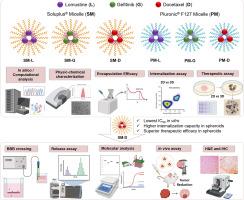
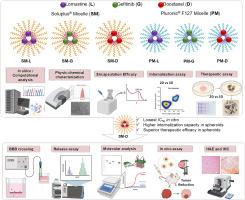
Glioblastoma multiforme (GBM) is one of the most lethal cancers, with limited treatment options due to the blood-brain barrier (BBB), systemic toxicity, and treatment resistance. Nanomedicine offers potential solutions to these challenges. This study explores Pluronic® F127 and Soluplus®-based micelles as carriers for Lomustine, Gefitinib, and Docetaxel to determine the optimal system for GBM therapy. Micelles were physicochemically characterized and biologically validated using U87-MG and U251-MG GBM cell lines in 2D and 3D models, assessing internalization, safety, and therapeutic efficacy. Soluplus® micelles (SM) showed favorable properties for intravenous administration, including low polydispersity, efficient drug release in the tumoral microenvironment, minimal cell toxicity, and a BBB-crossing rate of 15 %. Among the drugs tested, Docetaxel showed the lowest IC50 values in both 2D cell models and demonstrated superior efficacy in 3D cultures when delivered by SM. Molecular analysis confirmed that SM-D impacts key GBM-related pathways, affecting markers like E-cadherin, EPCAM, L1CAM, or EGFR. In vivo, SM-D significantly reduced tumor mass and cancer cell density, showing a favorable safety profile compared to free Docetaxel, as evidenced by reduced weight loss and histological assessments. Overall, SM-D stands out as the most promising approach for GBM treatment, supporting the potential of nanomedicine in overcoming the barriers to effective glioblastoma therapy.
期刊介绍:
The Journal of Controlled Release (JCR) proudly serves as the Official Journal of the Controlled Release Society and the Japan Society of Drug Delivery System.
Dedicated to the broad field of delivery science and technology, JCR publishes high-quality research articles covering drug delivery systems and all facets of formulations. This includes the physicochemical and biological properties of drugs, design and characterization of dosage forms, release mechanisms, in vivo testing, and formulation research and development across pharmaceutical, diagnostic, agricultural, environmental, cosmetic, and food industries.
Priority is given to manuscripts that contribute to the fundamental understanding of principles or demonstrate the advantages of novel technologies in terms of safety and efficacy over current clinical standards. JCR strives to be a leading platform for advancements in delivery science and technology.



 京公网安备 11010802042870号
京ICP备2023020795号-1
京公网安备 11010802042870号
京ICP备2023020795号-1

 分享
分享
 求助内容:
求助内容: 应助结果提醒方式:
 扫码关注我们
