Fabián Villena, Felipe Bravo-Marquez, Jocelyn Dunstan
{"title":"NLP modeling recommendations for restricted data availability in clinical settings.","authors":"Fabián Villena, Felipe Bravo-Marquez, Jocelyn Dunstan","doi":"10.1186/s12911-025-02948-2","DOIUrl":null,"url":null,"abstract":"<p><strong>Background: </strong>Clinical decision-making in healthcare often relies on unstructured text data, which can be challenging to analyze using traditional methods. Natural Language Processing (NLP) has emerged as a promising solution, but its application in clinical settings is hindered by restricted data availability and the need for domain-specific knowledge.</p><p><strong>Methods: </strong>We conducted an experimental analysis to evaluate the performance of various NLP modeling paradigms on multiple clinical NLP tasks in Spanish. These tasks included referral prioritization and referral specialty classification. We simulated three clinical settings with varying levels of data availability and evaluated the performance of four foundation models.</p><p><strong>Results: </strong>Clinical-specific pre-trained language models (PLMs) achieved the highest performance across tasks. For referral prioritization, Clinical PLMs attained an 88.85 % macro F1 score when fine-tuned. In referral specialty classification, the same models achieved a 53.79 % macro F1 score, surpassing domain-agnostic models. Continuing pre-training with environment-specific data improved model performance, but the gains were marginal compared to the computational resources required. Few-shot learning with large language models (LLMs) demonstrated lower performance but showed potential in data-scarce scenarios.</p><p><strong>Conclusions: </strong>Our study provides evidence-based recommendations for clinical NLP practitioners on selecting modeling paradigms based on data availability. We highlight the importance of considering data availability, task complexity, and institutional maturity when designing and training clinical NLP models. Our findings can inform the development of effective clinical NLP solutions in real-world settings.</p>","PeriodicalId":9340,"journal":{"name":"BMC Medical Informatics and Decision Making","volume":"25 1","pages":"116"},"PeriodicalIF":5.5000,"publicationDate":"2025-03-07","publicationTypes":"Journal Article","fieldsOfStudy":null,"isOpenAccess":false,"openAccessPdf":"https://www.ncbi.nlm.nih.gov/pmc/articles/PMC11889813/pdf/","citationCount":"0","resultStr":null,"platform":"Semanticscholar","paperid":null,"PeriodicalName":"BMC Medical Informatics and Decision Making","FirstCategoryId":"3","ListUrlMain":"https://doi.org/10.1186/s12911-025-02948-2","RegionNum":3,"RegionCategory":"医学","ArticlePicture":[],"TitleCN":null,"AbstractTextCN":null,"PMCID":null,"EPubDate":"","PubModel":"","JCR":"Q2","JCRName":"MEDICAL INFORMATICS","Score":null,"Total":0}
引用次数: 0
Abstract
Background: Clinical decision-making in healthcare often relies on unstructured text data, which can be challenging to analyze using traditional methods. Natural Language Processing (NLP) has emerged as a promising solution, but its application in clinical settings is hindered by restricted data availability and the need for domain-specific knowledge.
Methods: We conducted an experimental analysis to evaluate the performance of various NLP modeling paradigms on multiple clinical NLP tasks in Spanish. These tasks included referral prioritization and referral specialty classification. We simulated three clinical settings with varying levels of data availability and evaluated the performance of four foundation models.
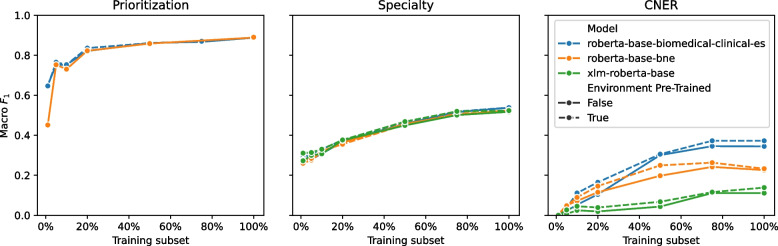
Results: Clinical-specific pre-trained language models (PLMs) achieved the highest performance across tasks. For referral prioritization, Clinical PLMs attained an 88.85 % macro F1 score when fine-tuned. In referral specialty classification, the same models achieved a 53.79 % macro F1 score, surpassing domain-agnostic models. Continuing pre-training with environment-specific data improved model performance, but the gains were marginal compared to the computational resources required. Few-shot learning with large language models (LLMs) demonstrated lower performance but showed potential in data-scarce scenarios.
Conclusions: Our study provides evidence-based recommendations for clinical NLP practitioners on selecting modeling paradigms based on data availability. We highlight the importance of considering data availability, task complexity, and institutional maturity when designing and training clinical NLP models. Our findings can inform the development of effective clinical NLP solutions in real-world settings.
期刊介绍:
BMC Medical Informatics and Decision Making is an open access journal publishing original peer-reviewed research articles in relation to the design, development, implementation, use, and evaluation of health information technologies and decision-making for human health.






 京公网安备 11010802042870号
京ICP备2023020795号-1
京公网安备 11010802042870号
京ICP备2023020795号-1

 分享
分享
 求助内容:
求助内容: 应助结果提醒方式:
 扫码关注我们
