Tommaso Cacco, Riccardo Papa, Luca Carmisciano, Carola Bruzzo, Lucia Semino, Alberto Tonelli, Caterina Matucci-Cerinic, Maja Di Rocco, Renata Bocciardi, Marco Gattorno, Roberto D'Agostino
{"title":"Hearing loss predictive model in fibrodysplasia ossificans progressiva from a national referral center: developing an hearing loss predictive model.","authors":"Tommaso Cacco, Riccardo Papa, Luca Carmisciano, Carola Bruzzo, Lucia Semino, Alberto Tonelli, Caterina Matucci-Cerinic, Maja Di Rocco, Renata Bocciardi, Marco Gattorno, Roberto D'Agostino","doi":"10.1093/jbmrpl/ziaf029","DOIUrl":null,"url":null,"abstract":"<p><p>Fibrodysplasia ossificans progressiva (FOP) is the most dramatic form of progressive heterotopic ossification of soft tissues. Hearing impairment in FOP patient is a common feature, reported by about 50% of affected patients. However, wide case series considering audiologic features are lacking. We report the audiologic history of a group of FOP patients in order to define the hearing loss characteristics, genotype association, and possible rehabilitative options. We report audiometric history of 16 FOP patients referred to our Institute from 2014 onwards without ear malformations or other known reason for audiologic impairment. Major involvement of high frequencies in our FOP cohort suggests that the position of the high-frequency receptors within the cochlea, near the oval window, makes them more exposed to damage than the low-frequency receptors located deeper in the cochlea. Furthermore, the reported gender difference may be secondary to a hormonal effect, as known in patients with otosclerosis. Finally, regarding the genotype, we noted that only the non-classic patient carrying the <i>ACVR1</i> c.619C>G; p.Q207E mutation, presented a mixed hypoacusia with a sensorineural component prevailing on acute frequencies, currently not deserving hearing aids. This evidence suggests a possible novel genotype association to be confirmed in larger cohort. The present analysis shows that a longer disease history is associated with a statistically significant worse hearing loss, mainly involving the high frequencies. The advent of new therapeutic options highlights the relevance of having comparative follow-up data in order to evaluate the effectiveness of these new therapies against all the various clinical manifestations of FOP.</p>","PeriodicalId":14611,"journal":{"name":"JBMR Plus","volume":"9 4","pages":"ziaf029"},"PeriodicalIF":2.4000,"publicationDate":"2025-02-14","publicationTypes":"Journal Article","fieldsOfStudy":null,"isOpenAccess":false,"openAccessPdf":"https://www.ncbi.nlm.nih.gov/pmc/articles/PMC11890112/pdf/","citationCount":"0","resultStr":null,"platform":"Semanticscholar","paperid":null,"PeriodicalName":"JBMR Plus","FirstCategoryId":"1085","ListUrlMain":"https://doi.org/10.1093/jbmrpl/ziaf029","RegionNum":0,"RegionCategory":null,"ArticlePicture":[],"TitleCN":null,"AbstractTextCN":null,"PMCID":null,"EPubDate":"2025/4/1 0:00:00","PubModel":"eCollection","JCR":"Q2","JCRName":"ENDOCRINOLOGY & METABOLISM","Score":null,"Total":0}
引用次数: 0
Abstract
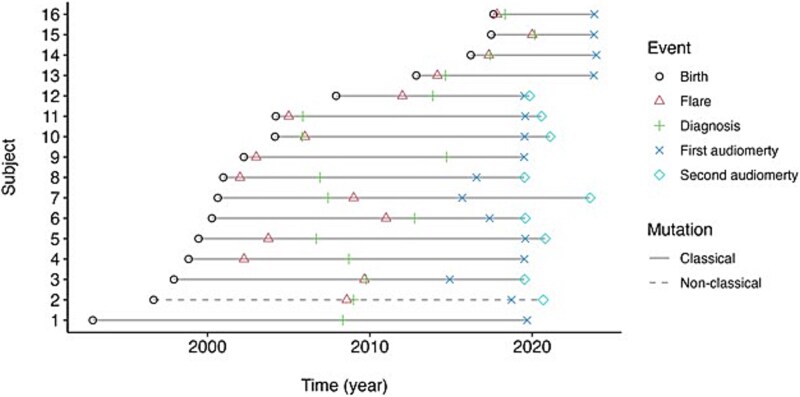
Fibrodysplasia ossificans progressiva (FOP) is the most dramatic form of progressive heterotopic ossification of soft tissues. Hearing impairment in FOP patient is a common feature, reported by about 50% of affected patients. However, wide case series considering audiologic features are lacking. We report the audiologic history of a group of FOP patients in order to define the hearing loss characteristics, genotype association, and possible rehabilitative options. We report audiometric history of 16 FOP patients referred to our Institute from 2014 onwards without ear malformations or other known reason for audiologic impairment. Major involvement of high frequencies in our FOP cohort suggests that the position of the high-frequency receptors within the cochlea, near the oval window, makes them more exposed to damage than the low-frequency receptors located deeper in the cochlea. Furthermore, the reported gender difference may be secondary to a hormonal effect, as known in patients with otosclerosis. Finally, regarding the genotype, we noted that only the non-classic patient carrying the ACVR1 c.619C>G; p.Q207E mutation, presented a mixed hypoacusia with a sensorineural component prevailing on acute frequencies, currently not deserving hearing aids. This evidence suggests a possible novel genotype association to be confirmed in larger cohort. The present analysis shows that a longer disease history is associated with a statistically significant worse hearing loss, mainly involving the high frequencies. The advent of new therapeutic options highlights the relevance of having comparative follow-up data in order to evaluate the effectiveness of these new therapies against all the various clinical manifestations of FOP.






 京公网安备 11010802042870号
京ICP备2023020795号-1
京公网安备 11010802042870号
京ICP备2023020795号-1

 分享
分享
 求助内容:
求助内容: 应助结果提醒方式:
 扫码关注我们
