{"title":"The skeletal abnormalities and their clinical challenges in <i>SATB2</i>-associated syndrome.","authors":"Bryan Kuo, Marcy B Bolster, WuQiang Fan","doi":"10.1093/jbmrpl/ziaf023","DOIUrl":null,"url":null,"abstract":"<p><p><i>SATB2</i>-associated syndrome (SAS) is an autosomal dominant genetic disorder caused by pathogenic variations in the special AT-rich sequence-binding protein 2 (<i>SATB2</i>) gene. In addition to neurodevelopmental and craniofacial defects, over 90% of patients with SAS manifest biochemical and/or radiographic skeletal abnormalities, and around one-third of patients report clinical and/or radiographic fractures. SATB2 protein is a potent transcription factor that promotes osteoblast differentiation and maturation; loss-of-function pathogenic variations of the <i>SATB2</i> gene result in a wide spectrum of skeletal abnormalities ranging from gross skeletal anomalies to abnormal bone turnover markers, low BMD, and recurrent fractures. There is at present no known effective treatment for bone health in patients with SAS. We present an adult patient with SAS who has recurrent fractures despite long-term treatment with antiresorptive agents. We propose an alternative pharmacotherapy approach utilizing a PTH analog to stimulate osteoblasts, hence addressing the underlying pathophysiology of bone disease in patients with SAS.</p>","PeriodicalId":14611,"journal":{"name":"JBMR Plus","volume":"9 4","pages":"ziaf023"},"PeriodicalIF":2.4000,"publicationDate":"2025-02-05","publicationTypes":"Journal Article","fieldsOfStudy":null,"isOpenAccess":false,"openAccessPdf":"https://www.ncbi.nlm.nih.gov/pmc/articles/PMC11890109/pdf/","citationCount":"0","resultStr":null,"platform":"Semanticscholar","paperid":null,"PeriodicalName":"JBMR Plus","FirstCategoryId":"1085","ListUrlMain":"https://doi.org/10.1093/jbmrpl/ziaf023","RegionNum":0,"RegionCategory":null,"ArticlePicture":[],"TitleCN":null,"AbstractTextCN":null,"PMCID":null,"EPubDate":"2025/4/1 0:00:00","PubModel":"eCollection","JCR":"Q2","JCRName":"ENDOCRINOLOGY & METABOLISM","Score":null,"Total":0}
引用次数: 0
Abstract
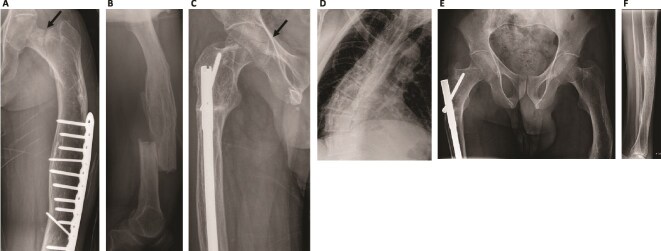
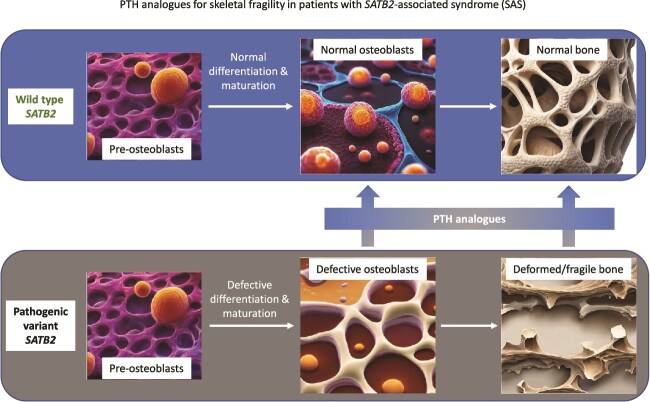
SATB2-associated syndrome (SAS) is an autosomal dominant genetic disorder caused by pathogenic variations in the special AT-rich sequence-binding protein 2 (SATB2) gene. In addition to neurodevelopmental and craniofacial defects, over 90% of patients with SAS manifest biochemical and/or radiographic skeletal abnormalities, and around one-third of patients report clinical and/or radiographic fractures. SATB2 protein is a potent transcription factor that promotes osteoblast differentiation and maturation; loss-of-function pathogenic variations of the SATB2 gene result in a wide spectrum of skeletal abnormalities ranging from gross skeletal anomalies to abnormal bone turnover markers, low BMD, and recurrent fractures. There is at present no known effective treatment for bone health in patients with SAS. We present an adult patient with SAS who has recurrent fractures despite long-term treatment with antiresorptive agents. We propose an alternative pharmacotherapy approach utilizing a PTH analog to stimulate osteoblasts, hence addressing the underlying pathophysiology of bone disease in patients with SAS.





 京公网安备 11010802042870号
京ICP备2023020795号-1
京公网安备 11010802042870号
京ICP备2023020795号-1

 分享
分享
 求助内容:
求助内容: 应助结果提醒方式:
 扫码关注我们
