Nouf Alsaati MD, MMSc , Chris Penney MSc , Ingo Helbig MD , Kathleen E. Sullivan MD, PhD
{"title":"A predictive model for identification of pediatric individuals with common variable immunodeficiency through electronic medical records","authors":"Nouf Alsaati MD, MMSc , Chris Penney MSc , Ingo Helbig MD , Kathleen E. Sullivan MD, PhD","doi":"10.1016/j.jaci.2025.02.032","DOIUrl":null,"url":null,"abstract":"<div><h3>Introduction</h3><div>Common variable immunodeficiency (CVID) is characterized by recurrent sinopulmonary infections. However, in the pediatric population, recurrent sinopulmonary infections early in life are common, which can render key clinical features of CVID less distinctive. Accordingly, the diagnosis of CVID is often delayed owing to the heterogeneous nature of the presentation and the broad range of ages of onset. A 10-year lag in diagnosis has been found for CVID, and there is a critical need for improved time to diagnosis.</div></div><div><h3>Objective</h3><div>Our aim was to utilize machine learning techniques to identify a clinical signature of CVID in a pediatric population.</div></div><div><h3>Methods</h3><div>Our selected cohort included 112 individuals with CVID and 627 controls. The controls were restricted from having other medical conditions associated with infection. A machine learning data set was constructed by summing patient-level counts of clinical metrics. A total of 3 supervised machine learning classifiers were trained, tuned, and performance-tested. We validated our findings using a distinct control cohort with high medical complexity and tested a logistic regression approach.</div></div><div><h3>Results</h3><div>Key features associated with CVID were chest radiograph count, number of antibiotic prescriptions, and number of common infections. Our Extreme Gradient Boosting (XGBoost) model best predicted eventual CVID diagnosis, with an F1 score of 0.77, a total of 21 of 29 CVID diagnoses classified correctly (8 false-negative results), and 179 of 183 patients without CVID correctly classified (4 false-positive results) up to 10 years before the eventual clinical diagnosis. Key features with a robust association with pediatric CVID were the frequency of common infections and antibiotic prescriptions.</div></div><div><h3>Conclusion</h3><div>In spite of a high frequency of infections in the comparator population, the clinical signature of pediatric CVID was sufficiently distinctive to enable early identification.</div></div>","PeriodicalId":14936,"journal":{"name":"Journal of Allergy and Clinical Immunology","volume":"156 1","pages":"Pages 186-194"},"PeriodicalIF":11.2000,"publicationDate":"2025-07-01","publicationTypes":"Journal Article","fieldsOfStudy":null,"isOpenAccess":false,"openAccessPdf":"","citationCount":"0","resultStr":null,"platform":"Semanticscholar","paperid":null,"PeriodicalName":"Journal of Allergy and Clinical Immunology","FirstCategoryId":"3","ListUrlMain":"https://www.sciencedirect.com/science/article/pii/S0091674925002635","RegionNum":1,"RegionCategory":"医学","ArticlePicture":[],"TitleCN":null,"AbstractTextCN":null,"PMCID":null,"EPubDate":"2025/3/7 0:00:00","PubModel":"Epub","JCR":"Q1","JCRName":"ALLERGY","Score":null,"Total":0}
引用次数: 0
Abstract
Introduction
Common variable immunodeficiency (CVID) is characterized by recurrent sinopulmonary infections. However, in the pediatric population, recurrent sinopulmonary infections early in life are common, which can render key clinical features of CVID less distinctive. Accordingly, the diagnosis of CVID is often delayed owing to the heterogeneous nature of the presentation and the broad range of ages of onset. A 10-year lag in diagnosis has been found for CVID, and there is a critical need for improved time to diagnosis.
Objective
Our aim was to utilize machine learning techniques to identify a clinical signature of CVID in a pediatric population.
Methods
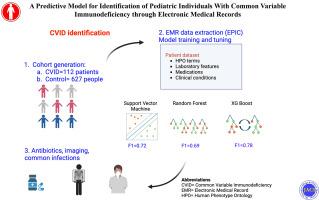
Our selected cohort included 112 individuals with CVID and 627 controls. The controls were restricted from having other medical conditions associated with infection. A machine learning data set was constructed by summing patient-level counts of clinical metrics. A total of 3 supervised machine learning classifiers were trained, tuned, and performance-tested. We validated our findings using a distinct control cohort with high medical complexity and tested a logistic regression approach.
Results
Key features associated with CVID were chest radiograph count, number of antibiotic prescriptions, and number of common infections. Our Extreme Gradient Boosting (XGBoost) model best predicted eventual CVID diagnosis, with an F1 score of 0.77, a total of 21 of 29 CVID diagnoses classified correctly (8 false-negative results), and 179 of 183 patients without CVID correctly classified (4 false-positive results) up to 10 years before the eventual clinical diagnosis. Key features with a robust association with pediatric CVID were the frequency of common infections and antibiotic prescriptions.
Conclusion
In spite of a high frequency of infections in the comparator population, the clinical signature of pediatric CVID was sufficiently distinctive to enable early identification.
期刊介绍:
The Journal of Allergy and Clinical Immunology is a prestigious publication that features groundbreaking research in the fields of Allergy, Asthma, and Immunology. This influential journal publishes high-impact research papers that explore various topics, including asthma, food allergy, allergic rhinitis, atopic dermatitis, primary immune deficiencies, occupational and environmental allergy, and other allergic and immunologic diseases. The articles not only report on clinical trials and mechanistic studies but also provide insights into novel therapies, underlying mechanisms, and important discoveries that contribute to our understanding of these diseases. By sharing this valuable information, the journal aims to enhance the diagnosis and management of patients in the future.



 京公网安备 11010802042870号
京ICP备2023020795号-1
京公网安备 11010802042870号
京ICP备2023020795号-1

 分享
分享

 求助内容:
求助内容: 应助结果提醒方式:
 扫码关注我们
