Yanni Li , Sihe Gong , Kaijie Yan , Zhonghong Shi , Yimin Bao , Ke Ning
{"title":"Artery tertiary lymphoid organs in atherosclerosis: A review","authors":"Yanni Li , Sihe Gong , Kaijie Yan , Zhonghong Shi , Yimin Bao , Ke Ning","doi":"10.1016/j.lfs.2025.123549","DOIUrl":null,"url":null,"abstract":"<div><div>Atherosclerosis (AS) is the common pathological basis for many cardiovascular diseases. Initial investigations into AS predominantly centered on endothelial immune responses associated with plaque formation. However, recent studies increasingly underscore the salutary immune modulation occurring on the aorta adventitia as the atheromatous plaque progresses. The immune responses extend from the intima of the vessel to the adventitia, and the artery tertiary lymphoid organ (ATLO) assumes a major immune role in advanced stages of AS, according to available studies conducted on ApoE<sup>−/−</sup> mice. In this review, we collate the history of studies on the participation of ATLOs in immunity to AS, detailing its structure, classification, cellular composition, and formation mechanisms. We elucidate the distinct roles of ATLO components in immune regulation, emphasizing unique features such as territorial organization, T cell-driven autoimmunity, and the T follicular helper-germinal center B cell axis, which distinguish ATLOs from conventional lymphoid responses. Furthermore, based on the latest research, we propose that ATLOs cooperate with the nervous system to regulate the progression of AS. Moreover, we highlight that aging has a great impact on the deterioration of AS and this impact is related to ATLOs. We conclude by suggesting that a focus on ATLOs is important for the clinical management of AS, and we offer a perspective for further research on ATLO and suggest whether it will be beneficial or detrimental to ATLOs.</div></div>","PeriodicalId":18122,"journal":{"name":"Life sciences","volume":"369 ","pages":"Article 123549"},"PeriodicalIF":5.1000,"publicationDate":"2025-03-08","publicationTypes":"Journal Article","fieldsOfStudy":null,"isOpenAccess":false,"openAccessPdf":"","citationCount":"0","resultStr":null,"platform":"Semanticscholar","paperid":null,"PeriodicalName":"Life sciences","FirstCategoryId":"3","ListUrlMain":"https://www.sciencedirect.com/science/article/pii/S0024320525001833","RegionNum":2,"RegionCategory":"医学","ArticlePicture":[],"TitleCN":null,"AbstractTextCN":null,"PMCID":null,"EPubDate":"","PubModel":"","JCR":"Q1","JCRName":"MEDICINE, RESEARCH & EXPERIMENTAL","Score":null,"Total":0}
引用次数: 0
Abstract
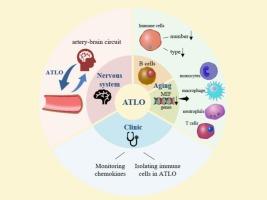
Atherosclerosis (AS) is the common pathological basis for many cardiovascular diseases. Initial investigations into AS predominantly centered on endothelial immune responses associated with plaque formation. However, recent studies increasingly underscore the salutary immune modulation occurring on the aorta adventitia as the atheromatous plaque progresses. The immune responses extend from the intima of the vessel to the adventitia, and the artery tertiary lymphoid organ (ATLO) assumes a major immune role in advanced stages of AS, according to available studies conducted on ApoE−/− mice. In this review, we collate the history of studies on the participation of ATLOs in immunity to AS, detailing its structure, classification, cellular composition, and formation mechanisms. We elucidate the distinct roles of ATLO components in immune regulation, emphasizing unique features such as territorial organization, T cell-driven autoimmunity, and the T follicular helper-germinal center B cell axis, which distinguish ATLOs from conventional lymphoid responses. Furthermore, based on the latest research, we propose that ATLOs cooperate with the nervous system to regulate the progression of AS. Moreover, we highlight that aging has a great impact on the deterioration of AS and this impact is related to ATLOs. We conclude by suggesting that a focus on ATLOs is important for the clinical management of AS, and we offer a perspective for further research on ATLO and suggest whether it will be beneficial or detrimental to ATLOs.
期刊介绍:
Life Sciences is an international journal publishing articles that emphasize the molecular, cellular, and functional basis of therapy. The journal emphasizes the understanding of mechanism that is relevant to all aspects of human disease and translation to patients. All articles are rigorously reviewed.
The Journal favors publication of full-length papers where modern scientific technologies are used to explain molecular, cellular and physiological mechanisms. Articles that merely report observations are rarely accepted. Recommendations from the Declaration of Helsinki or NIH guidelines for care and use of laboratory animals must be adhered to. Articles should be written at a level accessible to readers who are non-specialists in the topic of the article themselves, but who are interested in the research. The Journal welcomes reviews on topics of wide interest to investigators in the life sciences. We particularly encourage submission of brief, focused reviews containing high-quality artwork and require the use of mechanistic summary diagrams.



 京公网安备 11010802042870号
京ICP备2023020795号-1
京公网安备 11010802042870号
京ICP备2023020795号-1

 分享
分享
 求助内容:
求助内容: 应助结果提醒方式:
 扫码关注我们
