N. B. Diamond, S. Simpson, D. Baena, B. Murray, S. Fogel, B. Levine
{"title":"Sleep selectively and durably enhances memory for the sequence of real-world experiences","authors":"N. B. Diamond, S. Simpson, D. Baena, B. Murray, S. Fogel, B. Levine","doi":"10.1038/s41562-025-02117-5","DOIUrl":null,"url":null,"abstract":"Sleep is thought to play a critical role in the retention of memory for past experiences (episodic memory), reducing the rate of forgetting compared with wakefulness. Yet it remains unclear whether and how sleep actively transforms the way we remember multidimensional real-world experiences, and how such memory transformation unfolds over the days, months and years that follow. In an exception to the law of forgetting, we show that sleep actively and selectively improves the accuracy of memory for a one-time, real-world experience (an art tour)—specifically boosting memory for the order of tour items (sequential associations) versus perceptual details from the tour (featural associations). This above-baseline boost in sequence memory was not evident after a matched period of wakefulness. Moreover, the preferential retention of sequence relative to featural memory observed after a night’s sleep grew over time up to 1 year post-encoding. Finally, overnight polysomnography showed that sleep-related memory enhancement was associated with the duration and neurophysiological hallmarks of slow-wave sleep previously linked to sequential neural replay, particularly spindle–slow wave coupling. These results suggest that sleep serves a crucial and selective role in enhancing sequential organization in our memory for past events at the expense of perceptual details, linking sleep-related neural mechanisms to the days-to-years-long transformation of memory for complex real-life experiences. How does sleep transform the way we remember our experiences? This study finds that sleep enhances memory for the order of events from an art tour, but not the details of the events. The sleep-related advantage for sequences persists for over a year.","PeriodicalId":19074,"journal":{"name":"Nature Human Behaviour","volume":"9 4","pages":"746-757"},"PeriodicalIF":15.9000,"publicationDate":"2025-03-11","publicationTypes":"Journal Article","fieldsOfStudy":null,"isOpenAccess":false,"openAccessPdf":"https://www.nature.comhttps://www.nature.com/articles/s41562-025-02117-5.pdf","citationCount":"0","resultStr":null,"platform":"Semanticscholar","paperid":null,"PeriodicalName":"Nature Human Behaviour","FirstCategoryId":"102","ListUrlMain":"https://www.nature.com/articles/s41562-025-02117-5","RegionNum":1,"RegionCategory":"心理学","ArticlePicture":[],"TitleCN":null,"AbstractTextCN":null,"PMCID":null,"EPubDate":"","PubModel":"","JCR":"Q1","JCRName":"MULTIDISCIPLINARY SCIENCES","Score":null,"Total":0}
引用次数: 0
Abstract
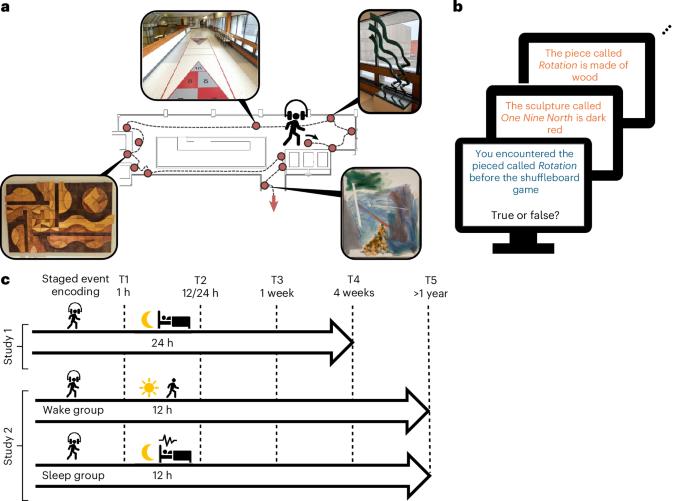
Sleep is thought to play a critical role in the retention of memory for past experiences (episodic memory), reducing the rate of forgetting compared with wakefulness. Yet it remains unclear whether and how sleep actively transforms the way we remember multidimensional real-world experiences, and how such memory transformation unfolds over the days, months and years that follow. In an exception to the law of forgetting, we show that sleep actively and selectively improves the accuracy of memory for a one-time, real-world experience (an art tour)—specifically boosting memory for the order of tour items (sequential associations) versus perceptual details from the tour (featural associations). This above-baseline boost in sequence memory was not evident after a matched period of wakefulness. Moreover, the preferential retention of sequence relative to featural memory observed after a night’s sleep grew over time up to 1 year post-encoding. Finally, overnight polysomnography showed that sleep-related memory enhancement was associated with the duration and neurophysiological hallmarks of slow-wave sleep previously linked to sequential neural replay, particularly spindle–slow wave coupling. These results suggest that sleep serves a crucial and selective role in enhancing sequential organization in our memory for past events at the expense of perceptual details, linking sleep-related neural mechanisms to the days-to-years-long transformation of memory for complex real-life experiences. How does sleep transform the way we remember our experiences? This study finds that sleep enhances memory for the order of events from an art tour, but not the details of the events. The sleep-related advantage for sequences persists for over a year.
期刊介绍:
Nature Human Behaviour is a journal that focuses on publishing research of outstanding significance into any aspect of human behavior.The research can cover various areas such as psychological, biological, and social bases of human behavior.It also includes the study of origins, development, and disorders related to human behavior.The primary aim of the journal is to increase the visibility of research in the field and enhance its societal reach and impact.



 京公网安备 11010802042870号
京ICP备2023020795号-1
京公网安备 11010802042870号
京ICP备2023020795号-1

 分享
分享
 求助内容:
求助内容: 应助结果提醒方式:
 扫码关注我们
