Coupling of high ion transport efficiency in hydrogel electrolytes and interfacial fusion for performance enhancement in all-solid-state paper-based self-powered electrochromic devices with low-temperature tolerance†
Guodong Liu, Shuyue Chen, Xiaohong Jiang, Zhuoqing Zhang, Yaoli Wang, Hanbin Liu, Zhijian Li and Patrick Gane
{"title":"Coupling of high ion transport efficiency in hydrogel electrolytes and interfacial fusion for performance enhancement in all-solid-state paper-based self-powered electrochromic devices with low-temperature tolerance†","authors":"Guodong Liu, Shuyue Chen, Xiaohong Jiang, Zhuoqing Zhang, Yaoli Wang, Hanbin Liu, Zhijian Li and Patrick Gane","doi":"10.1039/D4TA08719D","DOIUrl":null,"url":null,"abstract":"<p >Self-powered electrochromic devices (ECDs) have gained considerable attention for applications such as smart labels, displays and rechargeable batteries, thanks to their dynamic balance between color display and energy storage capabilities. The electrochemical performance of existing ECDs, however, is often constrained by the conductivity of electrolytes, the contact interface between electrodes and electrolytes, and the severe intolerance of ECDs to low temperature environments. In this study, we couple two approaches. Firstly, we harness the Hofmeister effect to modulate the concentration of an ionic compound within the hydrogel electrolyte. This modulation enhances ion solvation and ionic conductivity, thereby facilitating internal ion transport within the self-powered ECD and accelerating the device's response time. Secondly, we illustrate how it is possible to capitalize on the designable properties of the substrate. Paper offers a unique controllable substrate structure, which can be readily modified in terms of surface micro-roughness, which, in turn, can be utilized during the forming of the gravure printed electrode. This novel optimization can improve the final surface morphology of the paper-based electrode, enhancing its surface area properties. This enhancement subsequently facilitates improved integration of the electrode interface with the hydrogel electrolyte, reducing interface impedance and increasing ion transport efficiency within the ECD. Combining this morphological effect with the increased ion solvation in the hydrogel electrolyte enables an improved electrochemical performance and cyclic stability, maintaining stability even at temperatures as low as −40 °C.</p>","PeriodicalId":82,"journal":{"name":"Journal of Materials Chemistry A","volume":" 14","pages":" 10060-10076"},"PeriodicalIF":9.5000,"publicationDate":"2025-03-11","publicationTypes":"Journal Article","fieldsOfStudy":null,"isOpenAccess":false,"openAccessPdf":"","citationCount":"0","resultStr":null,"platform":"Semanticscholar","paperid":null,"PeriodicalName":"Journal of Materials Chemistry A","FirstCategoryId":"88","ListUrlMain":"https://pubs.rsc.org/en/content/articlelanding/2025/ta/d4ta08719d","RegionNum":2,"RegionCategory":"材料科学","ArticlePicture":[],"TitleCN":null,"AbstractTextCN":null,"PMCID":null,"EPubDate":"","PubModel":"","JCR":"Q1","JCRName":"CHEMISTRY, PHYSICAL","Score":null,"Total":0}
引用次数: 0
Abstract
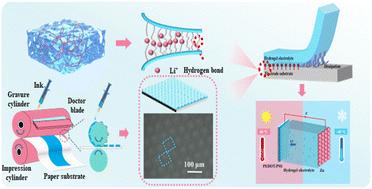
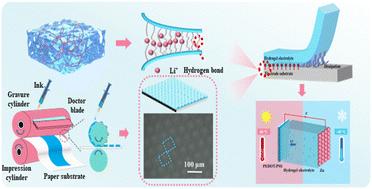
Self-powered electrochromic devices (ECDs) have gained considerable attention for applications such as smart labels, displays and rechargeable batteries, thanks to their dynamic balance between color display and energy storage capabilities. The electrochemical performance of existing ECDs, however, is often constrained by the conductivity of electrolytes, the contact interface between electrodes and electrolytes, and the severe intolerance of ECDs to low temperature environments. In this study, we couple two approaches. Firstly, we harness the Hofmeister effect to modulate the concentration of an ionic compound within the hydrogel electrolyte. This modulation enhances ion solvation and ionic conductivity, thereby facilitating internal ion transport within the self-powered ECD and accelerating the device's response time. Secondly, we illustrate how it is possible to capitalize on the designable properties of the substrate. Paper offers a unique controllable substrate structure, which can be readily modified in terms of surface micro-roughness, which, in turn, can be utilized during the forming of the gravure printed electrode. This novel optimization can improve the final surface morphology of the paper-based electrode, enhancing its surface area properties. This enhancement subsequently facilitates improved integration of the electrode interface with the hydrogel electrolyte, reducing interface impedance and increasing ion transport efficiency within the ECD. Combining this morphological effect with the increased ion solvation in the hydrogel electrolyte enables an improved electrochemical performance and cyclic stability, maintaining stability even at temperatures as low as −40 °C.
期刊介绍:
The Journal of Materials Chemistry A, B & C covers a wide range of high-quality studies in the field of materials chemistry, with each section focusing on specific applications of the materials studied. Journal of Materials Chemistry A emphasizes applications in energy and sustainability, including topics such as artificial photosynthesis, batteries, and fuel cells. Journal of Materials Chemistry B focuses on applications in biology and medicine, while Journal of Materials Chemistry C covers applications in optical, magnetic, and electronic devices. Example topic areas within the scope of Journal of Materials Chemistry A include catalysis, green/sustainable materials, sensors, and water treatment, among others.



 京公网安备 11010802042870号
京ICP备2023020795号-1
京公网安备 11010802042870号
京ICP备2023020795号-1

 分享
分享
 求助内容:
求助内容: 应助结果提醒方式:
 扫码关注我们
