Yang Bai , Hua Liang , Bin Ji , Bingheng Chen , Anjie Li , Xiaoyuan Zhang , Yu Liu
{"title":"Removal efficiency and adaptive response mechanisms of microalgal-bacterial granular sludge in treating chloramphenicol-laden wastewater","authors":"Yang Bai , Hua Liang , Bin Ji , Bingheng Chen , Anjie Li , Xiaoyuan Zhang , Yu Liu","doi":"10.1016/j.jhazmat.2025.137904","DOIUrl":null,"url":null,"abstract":"<div><div>Efficient and eco-friendly technologies for removing antibiotic pollutants like chloramphenicol (CAP) from wastewater are becoming increasingly important. Among these, microalgal-bacterial granular sludge (MBGS) represents a promising green biotechnology capable of tackling such contaminants. However, the interactions between CAP and MBGS, as well as how CAP influences the community structure and function of MBGS, have not yet been fully understood. This study investigated the effectiveness of the MBGS system in CAP removal and examined microbial responses to CAP exposure. Our findings indicate that MBGS exhibits remarkable adaptability to CAP, altering its microbial characteristics to mitigate CAP toxicity while maintaining the efficacy of pollutant removal. Notably, there was a significant increase in key microorganisms such as <em>Hydrogenophaga</em>, <em>Polaromonas</em>, and <em>Acidovorax</em>. Additionally, the prevalence of resistance genes <em>cmlA8</em>, <em>floR</em>, <em>catB</em> and <em>cfr</em> under CAP exposure suggests adaptive mechanisms likely involving efflux pumps, CAP acetyltransferase B and ribosomal RNA methyltransferase. CAP degradation appears to proceed via the amide bond hydrolase EstDL136, thereby reducing its toxicity and producing less harmful byproducts such as 2,2-dichloroacetic acid. This study provides new insights into how CAP affects MBGS communities and identifies the mechanisms for CAP degradation, offering valuable insights that MBGS could serve as an effective and environmentally sustainable technology for the treatment of wastewater containing antibiotic pollutants.</div></div>","PeriodicalId":361,"journal":{"name":"Journal of Hazardous Materials","volume":"491 ","pages":"Article 137904"},"PeriodicalIF":11.3000,"publicationDate":"2025-07-05","publicationTypes":"Journal Article","fieldsOfStudy":null,"isOpenAccess":false,"openAccessPdf":"","citationCount":"0","resultStr":null,"platform":"Semanticscholar","paperid":null,"PeriodicalName":"Journal of Hazardous Materials","FirstCategoryId":"93","ListUrlMain":"https://www.sciencedirect.com/science/article/pii/S0304389425008180","RegionNum":1,"RegionCategory":"环境科学与生态学","ArticlePicture":[],"TitleCN":null,"AbstractTextCN":null,"PMCID":null,"EPubDate":"2025/3/10 0:00:00","PubModel":"Epub","JCR":"Q1","JCRName":"ENGINEERING, ENVIRONMENTAL","Score":null,"Total":0}
引用次数: 0
Abstract
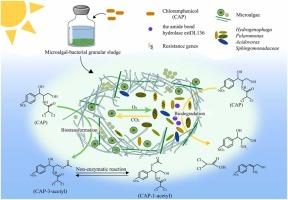
Efficient and eco-friendly technologies for removing antibiotic pollutants like chloramphenicol (CAP) from wastewater are becoming increasingly important. Among these, microalgal-bacterial granular sludge (MBGS) represents a promising green biotechnology capable of tackling such contaminants. However, the interactions between CAP and MBGS, as well as how CAP influences the community structure and function of MBGS, have not yet been fully understood. This study investigated the effectiveness of the MBGS system in CAP removal and examined microbial responses to CAP exposure. Our findings indicate that MBGS exhibits remarkable adaptability to CAP, altering its microbial characteristics to mitigate CAP toxicity while maintaining the efficacy of pollutant removal. Notably, there was a significant increase in key microorganisms such as Hydrogenophaga, Polaromonas, and Acidovorax. Additionally, the prevalence of resistance genes cmlA8, floR, catB and cfr under CAP exposure suggests adaptive mechanisms likely involving efflux pumps, CAP acetyltransferase B and ribosomal RNA methyltransferase. CAP degradation appears to proceed via the amide bond hydrolase EstDL136, thereby reducing its toxicity and producing less harmful byproducts such as 2,2-dichloroacetic acid. This study provides new insights into how CAP affects MBGS communities and identifies the mechanisms for CAP degradation, offering valuable insights that MBGS could serve as an effective and environmentally sustainable technology for the treatment of wastewater containing antibiotic pollutants.
期刊介绍:
The Journal of Hazardous Materials serves as a global platform for promoting cutting-edge research in the field of Environmental Science and Engineering. Our publication features a wide range of articles, including full-length research papers, review articles, and perspectives, with the aim of enhancing our understanding of the dangers and risks associated with various materials concerning public health and the environment. It is important to note that the term "environmental contaminants" refers specifically to substances that pose hazardous effects through contamination, while excluding those that do not have such impacts on the environment or human health. Moreover, we emphasize the distinction between wastes and hazardous materials in order to provide further clarity on the scope of the journal. We have a keen interest in exploring specific compounds and microbial agents that have adverse effects on the environment.



 京公网安备 11010802042870号
京ICP备2023020795号-1
京公网安备 11010802042870号
京ICP备2023020795号-1

 分享
分享
 求助内容:
求助内容: 应助结果提醒方式:
 扫码关注我们
