{"title":"Whole-body dosimetry and risk analysis of tebuconazole exposure in vineyard workers","authors":"Hyun Ho Noh , Jae Yun Lee , Kee Sung Kyung","doi":"10.1016/j.jhazmat.2025.137858","DOIUrl":null,"url":null,"abstract":"<div><div>Pesticide exposure poses substantial health risks to agricultural workers and requires tailored protective measures. Thus, we evaluated exposure to 25 % tebuconazole wettable powder in vineyard workers. Whole-body dosimetry and patch testing both have advantages and disadvantages. When conducted properly, both methods provide reliable exposure estimates. A validated liquid chromatography–mass spectrometry method enabled measurement of pesticide residues on body parts, yielding detailed inhalation and dermal exposure analyses and margin of safety (MOS) estimations. Mixing and loading workers experienced the highest hand exposure in Fields B and I. During spraying, exposure was elevated in enclosed environments, such as rain shelters, owing to limited ventilation. Exposure distribution data indicated the chest, back, and lower body as the most affected areas, with clothing penetration rates of 7.3–36.2 %, indicating that standard rates may underestimate real-world conditions. MOS exceeded safety thresholds in most cases, except in Field E, where high application amounts increased risk. These findings emphasize the importance of protective equipment, including gloves, coveralls, and masks, in minimizing exposure. Condition-specific assessments are recommended to enhance analytical accuracy. The results of this study provide a foundation for improving vineyard safety practices and extending research to other crops and pesticides.</div></div>","PeriodicalId":361,"journal":{"name":"Journal of Hazardous Materials","volume":"491 ","pages":"Article 137858"},"PeriodicalIF":11.3000,"publicationDate":"2025-07-05","publicationTypes":"Journal Article","fieldsOfStudy":null,"isOpenAccess":false,"openAccessPdf":"","citationCount":"0","resultStr":null,"platform":"Semanticscholar","paperid":null,"PeriodicalName":"Journal of Hazardous Materials","FirstCategoryId":"93","ListUrlMain":"https://www.sciencedirect.com/science/article/pii/S0304389425007721","RegionNum":1,"RegionCategory":"环境科学与生态学","ArticlePicture":[],"TitleCN":null,"AbstractTextCN":null,"PMCID":null,"EPubDate":"2025/3/10 0:00:00","PubModel":"Epub","JCR":"Q1","JCRName":"ENGINEERING, ENVIRONMENTAL","Score":null,"Total":0}
引用次数: 0
Abstract
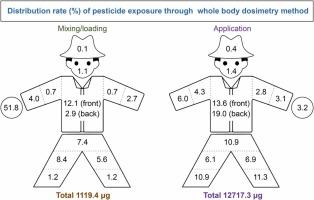
Pesticide exposure poses substantial health risks to agricultural workers and requires tailored protective measures. Thus, we evaluated exposure to 25 % tebuconazole wettable powder in vineyard workers. Whole-body dosimetry and patch testing both have advantages and disadvantages. When conducted properly, both methods provide reliable exposure estimates. A validated liquid chromatography–mass spectrometry method enabled measurement of pesticide residues on body parts, yielding detailed inhalation and dermal exposure analyses and margin of safety (MOS) estimations. Mixing and loading workers experienced the highest hand exposure in Fields B and I. During spraying, exposure was elevated in enclosed environments, such as rain shelters, owing to limited ventilation. Exposure distribution data indicated the chest, back, and lower body as the most affected areas, with clothing penetration rates of 7.3–36.2 %, indicating that standard rates may underestimate real-world conditions. MOS exceeded safety thresholds in most cases, except in Field E, where high application amounts increased risk. These findings emphasize the importance of protective equipment, including gloves, coveralls, and masks, in minimizing exposure. Condition-specific assessments are recommended to enhance analytical accuracy. The results of this study provide a foundation for improving vineyard safety practices and extending research to other crops and pesticides.
期刊介绍:
The Journal of Hazardous Materials serves as a global platform for promoting cutting-edge research in the field of Environmental Science and Engineering. Our publication features a wide range of articles, including full-length research papers, review articles, and perspectives, with the aim of enhancing our understanding of the dangers and risks associated with various materials concerning public health and the environment. It is important to note that the term "environmental contaminants" refers specifically to substances that pose hazardous effects through contamination, while excluding those that do not have such impacts on the environment or human health. Moreover, we emphasize the distinction between wastes and hazardous materials in order to provide further clarity on the scope of the journal. We have a keen interest in exploring specific compounds and microbial agents that have adverse effects on the environment.



 京公网安备 11010802042870号
京ICP备2023020795号-1
京公网安备 11010802042870号
京ICP备2023020795号-1

 分享
分享
 求助内容:
求助内容: 应助结果提醒方式:
 扫码关注我们
