Biplab Kumar Manna, Rajib Samanta, Manjunatha Kempasiddaiah and Sudip Barman
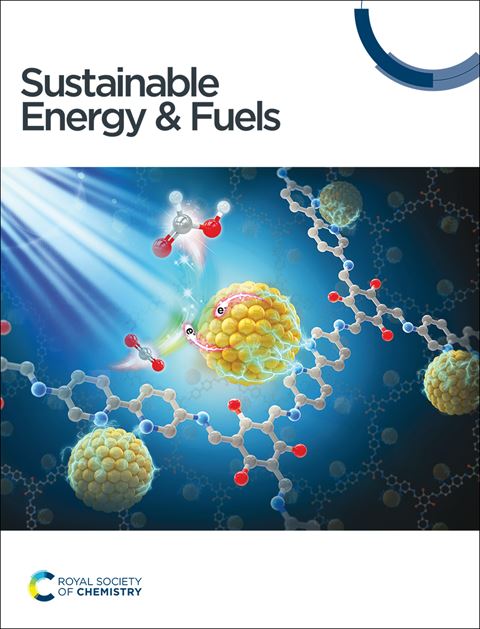
{"title":"Amorphous cobalt–copper oxide for upgrading anodic electro-oxidation of glycerol to formate in a basic medium†","authors":"Biplab Kumar Manna, Rajib Samanta, Manjunatha Kempasiddaiah and Sudip Barman","doi":"10.1039/D4SE01317D","DOIUrl":null,"url":null,"abstract":"<p >The electrochemical glycerol oxidation reaction (GOR) offers a dynamically favourable pathway to transform biomass byproducts into value-added chemicals such as formic acid, glycolic acid, glyceraldehyde, and glyceric acid. This approach offers a more efficient utilization of glycerol and might fulfil the anticipated future demands for formic acid, and which serves as a potential fuel for both direct and indirect formic acid fuel cells. However, the current challenge lies in the low oxidation activity and conversion ratio exhibited by existing catalysts. Herein, an amorphous Co<small><sub>3</sub></small>O<small><sub>4</sub></small>–CuO/CN<small><sub><em>x</em></sub></small>-300 composite on a carbon cloth was fabricated, which shows high activity toward electrochemical glycerol oxidation with a very low potential of 1.25 V (RHE) at 10 mA cm<small><sup>−2</sup></small> and a very high faradaic efficiency of about 91% (formic acid = 81% and glycolic acid = 10%) at 1.5 V (RHE) potential for oxidative product formation with a high selectivity of 89% for formic acid production. Furthermore, the as-prepared Pt/C‖Co<small><sub>3</sub></small>O<small><sub>4</sub></small>–CuO/CN<small><sub><em>x</em></sub></small>-300 electrolyzer required 260 mV less potential compared with conventional water splitting to achieve a current density of 10 mA cm<small><sup>−2</sup></small>. In addition, the electrolyzer was stable at a cell potential of 1.7 V for up to 60 hours, reducing the energy consumption of traditional water splitting by ∼15.48%. The high GOR performance of Co<small><sub>3</sub></small>O<small><sub>4</sub></small>–CuO/CN<small><sub><em>x</em></sub></small>-300 is attributed to the synergistic interaction between its components, its amorphous structure, and its high surface area. This study offers fascinating insights for designing cost-effective transition metal-based electrocatalysts, aiming to facilitate glycerol oxidation for the production of value-added chemicals while boosting efficient cathodic hydrogen evolution with minimal energy depletion.</p>","PeriodicalId":104,"journal":{"name":"Sustainable Energy & Fuels","volume":" 6","pages":" 1565-1575"},"PeriodicalIF":4.1000,"publicationDate":"2025-02-14","publicationTypes":"Journal Article","fieldsOfStudy":null,"isOpenAccess":false,"openAccessPdf":"","citationCount":"0","resultStr":null,"platform":"Semanticscholar","paperid":null,"PeriodicalName":"Sustainable Energy & Fuels","FirstCategoryId":"88","ListUrlMain":"https://pubs.rsc.org/en/content/articlelanding/2025/se/d4se01317d","RegionNum":3,"RegionCategory":"材料科学","ArticlePicture":[],"TitleCN":null,"AbstractTextCN":null,"PMCID":null,"EPubDate":"","PubModel":"","JCR":"Q2","JCRName":"CHEMISTRY, PHYSICAL","Score":null,"Total":0}
引用次数: 0
Abstract
The electrochemical glycerol oxidation reaction (GOR) offers a dynamically favourable pathway to transform biomass byproducts into value-added chemicals such as formic acid, glycolic acid, glyceraldehyde, and glyceric acid. This approach offers a more efficient utilization of glycerol and might fulfil the anticipated future demands for formic acid, and which serves as a potential fuel for both direct and indirect formic acid fuel cells. However, the current challenge lies in the low oxidation activity and conversion ratio exhibited by existing catalysts. Herein, an amorphous Co3O4–CuO/CNx-300 composite on a carbon cloth was fabricated, which shows high activity toward electrochemical glycerol oxidation with a very low potential of 1.25 V (RHE) at 10 mA cm−2 and a very high faradaic efficiency of about 91% (formic acid = 81% and glycolic acid = 10%) at 1.5 V (RHE) potential for oxidative product formation with a high selectivity of 89% for formic acid production. Furthermore, the as-prepared Pt/C‖Co3O4–CuO/CNx-300 electrolyzer required 260 mV less potential compared with conventional water splitting to achieve a current density of 10 mA cm−2. In addition, the electrolyzer was stable at a cell potential of 1.7 V for up to 60 hours, reducing the energy consumption of traditional water splitting by ∼15.48%. The high GOR performance of Co3O4–CuO/CNx-300 is attributed to the synergistic interaction between its components, its amorphous structure, and its high surface area. This study offers fascinating insights for designing cost-effective transition metal-based electrocatalysts, aiming to facilitate glycerol oxidation for the production of value-added chemicals while boosting efficient cathodic hydrogen evolution with minimal energy depletion.
电化学甘油氧化反应(GOR)提供了一个动态的有利途径,将生物质副产物转化为增值化学品,如甲酸、乙醇酸、甘油醛和甘油酸。这种方法可以更有效地利用甘油,并可能满足对甲酸的预期未来需求,并且可以作为直接和间接甲酸燃料电池的潜在燃料。然而,目前的挑战在于现有催化剂的氧化活性和转化率较低。在碳布上制备了一种无定形Co3O4-CuO /CNx-300复合材料,该复合材料在10 mA cm - 2电位下具有很高的电化学氧化活性,极低的电位为1.25 V (RHE);在1.5 V (RHE)电位下具有很高的氧化产物效率,约为91%(甲酸= 81%,乙醇酸= 10%),生成甲酸的选择性为89%。此外,制备的Pt/C‖Co3O4-CuO /CNx-300电解槽与传统的水分解相比,需要260 mV的电位,以实现10 mA cm−2的电流密度。此外,电解槽在1.7 V的电池电位下稳定运行长达60小时,将传统的水分解能耗降低了~ 15.48%。Co3O4-CuO /CNx-300的高GOR性能归因于其组分之间的协同作用,其非晶结构和高表面积。该研究为设计具有成本效益的过渡金属基电催化剂提供了有趣的见解,旨在促进甘油氧化以生产增值化学品,同时以最小的能量消耗促进高效的阴极析氢。
期刊介绍:
Sustainable Energy & Fuels will publish research that contributes to the development of sustainable energy technologies with a particular emphasis on new and next-generation technologies.




 京公网安备 11010802042870号
京ICP备2023020795号-1
京公网安备 11010802042870号
京ICP备2023020795号-1

 分享
分享
 求助内容:
求助内容: 应助结果提醒方式:
 扫码关注我们
