{"title":"Seafood intake in children at age 7 years and neurodevelopmental outcomes in an observational cohort study (ALSPAC).","authors":"L Nel, P M Emmett, J Golding, C M Taylor","doi":"10.1007/s00394-025-03636-7","DOIUrl":null,"url":null,"abstract":"<p><strong>Purpose: </strong>Seafood is rich in other essential nutrients such as long-chain fatty acids, selenium and iodine that play an important role in neurodevelopment and cognitive function. The association between seafood intake in childhood and cognitive outcomes has not been well evidenced. Our aim was to investigate the association between seafood intake in children at age 7 years and cognitive and behavioural outcomes at age 7-9 years.</p><p><strong>Methods: </strong>Data on seafood intakes were collected at age 7 years in children enrolled in the Avon Longitudinal Study of Parents and Children (ALSPAC). Adjusted logistic regression was use to model seafood intake with the odds of suboptimal behavioural scores (Strength and Difficulties Questionnaire (SDQ)) measured at age 7 and 9 years and cognitive scores (IQ) at age 8 years.</p><p><strong>Results: </strong>Lower seafood intake at age 7 years (0 vs. ≥ 190 g/week) increased the adjusted odds of suboptimal prosocial behaviour measured by the SDQ at 7 years by 35% (OR 1.35 (95% CI 1.10, 1.81), p = 0.042) and at 9 years by 43% (OR 1.43 (95% CI 1.02, 1.99), p = 0.036). We found no evidence of any associations with IQ at 8 years.</p><p><strong>Conclusion: </strong>In a population in which fish intakes were below national recommendations, our results illustrate the importance of seafood intake in children on behavioural variables, specifically prosocial behaviour. Further research on the association of seafood intake with a wider range of indicators of child neurodevelopment will provide stronger evidence of the role of seafood intake in cognitive development.</p>","PeriodicalId":12030,"journal":{"name":"European Journal of Nutrition","volume":"64 3","pages":"120"},"PeriodicalIF":4.3000,"publicationDate":"2025-03-11","publicationTypes":"Journal Article","fieldsOfStudy":null,"isOpenAccess":false,"openAccessPdf":"https://www.ncbi.nlm.nih.gov/pmc/articles/PMC11893685/pdf/","citationCount":"0","resultStr":null,"platform":"Semanticscholar","paperid":null,"PeriodicalName":"European Journal of Nutrition","FirstCategoryId":"3","ListUrlMain":"https://doi.org/10.1007/s00394-025-03636-7","RegionNum":2,"RegionCategory":"医学","ArticlePicture":[],"TitleCN":null,"AbstractTextCN":null,"PMCID":null,"EPubDate":"","PubModel":"","JCR":"Q2","JCRName":"NUTRITION & DIETETICS","Score":null,"Total":0}
引用次数: 0
Abstract
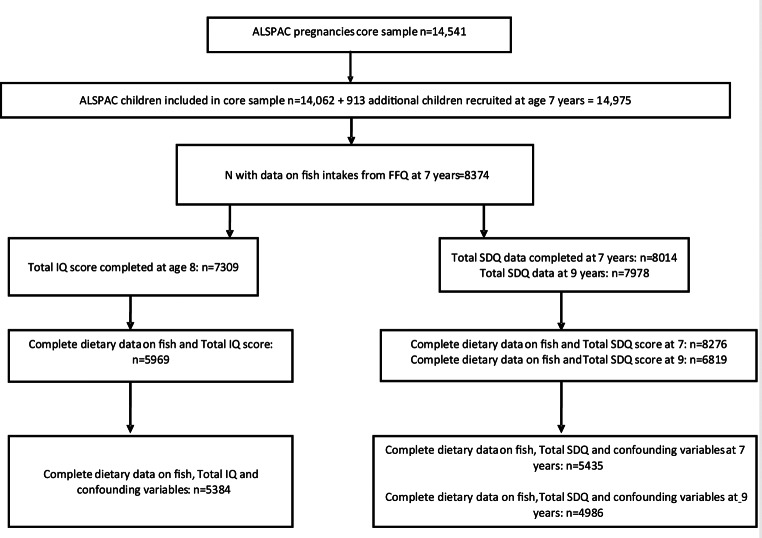
Purpose: Seafood is rich in other essential nutrients such as long-chain fatty acids, selenium and iodine that play an important role in neurodevelopment and cognitive function. The association between seafood intake in childhood and cognitive outcomes has not been well evidenced. Our aim was to investigate the association between seafood intake in children at age 7 years and cognitive and behavioural outcomes at age 7-9 years.
Methods: Data on seafood intakes were collected at age 7 years in children enrolled in the Avon Longitudinal Study of Parents and Children (ALSPAC). Adjusted logistic regression was use to model seafood intake with the odds of suboptimal behavioural scores (Strength and Difficulties Questionnaire (SDQ)) measured at age 7 and 9 years and cognitive scores (IQ) at age 8 years.
Results: Lower seafood intake at age 7 years (0 vs. ≥ 190 g/week) increased the adjusted odds of suboptimal prosocial behaviour measured by the SDQ at 7 years by 35% (OR 1.35 (95% CI 1.10, 1.81), p = 0.042) and at 9 years by 43% (OR 1.43 (95% CI 1.02, 1.99), p = 0.036). We found no evidence of any associations with IQ at 8 years.
Conclusion: In a population in which fish intakes were below national recommendations, our results illustrate the importance of seafood intake in children on behavioural variables, specifically prosocial behaviour. Further research on the association of seafood intake with a wider range of indicators of child neurodevelopment will provide stronger evidence of the role of seafood intake in cognitive development.
期刊介绍:
The European Journal of Nutrition publishes original papers, reviews, and short communications in the nutritional sciences. The manuscripts submitted to the European Journal of Nutrition should have their major focus on the impact of nutrients and non-nutrients on
immunology and inflammation,
gene expression,
metabolism,
chronic diseases, or
carcinogenesis,
or a major focus on
epidemiology, including intervention studies with healthy subjects and with patients,
biofunctionality of food and food components, or
the impact of diet on the environment.



 京公网安备 11010802042870号
京ICP备2023020795号-1
京公网安备 11010802042870号
京ICP备2023020795号-1

 分享
分享
 求助内容:
求助内容: 应助结果提醒方式:
 扫码关注我们
