Jianing Tan, Zhaoyuan Liu, Wei Wu, Gang Li and Wei Guo
{"title":"Reduced graphene oxides prepared via mass loading-controlled non-explosive thermal reduction for high volumetric capacitance supercapacitors†","authors":"Jianing Tan, Zhaoyuan Liu, Wei Wu, Gang Li and Wei Guo","doi":"10.1039/D5TA01172H","DOIUrl":null,"url":null,"abstract":"<p >Graphene oxide (GO) is known to undergo volume expansion during rapid and high-temperature heat treatment, resulting in a low packing density and thus a poor volumetric capacitance. This paper reports a non-explosive thermal reduction strategy (NET) to prepare compact thermally reduced graphene oxide (NE-TRGO) by controlling the mass loading of the GO film below a typical value (<5 mg cm<small><sup>−2</sup></small>). On one hand, the NET strategy effectively inhibits the expansion of graphene sheets, and thus the optimized NE-TRGO exhibits a high packing density of 1.94 g cm<small><sup>−3</sup></small>. On the other hand, the NET strategy contributes to preserving the electrochemically active C–OH and C<img>O groups. Due to the high packing density and the abundance of electrochemically active groups, the gravimetric and volumetric capacitance of the optimized NE-TRGO were 314 F g<small><sup>−1</sup></small> and 609 F cm<small><sup>−3</sup></small> @ 0.1 A g<small><sup>−1</sup></small>, respectively, with excellent rate capability (160 F g<small><sup>−1</sup></small> and 310 F cm<small><sup>−3</sup></small> @ 10 A g<small><sup>−1</sup></small>) and significant cycling performance (∼99% capacitance retention after 9000 cycling at 5 A g<small><sup>−1</sup></small>). The assembled symmetric supercapacitor delivers an energy density of 9.5 W h L<small><sup>−1</sup></small> at a power density of 96.7 W L<small><sup>−1</sup></small> and 1.5 W h L<small><sup>−1</sup></small> at a power density of 1056.3 W L<small><sup>−1</sup></small>. This NET strategy represents a simple and feasible heat treatment approach to control the packing density and oxygen functional groups of graphene-based materials toward compact energy storage devices.</p>","PeriodicalId":82,"journal":{"name":"Journal of Materials Chemistry A","volume":" 16","pages":" 11330-11343"},"PeriodicalIF":9.5000,"publicationDate":"2025-03-12","publicationTypes":"Journal Article","fieldsOfStudy":null,"isOpenAccess":false,"openAccessPdf":"","citationCount":"0","resultStr":null,"platform":"Semanticscholar","paperid":null,"PeriodicalName":"Journal of Materials Chemistry A","FirstCategoryId":"88","ListUrlMain":"https://pubs.rsc.org/en/content/articlelanding/2025/ta/d5ta01172h","RegionNum":2,"RegionCategory":"材料科学","ArticlePicture":[],"TitleCN":null,"AbstractTextCN":null,"PMCID":null,"EPubDate":"","PubModel":"","JCR":"Q1","JCRName":"CHEMISTRY, PHYSICAL","Score":null,"Total":0}
引用次数: 0
Abstract
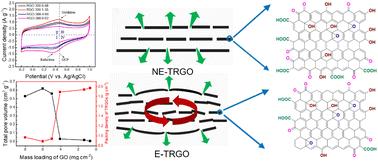
Graphene oxide (GO) is known to undergo volume expansion during rapid and high-temperature heat treatment, resulting in a low packing density and thus a poor volumetric capacitance. This paper reports a non-explosive thermal reduction strategy (NET) to prepare compact thermally reduced graphene oxide (NE-TRGO) by controlling the mass loading of the GO film below a typical value (<5 mg cm−2). On one hand, the NET strategy effectively inhibits the expansion of graphene sheets, and thus the optimized NE-TRGO exhibits a high packing density of 1.94 g cm−3. On the other hand, the NET strategy contributes to preserving the electrochemically active C–OH and CO groups. Due to the high packing density and the abundance of electrochemically active groups, the gravimetric and volumetric capacitance of the optimized NE-TRGO were 314 F g−1 and 609 F cm−3 @ 0.1 A g−1, respectively, with excellent rate capability (160 F g−1 and 310 F cm−3 @ 10 A g−1) and significant cycling performance (∼99% capacitance retention after 9000 cycling at 5 A g−1). The assembled symmetric supercapacitor delivers an energy density of 9.5 W h L−1 at a power density of 96.7 W L−1 and 1.5 W h L−1 at a power density of 1056.3 W L−1. This NET strategy represents a simple and feasible heat treatment approach to control the packing density and oxygen functional groups of graphene-based materials toward compact energy storage devices.
众所周知,氧化石墨烯(GO)在快速和高温热处理过程中会发生体积膨胀,导致填料密度低,因此体积电容很差。本文报道了一种非爆炸热还原策略(NET),通过控制氧化石墨烯薄膜的质量负荷低于典型值(<;5mg cm-2)。一方面,NET策略有效地抑制了石墨烯片的膨胀,因此优化后的NE-TRGO具有1.94 g cm-3的高堆积密度。另一方面,NET策略有助于保留电化学活性的C- oh和C=O基团。由于高密度的填料和丰富的电化学活性基团,优化后的NE-TRGO的重量和体积电容分别为314 F g-1和609 F cm-3 @ 0.1 A g-1,具有优异的倍率性能(160 F g-1和310 F cm-3 @ 10 A g-1)和显著的循环性能(在5 A g-1下循环9000次后电容保持率~ 99%)。当功率密度为96.7 W L-1时,对称超级电容器的能量密度为9.5 W h L-1;当功率密度为1056.3 W L-1时,对称超级电容器的能量密度为1.5 W h L-1。这种NET策略代表了一种简单可行的热处理方法,可以控制石墨烯基材料的包装密度和氧官能团,从而实现紧凑的储能装置。
期刊介绍:
The Journal of Materials Chemistry A, B & C covers a wide range of high-quality studies in the field of materials chemistry, with each section focusing on specific applications of the materials studied. Journal of Materials Chemistry A emphasizes applications in energy and sustainability, including topics such as artificial photosynthesis, batteries, and fuel cells. Journal of Materials Chemistry B focuses on applications in biology and medicine, while Journal of Materials Chemistry C covers applications in optical, magnetic, and electronic devices. Example topic areas within the scope of Journal of Materials Chemistry A include catalysis, green/sustainable materials, sensors, and water treatment, among others.



 京公网安备 11010802042870号
京ICP备2023020795号-1
京公网安备 11010802042870号
京ICP备2023020795号-1

 分享
分享
 求助内容:
求助内容: 应助结果提醒方式:
 扫码关注我们
