{"title":"Mucosal Macrophages Govern Intestinal Regeneration in Response to Injury","authors":"Ilias Moraitis , Jasin Taelman , Borja Arozamena , Loris Mularoni , Olga Wienskowska , Xavier Sanjuan Garriga , Laura Arregui , Milica Stefanovic , Ignasi Modolell Farré , Ferran Guedea , Mònica Diaz , Jordi Guiu","doi":"10.1053/j.gastro.2025.01.252","DOIUrl":null,"url":null,"abstract":"<div><h3>Background & Aims</h3><div>Radiation-induced enteritis develops in cancer patients treated with radiotherapy in the abdominal and pelvic cavity, a condition that impairs their quality of life. Radiation injury depletes proliferative intestinal stem cells; in response to this, the epithelium activates a regenerative program that facilitates the healing of the intestine. However, the mechanisms that induce the activation of the intestinal regenerative program are poorly characterized.</div></div><div><h3>Methods</h3><div>In this study, we induced radiation-induced enteritis in mice through abdominal irradiation, mimicking clinical scenarios. Through imaging and flow cytometric analysis, we investigated the recruitment of macrophages to the small intestine during injury and healing. Additionally, we developed a coculture system for mouse and human intestinal organoids and macrophages to explore the cross talk between these cells. Then by combining in vivo ablation of macrophages, fluorescent lineage tracing, imaging, bulk RNA-sequencing (RNA-seq), single-cell RNA-seq, human intestinal organoids, and cell trajectory analysis, we studied the macrophage induction of intestinal regeneration at the cellular and molecular level.</div></div><div><h3>Results</h3><div>Our findings revealed that macrophages are recruited around the intestinal stem cell compartment upon radiation injury, promoting a fetal-like reprogramming and proliferation of epithelial cells that drives the regeneration process. In contrast, macrophage ablation led to compromised regeneration. Moreover, our single-cell RNA-seq analysis identified key secreted molecules, neuregulin 1 and osteopontin, as pivotal players in regulating this process. Additionally, characterization of human macrophage/organoid cocultures and cell trajectory inference confirmed the conservation of macrophages' role in triggering the regenerative program in primary human cells.</div></div><div><h3>Conclusions</h3><div>This study identifies macrophages as essential contributors to intestinal regeneration beyond their innate immune response. Targeting macrophages therapeutically may hold promise in enhancing regeneration and improving the quality of life for cancer survivors.</div></div>","PeriodicalId":12590,"journal":{"name":"Gastroenterology","volume":"169 1","pages":"Pages 119-135.e26"},"PeriodicalIF":25.1000,"publicationDate":"2025-07-01","publicationTypes":"Journal Article","fieldsOfStudy":null,"isOpenAccess":false,"openAccessPdf":"","citationCount":"0","resultStr":null,"platform":"Semanticscholar","paperid":null,"PeriodicalName":"Gastroenterology","FirstCategoryId":"3","ListUrlMain":"https://www.sciencedirect.com/science/article/pii/S0016508525004652","RegionNum":1,"RegionCategory":"医学","ArticlePicture":[],"TitleCN":null,"AbstractTextCN":null,"PMCID":null,"EPubDate":"2025/3/12 0:00:00","PubModel":"Epub","JCR":"Q1","JCRName":"GASTROENTEROLOGY & HEPATOLOGY","Score":null,"Total":0}
引用次数: 0
Abstract
Background & Aims
Radiation-induced enteritis develops in cancer patients treated with radiotherapy in the abdominal and pelvic cavity, a condition that impairs their quality of life. Radiation injury depletes proliferative intestinal stem cells; in response to this, the epithelium activates a regenerative program that facilitates the healing of the intestine. However, the mechanisms that induce the activation of the intestinal regenerative program are poorly characterized.
Methods
In this study, we induced radiation-induced enteritis in mice through abdominal irradiation, mimicking clinical scenarios. Through imaging and flow cytometric analysis, we investigated the recruitment of macrophages to the small intestine during injury and healing. Additionally, we developed a coculture system for mouse and human intestinal organoids and macrophages to explore the cross talk between these cells. Then by combining in vivo ablation of macrophages, fluorescent lineage tracing, imaging, bulk RNA-sequencing (RNA-seq), single-cell RNA-seq, human intestinal organoids, and cell trajectory analysis, we studied the macrophage induction of intestinal regeneration at the cellular and molecular level.
Results
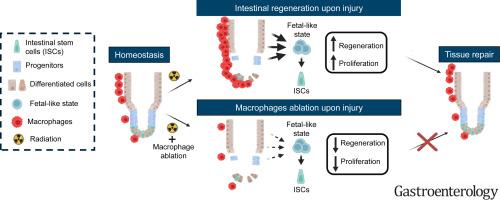
Our findings revealed that macrophages are recruited around the intestinal stem cell compartment upon radiation injury, promoting a fetal-like reprogramming and proliferation of epithelial cells that drives the regeneration process. In contrast, macrophage ablation led to compromised regeneration. Moreover, our single-cell RNA-seq analysis identified key secreted molecules, neuregulin 1 and osteopontin, as pivotal players in regulating this process. Additionally, characterization of human macrophage/organoid cocultures and cell trajectory inference confirmed the conservation of macrophages' role in triggering the regenerative program in primary human cells.
Conclusions
This study identifies macrophages as essential contributors to intestinal regeneration beyond their innate immune response. Targeting macrophages therapeutically may hold promise in enhancing regeneration and improving the quality of life for cancer survivors.
期刊介绍:
Gastroenterology is the most prominent journal in the field of gastrointestinal disease. It is the flagship journal of the American Gastroenterological Association and delivers authoritative coverage of clinical, translational, and basic studies of all aspects of the digestive system, including the liver and pancreas, as well as nutrition.
Some regular features of Gastroenterology include original research studies by leading authorities, comprehensive reviews and perspectives on important topics in adult and pediatric gastroenterology and hepatology. The journal also includes features such as editorials, correspondence, and commentaries, as well as special sections like "Mentoring, Education and Training Corner," "Diversity, Equity and Inclusion in GI," "Gastro Digest," "Gastro Curbside Consult," and "Gastro Grand Rounds."
Gastroenterology also provides digital media materials such as videos and "GI Rapid Reel" animations. It is abstracted and indexed in various databases including Scopus, Biological Abstracts, Current Contents, Embase, Nutrition Abstracts, Chemical Abstracts, Current Awareness in Biological Sciences, PubMed/Medline, and the Science Citation Index.





 京公网安备 11010802042870号
京ICP备2023020795号-1
京公网安备 11010802042870号
京ICP备2023020795号-1

 分享
分享
 求助内容:
求助内容: 应助结果提醒方式:
 扫码关注我们
