Diethelm Johannsmann, Paul Häusner, Arne Langhoff, Christian Leppin, Ilya Reviakine, Viktor Vanoppen
{"title":"The Frequency-Domain Lattice Boltzmann Method (FreqD-LBM): A Versatile Tool to Predict the QCM Response Induced by Structured Samples","authors":"Diethelm Johannsmann, Paul Häusner, Arne Langhoff, Christian Leppin, Ilya Reviakine, Viktor Vanoppen","doi":"10.1002/adts.202401373","DOIUrl":null,"url":null,"abstract":"<p>The quartz crystal microbalance with dissipation monitoring (QCM-D) is routinely used to investigate structured samples. Here, a simulation technique is described, that predicts the shifts of frequency and half bandwidth, Δ<i>f<sub>n</sub></i> and ΔΓ<i><sub>n</sub></i>, of a quartz resonator operating on different overtone orders, <i>n</i>, induced by structured samples in contact with the resonator surface in liquid. The technique, abbreviated as FreqD-LBM, solves the Stokes equation in the frequency domain. The solution provides the complex amplitude of the area-averaged tangential stress at the resonator surface, from which Δ<i>f<sub>n</sub></i> and ΔΓ<i><sub>n</sub></i> are derived. Because the dynamical variables are complex amplitudes, the viscosity can be complex, as well. The technique naturally covers viscoelasticity. Limitations are linked to the grid resolution and to problems at large viscosity. Validation steps include viscoelastic films, rough surfaces, an oscillating cylinder in a viscous medium, and a free-floating sphere above the resonator. Application examples are soft adsorbed particles, stiff adsorbed particles, and a large, immobile spherical cap above the resonator, which allows to study the high-frequency properties of the material in the gap. FreqDLBM runs on an office PC and does not require expert knowledge of numerical techniques. It is accessible to an experimentalist.</p>","PeriodicalId":7219,"journal":{"name":"Advanced Theory and Simulations","volume":"8 7","pages":""},"PeriodicalIF":2.9000,"publicationDate":"2025-03-12","publicationTypes":"Journal Article","fieldsOfStudy":null,"isOpenAccess":false,"openAccessPdf":"https://onlinelibrary.wiley.com/doi/epdf/10.1002/adts.202401373","citationCount":"0","resultStr":null,"platform":"Semanticscholar","paperid":null,"PeriodicalName":"Advanced Theory and Simulations","FirstCategoryId":"5","ListUrlMain":"https://advanced.onlinelibrary.wiley.com/doi/10.1002/adts.202401373","RegionNum":4,"RegionCategory":"工程技术","ArticlePicture":[],"TitleCN":null,"AbstractTextCN":null,"PMCID":null,"EPubDate":"","PubModel":"","JCR":"Q1","JCRName":"MULTIDISCIPLINARY SCIENCES","Score":null,"Total":0}
引用次数: 0
Abstract
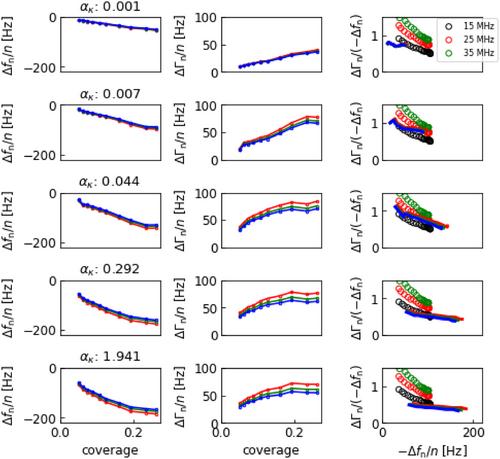
The quartz crystal microbalance with dissipation monitoring (QCM-D) is routinely used to investigate structured samples. Here, a simulation technique is described, that predicts the shifts of frequency and half bandwidth, Δfn and ΔΓn, of a quartz resonator operating on different overtone orders, n, induced by structured samples in contact with the resonator surface in liquid. The technique, abbreviated as FreqD-LBM, solves the Stokes equation in the frequency domain. The solution provides the complex amplitude of the area-averaged tangential stress at the resonator surface, from which Δfn and ΔΓn are derived. Because the dynamical variables are complex amplitudes, the viscosity can be complex, as well. The technique naturally covers viscoelasticity. Limitations are linked to the grid resolution and to problems at large viscosity. Validation steps include viscoelastic films, rough surfaces, an oscillating cylinder in a viscous medium, and a free-floating sphere above the resonator. Application examples are soft adsorbed particles, stiff adsorbed particles, and a large, immobile spherical cap above the resonator, which allows to study the high-frequency properties of the material in the gap. FreqDLBM runs on an office PC and does not require expert knowledge of numerical techniques. It is accessible to an experimentalist.
期刊介绍:
Advanced Theory and Simulations is an interdisciplinary, international, English-language journal that publishes high-quality scientific results focusing on the development and application of theoretical methods, modeling and simulation approaches in all natural science and medicine areas, including:
materials, chemistry, condensed matter physics
engineering, energy
life science, biology, medicine
atmospheric/environmental science, climate science
planetary science, astronomy, cosmology
method development, numerical methods, statistics






 京公网安备 11010802042870号
京ICP备2023020795号-1
京公网安备 11010802042870号
京ICP备2023020795号-1

 分享
分享
 求助内容:
求助内容: 应助结果提醒方式:
 扫码关注我们
