Meagan G Grant, Gabriel Anaya, Olga Brazhnik, Christian R Gomez, Aaron D Laposky, Lisa Postow, Vandana Sachdev, Xinzhi Zhang, Nicole Redmond
{"title":"Leveraging the All of Us research program to advance heart, lung, blood, and sleep research.","authors":"Meagan G Grant, Gabriel Anaya, Olga Brazhnik, Christian R Gomez, Aaron D Laposky, Lisa Postow, Vandana Sachdev, Xinzhi Zhang, Nicole Redmond","doi":"10.1093/aje/kwaf048","DOIUrl":null,"url":null,"abstract":"<p><p>Recent scientific and technological innovations presage a future wherein heart, lung, blood, and sleep (HLBS) health threats are preempted and wherein precision medicine reduces the burden of HLBS disease. The research priorities of the National Heart, Lung, and Blood Institute (NHLBI) Strategic Vision guide Institute activities toward this future. To realize the Strategic Vision, NHLBI has drawn upon its rich resources, including its cohort studies, clinical trial infrastructure, and precision medicine programs. Strategic Vision implementation also requires leveraging datasets of scale and scope expansive enough to deconstruct the complexity of human biology and disease. The large platform of participants and datatypes in the All of Us Research Program (All of Us) facilitates exploration of scientific questions toward improved knowledge, prevention, and management of HLBS conditions. Here, we discuss how utilizing All of Us has stimulated novel HLBS research and provide examples of future research that can be conducted via this platform. Overall, Strategic Vision implementation through All of Us will elucidate how biology, lifestyle, and social and physical environment influence health and disease; deepen understanding of population and individual differences or disparities; and accelerate development, implementation, and dissemination of targeted diagnostic, prevention, and treatment strategies for HLBS conditions.</p>","PeriodicalId":7472,"journal":{"name":"American journal of epidemiology","volume":" ","pages":"2154-2163"},"PeriodicalIF":4.8000,"publicationDate":"2025-08-05","publicationTypes":"Journal Article","fieldsOfStudy":null,"isOpenAccess":false,"openAccessPdf":"https://www.ncbi.nlm.nih.gov/pmc/articles/PMC12709128/pdf/","citationCount":"0","resultStr":null,"platform":"Semanticscholar","paperid":null,"PeriodicalName":"American journal of epidemiology","FirstCategoryId":"3","ListUrlMain":"https://doi.org/10.1093/aje/kwaf048","RegionNum":2,"RegionCategory":"医学","ArticlePicture":[],"TitleCN":null,"AbstractTextCN":null,"PMCID":null,"EPubDate":"","PubModel":"","JCR":"Q1","JCRName":"PUBLIC, ENVIRONMENTAL & OCCUPATIONAL HEALTH","Score":null,"Total":0}
引用次数: 0
Abstract
Recent scientific and technological innovations presage a future wherein heart, lung, blood, and sleep (HLBS) health threats are preempted and wherein precision medicine reduces the burden of HLBS disease. The research priorities of the National Heart, Lung, and Blood Institute (NHLBI) Strategic Vision guide Institute activities toward this future. To realize the Strategic Vision, NHLBI has drawn upon its rich resources, including its cohort studies, clinical trial infrastructure, and precision medicine programs. Strategic Vision implementation also requires leveraging datasets of scale and scope expansive enough to deconstruct the complexity of human biology and disease. The large platform of participants and datatypes in the All of Us Research Program (All of Us) facilitates exploration of scientific questions toward improved knowledge, prevention, and management of HLBS conditions. Here, we discuss how utilizing All of Us has stimulated novel HLBS research and provide examples of future research that can be conducted via this platform. Overall, Strategic Vision implementation through All of Us will elucidate how biology, lifestyle, and social and physical environment influence health and disease; deepen understanding of population and individual differences or disparities; and accelerate development, implementation, and dissemination of targeted diagnostic, prevention, and treatment strategies for HLBS conditions.
最近的科技创新预示着一个未来,心脏、肺、血液和睡眠(HLBS)健康威胁被先发制人,精准医学减轻了HLBS疾病的负担。国家心脏,肺和血液研究所(NHLBI)战略愿景的研究重点指导研究所的活动走向这一未来。为了实现战略愿景,NHLBI利用其丰富的资源,包括队列研究,临床试验基础设施和精准医学项目。战略愿景的实施还需要利用规模和范围足够大的数据集来解构人类生物学和疾病的复杂性。我们所有人研究计划(All of Us)的参与者和数据类型的大型平台促进了对科学问题的探索,以提高对HLBS疾病的认识、预防和管理。在这里,我们将讨论如何利用“我们所有人”来促进新的hbs研究,并提供可以通过这个平台进行的未来研究的例子。总体而言,通过“我们所有人”实施战略愿景将阐明生物、生活方式、社会和自然环境如何影响健康和疾病;加深对人口和个体差异或差距的理解;加快制定、实施和传播针对HLBS病症的有针对性的诊断、预防和治疗策略。
期刊介绍:
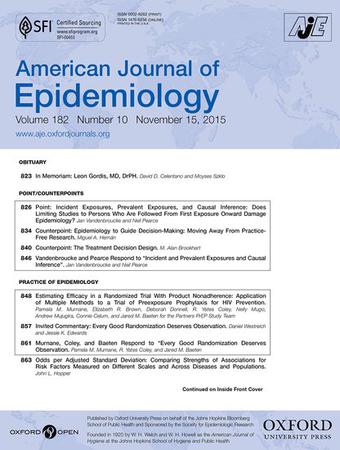
The American Journal of Epidemiology is the oldest and one of the premier epidemiologic journals devoted to the publication of empirical research findings, opinion pieces, and methodological developments in the field of epidemiologic research.
It is a peer-reviewed journal aimed at both fellow epidemiologists and those who use epidemiologic data, including public health workers and clinicians.



 京公网安备 11010802042870号
京ICP备2023020795号-1
京公网安备 11010802042870号
京ICP备2023020795号-1

 分享
分享
 求助内容:
求助内容: 应助结果提醒方式:
 扫码关注我们
