{"title":"Gender Differences in Protein Consumption and Body Composition: The Influence of Socioeconomic Status on Dietary Choices.","authors":"Mauro Lombardo","doi":"10.3390/foods14050887","DOIUrl":null,"url":null,"abstract":"<p><strong>Introduction: </strong>Gender differences in eating habits and protein consumption patterns are determined by cultural, socio-economic, and behavioural factors. Men tend to consume more meat, while women prefer plant-based proteins; however, the impact of these choices on body composition remains unclear.</p><p><strong>Objectives: </strong>This study explores gender differences in protein consumption and the influence of socioeconomic status on dietary choices, evaluating their potential association with body composition parameters, including fat mass (FM%) and fat-free mass (FFM%).</p><p><strong>Methods: </strong>A cross-sectional study was conducted on 1708 Italian adults (721 males, 987 females). Food intake was assessed using a validated 7-day food diary. Participants were classified as non-consumers, low consumers, or high consumers according to the median intake of each protein source. Body composition was measured using bioelectrical impedance analysis.</p><p><strong>Results: </strong>Meat and processed meat consumption was significantly higher in men (<i>p</i> < 0.001), while women consumed more soy (<i>p</i> = 0.0087). Individuals with high meat and processed meat consumption had a higher BMI (<i>p</i> < 0.01), whereas soy consumption was associated with a lower BMI (<i>p</i> = 0.0027). Socioeconomic status influenced food choices: low-income men consumed more meat and processed meat compared to higher-income groups (<i>p</i> < 0.01), while differences in fish consumption were mainly observed in low-income groups.</p><p><strong>Conclusions: </strong>Gender differences in protein consumption persist across socioeconomic levels and are related to body composition. Meat consumption is culturally linked to masculinity, whereas plant-based proteins are more commonly consumed by women. Understanding these dietary patterns can inform targeted nutritional interventions that promote balanced and sustainable diets.</p>","PeriodicalId":12386,"journal":{"name":"Foods","volume":"14 5","pages":""},"PeriodicalIF":5.1000,"publicationDate":"2025-03-05","publicationTypes":"Journal Article","fieldsOfStudy":null,"isOpenAccess":false,"openAccessPdf":"https://www.ncbi.nlm.nih.gov/pmc/articles/PMC11899518/pdf/","citationCount":"0","resultStr":null,"platform":"Semanticscholar","paperid":null,"PeriodicalName":"Foods","FirstCategoryId":"97","ListUrlMain":"https://doi.org/10.3390/foods14050887","RegionNum":2,"RegionCategory":"农林科学","ArticlePicture":[],"TitleCN":null,"AbstractTextCN":null,"PMCID":null,"EPubDate":"","PubModel":"","JCR":"Q1","JCRName":"FOOD SCIENCE & TECHNOLOGY","Score":null,"Total":0}
引用次数: 0
Abstract
Introduction: Gender differences in eating habits and protein consumption patterns are determined by cultural, socio-economic, and behavioural factors. Men tend to consume more meat, while women prefer plant-based proteins; however, the impact of these choices on body composition remains unclear.
Objectives: This study explores gender differences in protein consumption and the influence of socioeconomic status on dietary choices, evaluating their potential association with body composition parameters, including fat mass (FM%) and fat-free mass (FFM%).
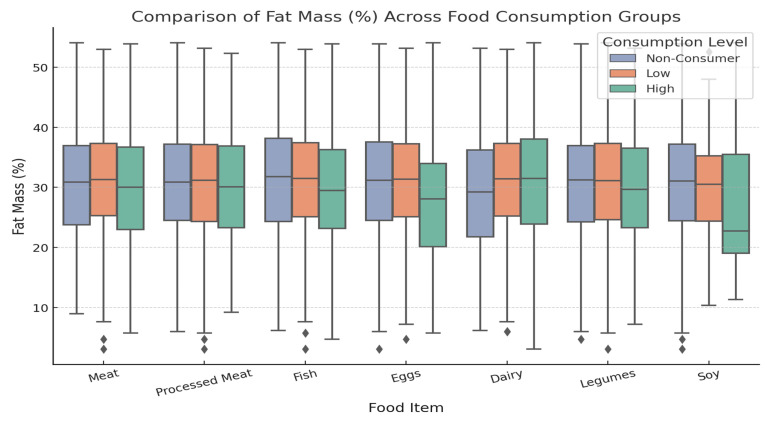
Methods: A cross-sectional study was conducted on 1708 Italian adults (721 males, 987 females). Food intake was assessed using a validated 7-day food diary. Participants were classified as non-consumers, low consumers, or high consumers according to the median intake of each protein source. Body composition was measured using bioelectrical impedance analysis.
Results: Meat and processed meat consumption was significantly higher in men (p < 0.001), while women consumed more soy (p = 0.0087). Individuals with high meat and processed meat consumption had a higher BMI (p < 0.01), whereas soy consumption was associated with a lower BMI (p = 0.0027). Socioeconomic status influenced food choices: low-income men consumed more meat and processed meat compared to higher-income groups (p < 0.01), while differences in fish consumption were mainly observed in low-income groups.
Conclusions: Gender differences in protein consumption persist across socioeconomic levels and are related to body composition. Meat consumption is culturally linked to masculinity, whereas plant-based proteins are more commonly consumed by women. Understanding these dietary patterns can inform targeted nutritional interventions that promote balanced and sustainable diets.
期刊介绍:
Foods (ISSN 2304-8158) is an international, peer-reviewed scientific open access journal which provides an advanced forum for studies related to all aspects of food research. It publishes reviews, regular research papers and short communications. Our aim is to encourage scientists, researchers, and other food professionals to publish their experimental and theoretical results in as much detail as possible or share their knowledge with as much readers unlimitedly as possible. There is no restriction on the length of the papers. The full experimental details must be provided so that the results can be reproduced. There are, in addition, unique features of this journal:
manuscripts regarding research proposals and research ideas will be particularly welcomed
electronic files or software regarding the full details of the calculation and experimental procedure, if unable to be published in a normal way, can be deposited as supplementary material
we also accept manuscripts communicating to a broader audience with regard to research projects financed with public funds





 京公网安备 11010802042870号
京ICP备2023020795号-1
京公网安备 11010802042870号
京ICP备2023020795号-1

 分享
分享
 求助内容:
求助内容: 应助结果提醒方式:
 扫码关注我们
