{"title":"Exploring the relationship between urban green infrastructure connectivity, size and multifunctionality: a systematic review.","authors":"Lei Li, Jeremy Carter","doi":"10.1007/s10980-025-02069-1","DOIUrl":null,"url":null,"abstract":"<p><strong>Context: </strong>Urban green infrastructure (GI) multifunctionality is widely valued within the academic literature, and underpins calls from policy makers to enhance and expand GI resources. However, there is a gap in understanding concerning how GI connectivity and size influence GI multifunctionality outcomes.</p><p><strong>Objectives: </strong>The objectives are to: (1) present the current status of research on urban GI multifunctionality (encompassing ecosystem services and disservices) and the GI traits of connectivity and size; (2) identify relationships between these topics within the literature; (3) provide research insights and present actionable GI planning recommendations based on the findings of the research.</p><p><strong>Methods: </strong>A systematic review of 139 academic sources (2010-2023) was conducted following the PRISMA guidelines.</p><p><strong>Results: </strong>Key findings include that multifunctionality themes are more commonly considered within research exploring GI connectivity across urban boundaries than within them, where a wider range of flows of ecosystem functions and associated services (and disservices) are enabled. Also, research predominantly focuses on multiple large GI sites, with limited attention to the multifunctionality of single small GI sites that are commonly found in dense urban areas.</p><p><strong>Conclusions: </strong>Greater consideration is needed of how the manipulation of GI size and connectivity influence multifunctionality outcomes, whilst also recognising the threat of ecosystem disservices emerging as a result of such actions. Through uncovering gaps in understanding concerning these issues, and highlighting topics benefiting from stronger research foundations, this research can support GI policy, practice and research in realising GI multifunctionality outcomes in urban settings, whilst minimising ecosystem disservices.</p><p><strong>Supplementary information: </strong>The online version contains supplementary material available at 10.1007/s10980-025-02069-1.</p>","PeriodicalId":54745,"journal":{"name":"Landscape Ecology","volume":"40 3","pages":"61"},"PeriodicalIF":3.7000,"publicationDate":"2025-01-01","publicationTypes":"Journal Article","fieldsOfStudy":null,"isOpenAccess":false,"openAccessPdf":"https://www.ncbi.nlm.nih.gov/pmc/articles/PMC11893650/pdf/","citationCount":"0","resultStr":null,"platform":"Semanticscholar","paperid":null,"PeriodicalName":"Landscape Ecology","FirstCategoryId":"93","ListUrlMain":"https://doi.org/10.1007/s10980-025-02069-1","RegionNum":2,"RegionCategory":"环境科学与生态学","ArticlePicture":[],"TitleCN":null,"AbstractTextCN":null,"PMCID":null,"EPubDate":"2025/3/10 0:00:00","PubModel":"Epub","JCR":"Q1","JCRName":"ECOLOGY","Score":null,"Total":0}
引用次数: 0
Abstract
Context: Urban green infrastructure (GI) multifunctionality is widely valued within the academic literature, and underpins calls from policy makers to enhance and expand GI resources. However, there is a gap in understanding concerning how GI connectivity and size influence GI multifunctionality outcomes.
Objectives: The objectives are to: (1) present the current status of research on urban GI multifunctionality (encompassing ecosystem services and disservices) and the GI traits of connectivity and size; (2) identify relationships between these topics within the literature; (3) provide research insights and present actionable GI planning recommendations based on the findings of the research.
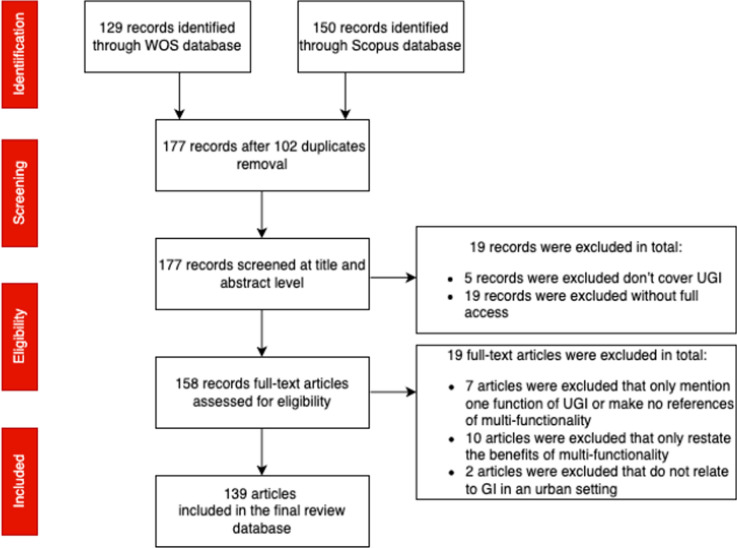
Methods: A systematic review of 139 academic sources (2010-2023) was conducted following the PRISMA guidelines.
Results: Key findings include that multifunctionality themes are more commonly considered within research exploring GI connectivity across urban boundaries than within them, where a wider range of flows of ecosystem functions and associated services (and disservices) are enabled. Also, research predominantly focuses on multiple large GI sites, with limited attention to the multifunctionality of single small GI sites that are commonly found in dense urban areas.
Conclusions: Greater consideration is needed of how the manipulation of GI size and connectivity influence multifunctionality outcomes, whilst also recognising the threat of ecosystem disservices emerging as a result of such actions. Through uncovering gaps in understanding concerning these issues, and highlighting topics benefiting from stronger research foundations, this research can support GI policy, practice and research in realising GI multifunctionality outcomes in urban settings, whilst minimising ecosystem disservices.
Supplementary information: The online version contains supplementary material available at 10.1007/s10980-025-02069-1.
期刊介绍:
Landscape Ecology is the flagship journal of a well-established and rapidly developing interdisciplinary science that focuses explicitly on the ecological understanding of spatial heterogeneity. Landscape Ecology draws together expertise from both biophysical and socioeconomic sciences to explore basic and applied research questions concerning the ecology, conservation, management, design/planning, and sustainability of landscapes as coupled human-environment systems. Landscape ecology studies are characterized by spatially explicit methods in which spatial attributes and arrangements of landscape elements are directly analyzed and related to ecological processes.




 京公网安备 11010802042870号
京ICP备2023020795号-1
京公网安备 11010802042870号
京ICP备2023020795号-1

 分享
分享
 求助内容:
求助内容: 应助结果提醒方式:
 扫码关注我们
